Recommended children's booklists sorted by age or topic

Topic: Science, Maths and Computing

Non-fictionPicturebook

A stylishly illustrated non-fiction book about the search for life on Mars, told from the unique perspective of NASA’s Mars rover, Curiosity.

Discover the incredible story of the search for life on Mars, told from the unique perspective of Curiosity, the Mars Rover sent to explore the red planet. Markus Motum’s stylish illustrations and diagrams reveal how a robot travelled 350,000,000 miles to explore a planet where no human has ever been.
Shortlisted for the Klaus Flugge Prize 2018.

A hardback non-fiction book from Usborne’s interactive lift-the-flap series, exploring the topic of germs through bite-sized question-and-answer chunks. Written with advice from Public Health England, it’s an attractive book that is useful for addressing queries, ‘just-wonderings’ and misconceptions about germs. By learning what germs are, where they live and how they behave, young readers can also learn how to prevent germs from spreading between people and the book includes top tips about staying healthy and hygienic.

After George visits the Museum of Wildlife with Grandad, all he can think about is bugs! The very next day he goes out hunting, but he soon finds there are no more insects left in the garden, and the ones he has captured in jars don’t look very happy… George is about to learn exactly why bugs are so important. A brilliant, vibrant debut from Alex G Griffiths, featuring a wonderful grandfather-grandson relationship.

Zoooooooom! We’re off on an exciting space adventure in our rocket to meet all the planets of the solar system.

Join in with the rhymes and spot all the smiley-faced, friendly planets, from shimmering Saturn to mighty Mars. Little ones will have a blast (and be back in time for bed!) in this striking, read-aloud, story-led picture book. It’s perfect for all would-be astronauts!

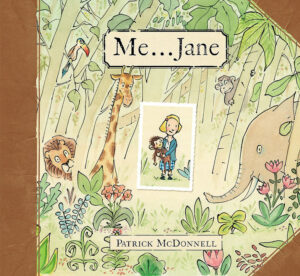
In his characteristic heartwarming and minimalistic style, Patrick McDonnell tells the story of a young Jane Goodall and her special childhood toy chimpanzee named Jubilee. As the young Jane observes the natural world around her with wonder, she dreams of ‘a life living with and helping all animals,’ until one day she finds that her dream has come true.

One of the world’s most inspiring women, Dr. Jane Goodall is a renowned humanitarian, conservationist, animal activist, environmentalist, and United Nations Messenger of Peace. In 1977 she founded the Jane Goodall Institute (JGI), a global nonprofit organization that empowers people to make a difference for all living things.

With anecdotes taken directly from Jane Goodall’s autobiography, McDonnell makes this very true story accessible for the very young – and young at heart.
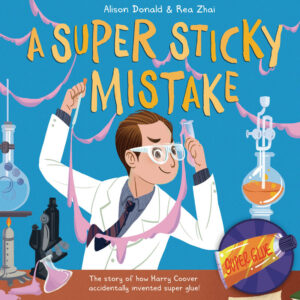
A Super Sticky Mistake brilliantly retells the story of Harry Coover. He was a scientist who worked in the USA during World War Two. He was tasked with developing a plastic that needed to be strong, solid and transparent. His team created a new substance that did not meet the brief; instead creating a super sticky substance called ‘Cyanoacrylate’. Rather than giving up, Harry continued to work on his scientific research and returned to try his new sticky compound when he needed a new material that would be strong enough to stick aircraft windshields.
The material was found to be particularly strong and useful in so many ways; from mending broken bones to repairing spacecraft.
At the age of 92, Harry was presented with the National Medal of Technology and Innovation for his work; one of the highest scientific accolades in the field.
The story is a brilliant way to introduce themes of perseverance, determination and creativity. It is full of humour and the illustrations show some of the frustrations of the rest of his team alongside Harry’s optimism; which could lead to some fantastic discussions.
It is perfect for use in Key Stage One and Lower Key Stage Two or as a text to read with the whole school in assembly….

Electrifying illustrations and an empowering story combine to introduce young readers to the world of science, observation and problem-solving.

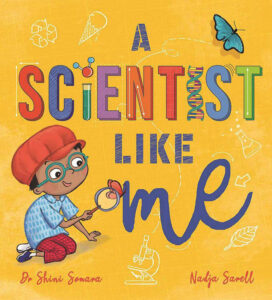
There’s NOTHING that Ruben doesn’t find fascinating. Why do leaves change colour? What makes ice cream melt? On a trip to the beach with his mum, he discovers how the world works and the brilliant scientists who have helped us understand it. Maybe he can try out some awesome experiments and become a scientist too?

With pages encouraging kids to try out their very own science experiments such as germinating seeds and writing with invisible ink, this brilliant picture book written by scientist and TV presenter Dr Shini Somara unlocks a love of science and celebrates women in STEM.

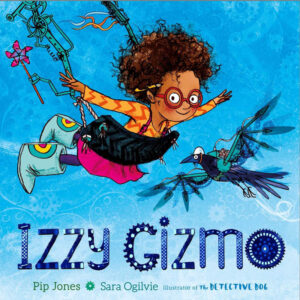
Izzy Gizmo, a girl who LOVED to invent ,
carried her tool bag wherever she went
in case she discovered a thing to be mended,
or a gadget to tweak to make to make it more splendid.

Izabelle Gizmo just loves to invent, but her inventions never seem to work the way she wants them to. And that makes her really CROSS! When she finds a crow with a broken wing she just has to help. But will she be able to put her frustrations to one side and help her new friend to fly again?

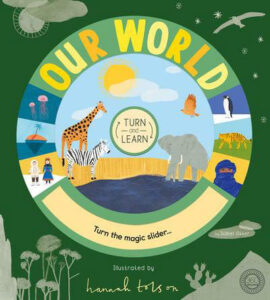
Our world is a spectacular place, full of curiosity and wonder. Why not take a closer look…
Prepare to explore five fascinating habitats. Read about weird and wonderful plants, from the prickly cactus to the carnivorous Venus flytrap; discover the amazing adaptations that animals have made to survive in some of the harshest places on Earth; and learn about the traditions of people from all over our world.

Quog and Oort are on their way to Kevin’s birthday party. Unfortunately, their spaceship has crashed. Pick up this book to lend them a hand!

An interstellar exploration of hands and what’s inside them, from the award-winning creators of the internationally successful Do Not Lick This Book.

Subscribe to our newsletter

Your Review

Stone Girl Bone Girl

review

Year group(s) the book is most suitable for:

Year group(s) the book is most suitable for:

Does the book contain anything that teachers would wish to know about before recommending in class (strong language, sensitive topics etc.)?

Does the book contain anything that teachers would wish to know about before recommending in class (strong language, sensitive topics etc.)?

Would you recommend the book for use in primary schools?

yes

Curriculum links (if relevant)

Curriculum links (if relevant)

Any other comments

Any other comments