Recommended children's booklists sorted by age or topic

Home > Year Group Booklists: 50 Recommended Reads > Year 3 Booklist: 50 Recommended Reads

Year 3 Booklist: 50 Recommended Reads

Icon Award
best books for year 3 2026 2027

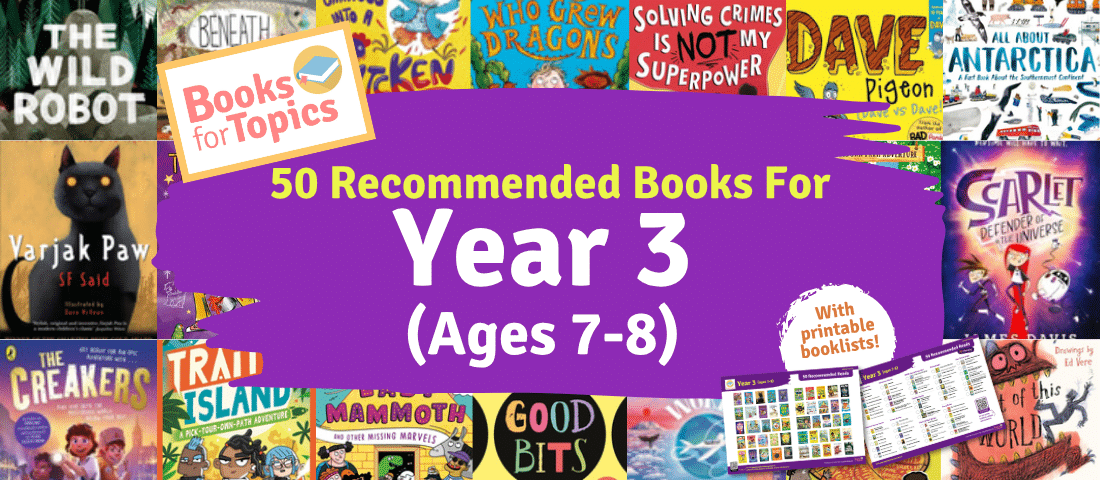
50 Best Books for Y3 (Children Aged 7-8)

Newly updated: June 2026

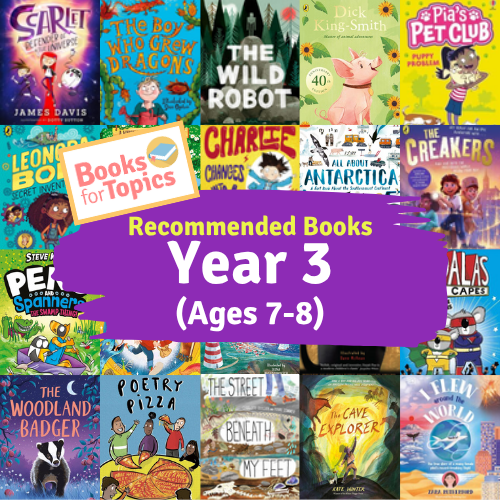
This is the BooksForTopics list of 50 top recommended books for Year 3 (children aged seven and eight). Y3 reading collections are best when they contain a variety of selected storytime chapter books, independent reads, funny stories, picturebooks, poetry collections, graphic novels, non-fiction texts and more. On this Year 3 booklist, there’s something for all tastes, but keep an eye out for jam-jar-sized mythical heroes, runaway trains , animal rescues and the odd time machine here and there, too…

y3 best booksAs well as taking into account which reading trends are currently the most popular with Year 3 children, our team of experts at BooksForTopics loves to put each book through its paces to find the best quality books matched to the age, developmental stage and interest level of children in Year 3.

This booklist includes popular Year 3 stories such as The Boy Who Grew Dragons, Charlotte’s Web and Varjak Paw, as well as the most popular read-it-yourself choices like Dog Man and The 13-Storey Tree House. We have also included some lesser-known storytime delights that we recommend for Y3, like the illustrated conservation adventure Guardians of the New Moon, the wildlife rescue story Saving Sorya, and the choose-your-own-adventure style Traitor Island.

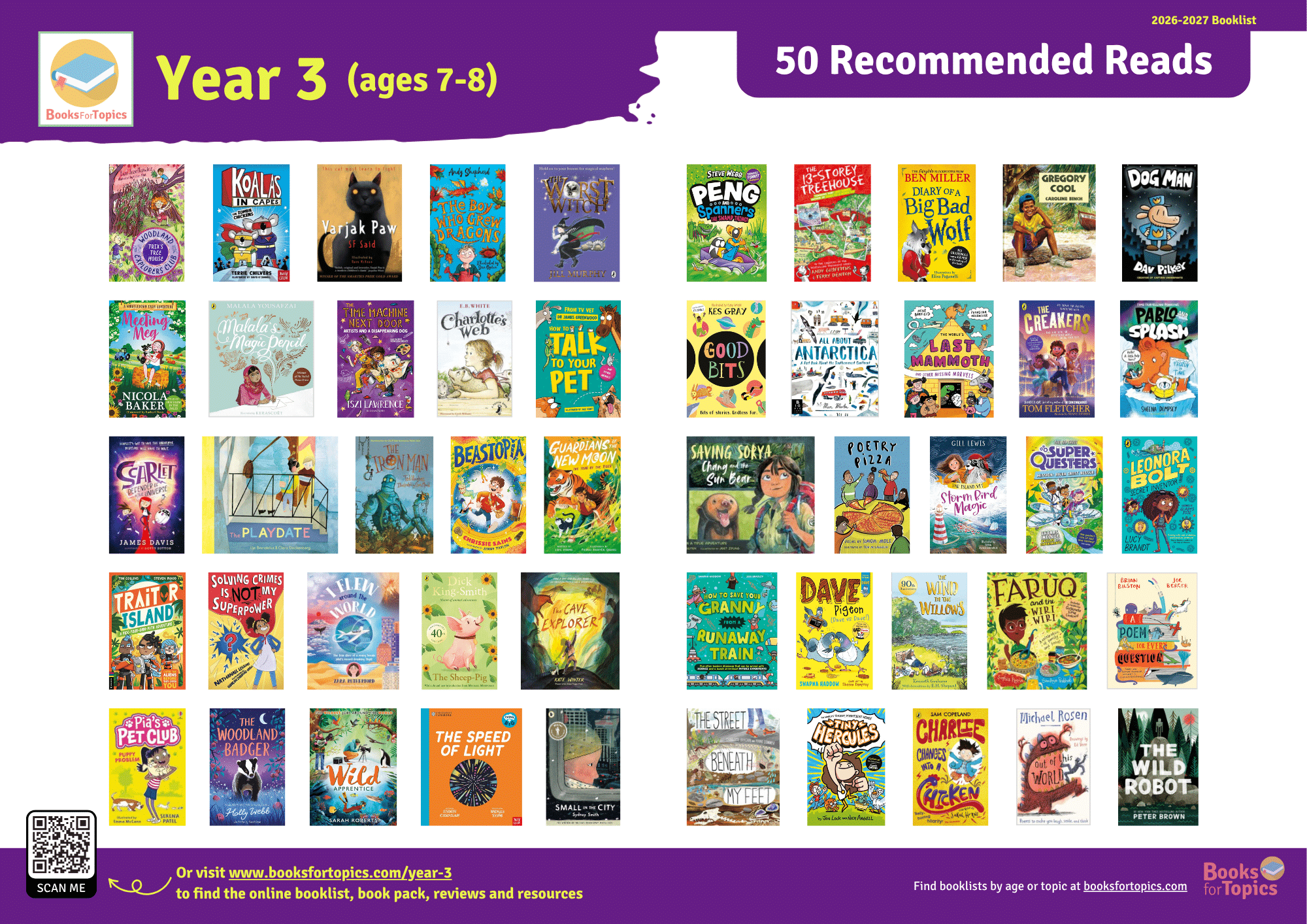
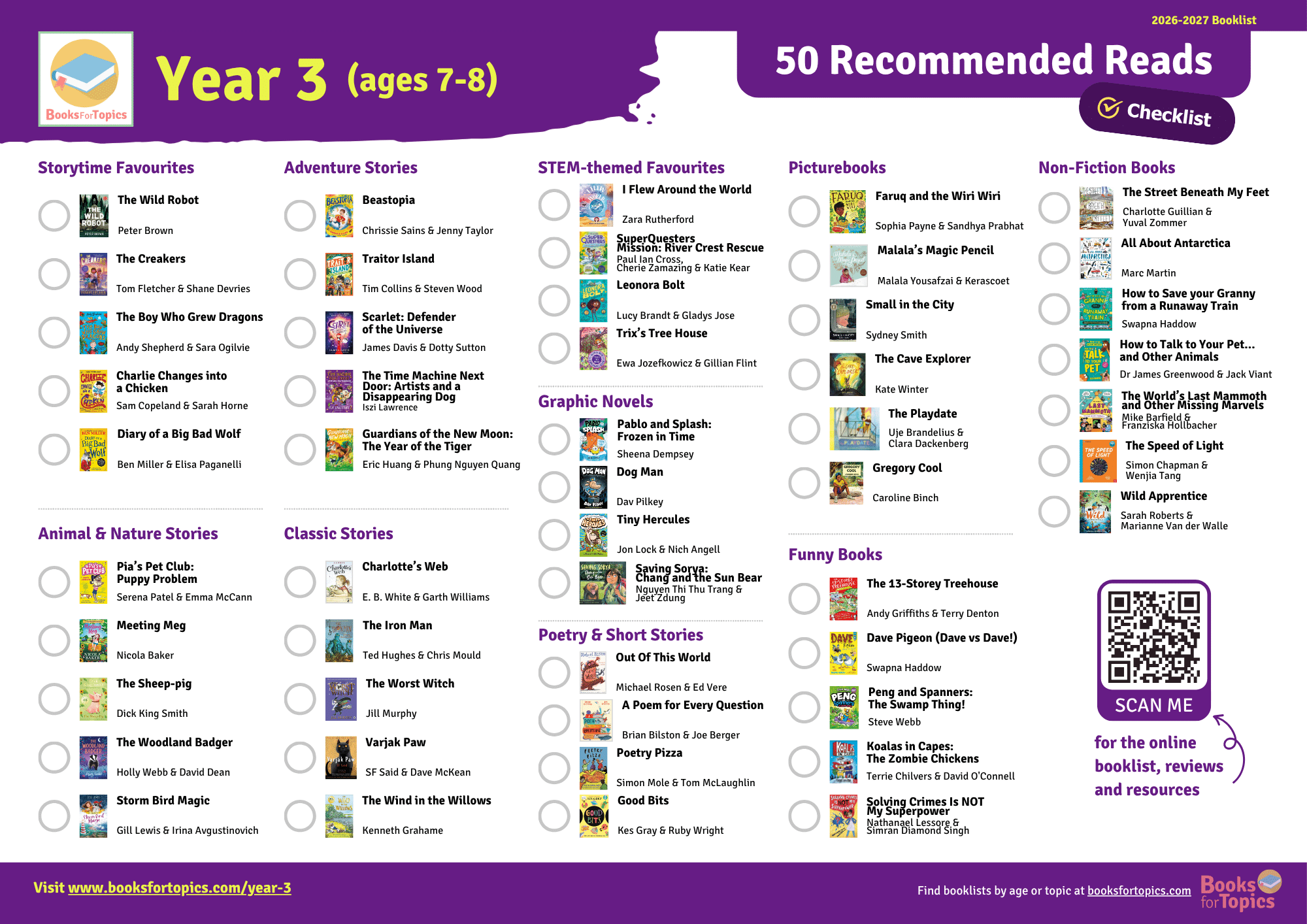
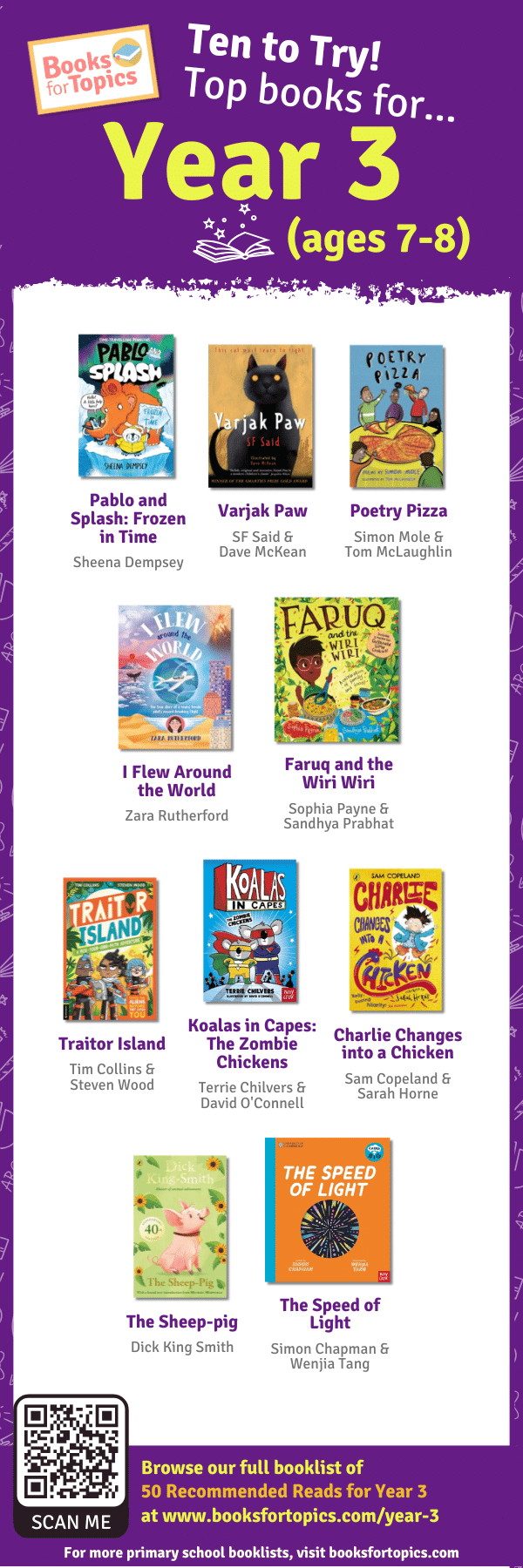
As well as the Y3 booklist below to browse, we’ve also got a printable poster, a downloadable checklist and a handy bookmark for you, and schools can purchase full sets of the 50 books via Peters.

Browse the Y3 booklist below or scroll down to find more purchasing options and printable resources.

Year 3 Booklist: 50 Recommended Reads Quick Links

Add to Favourites
Please login to bookmark Close

Visit our booklists on Amazon

Support independent bookshops

SAVE 20% with Peters

Favourite Storytime Reads for Year 3

Chapter book

If you’re looking for a heartwarming and thought-provoking storytime read, The Wild Robot by Peter Brown is the perfect choice. This highly original story combines themes of technology and nature and is a sure-fire hit in the classroom.

The story follows a curious robot called Roz, who finds herself stranded in the wild on an island. Roz must learn to survive and earn the trust of the island’s animals.

This is a beautiful tale of acceptance, friendship and what it means to care about others. With short chapters and lovely illustrations, The Wild Robot is a delightful read for Year 3 and beyond.

Chapter book

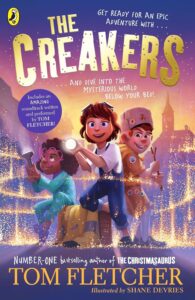
An adventure story that fans of Roald Dahl will enjoy. The story revolves around the plight of a girl named Lucy, who has been left distraught after her parents suddenly go missing. Lucy soon finds that all of the children on her street seem to be facing the same fate, with their parents disappearing as well. Consequently, the children embark on a rampage, causing havoc in houses and on the street, throwing toilet paper on trees, and creating a mess everywhere.

Lucy is a natural-born leader as well as an instinctive problem solver. Amid the chaos, Lucy takes it upon herself to investigate and locate the missing parents. In her quest for answers, she discovers a mysterious creature called Woleb from the world of Creakers, hidden under her bed. The strange state of the world she discovers leads her to wonder if the Creakers are responsible for the parents’ disappearance.

Lucy teams up with Norman Quirk, a smart and organized boy with multiple scout badges, to formulate a plan to rescue their parents.  Lucy Dungston is a likeable character whose curiosity and determination drive the story forward. Norman Quirk’s sharp wit and intelligence make him an excellent addition to the team. A thrilling adventure follows as the pair try to uncover the truth behind the strange happenings.

Most children have wondered at some time or other if there is another world under their bed, and this story makes a light-hearted fantasy out of a common fear. A brave adventure story coupled with likeable characters and good clean humour makes this a popular choice with Year 3 at storytime.

.

Chapter book

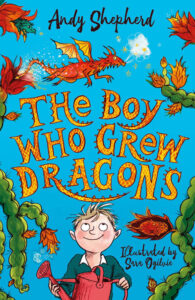
Imaginative and charming, The Boy Who Grew Dragons is a wonderfully whimsical story that kept me smiling the whole way through. The first in a series, this hugely entertaining adventure about a small boy and his pet dragon makes a super read-aloud for Year 3.

Tomas is busy in the garden with Grandad, planning which fruits to grow that might be turned into delicious jams or tarts. When Tomas stumbles across a strange tree with curious-looking fruit, he never expects that what might emerge from the fruit is a real live dragon! This is an adventure that is humorous at every turn, but also full of heart. Tomas is a great positive role model for showing how young people can apply curiosity and creativity to the process of growing and nurturing plants and see ‘magic’ in the course.

Coupled with charming illustrations by Sara Ogilvie, this early chapter book makes a fantastic choice for newly confident readers just taking off with independent reading and it will also go down a storm as an entertaining story choice.

Chapter book

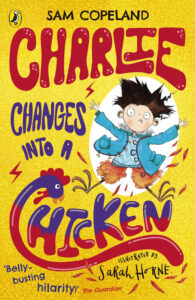
We love this laugh-out-loud series with a tongue-in-cheek humour and plenty of funny asides, but also a poignant side about bullying, overcoming adversity and dealing with big emotions.

Charlie magically changes into animals when he is worried or stressed (not necessarily chickens, though). Charlie’s worries pile up, with a brother in hospital, parents bickering and a school bully to deal with. Riproaring and hilarious antics follow suit as Charlie navigates temporarily changing into a spider, a rhino, a pigeon, snake and more.

Children with a wacky sense of humour will find this story really funny, and it provides plenty of opportunity to think and discuss the deeper topics too.

Chapter book

Lawrence, a big, bad, wolf, has just emerged from his den after a long, hard winter. He’s weak, tired and hungry and so embarks on a mission to get fit and find the ultimate, delectable treat: Little Red Riding Hood. But it’s not as easy as he thinks, for Lawrence is a lone wolf, without a pack and there is a pesky group of characters who keep getting in the way of his nefarious dinner plans… three little pigs, a woodcutter, a grandma and a mysterious old woman who brews concoctions in her gingerbread house all get in his way, tricking or outwitting him!

This is a fun and easy read that children will love. It’s funny, silly and the outcomes of Lawrence the Wolf’s actions are always hilariously predictable, making the story highly enjoyable. You can’t help but like and feel sorry for the misguided Lawrence, who struggles to see what is right in front of him.

The illustrations are endearing and add to the fun element of the story. There is a mixture of fonts and page layouts, which make the book appealing to reluctant readers.

A really enjoyable read which I would recommend to all pupils.


Animal and Nature Stories for Year 3

Chapter book

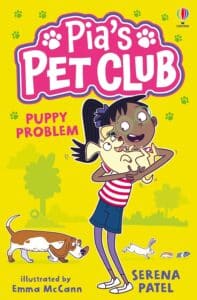
A brilliant new series from the very talented Serena Patel. In the first book of this series, we are introduced to eight-year-old Pia, who is crazy about animals and even more so as she isn’t allowed one of her own. She lives with her older-but-annoying sister, Anjali, in two places – one with her mum in a nice little house and the other a flat with her dad.

Pia meets a boy called Hari in the communal garden. He is with his two dogs, an older basset hound called Raja and a boisterous puppy, Luna. Hari is upset because he has to train Luna to behave before his Nani comes to visit, or she will be given away. What ensues is plenty of chaos, giggles and new friendships.

This is a heartwarming read with such lovable, diverse characters. Emma McCann’s illustrations beautifully complement this fun story.

Chapter book

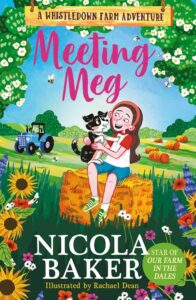
Meeting Meg is a charming and heartwarming story that brings the gentle rhythms of farm life to life through the eyes of young Tilly. During a busy summer on the farm, the book follows Ava as she helps with seasonal tasks like sheep-shearing and hay-baling, until a litter of Border Collie puppies, including Meg, a lively and endearing pup, brings a new excitement. Nicola Baker captures the excitement of a new animal arriving on the farm, and the story offers rich opportunities for discussing themes such as responsibility, friendship, and animal care.

With its calm, countryside setting and engaging, accessible language, this will appeal who enjoy animal stories or are curious about rural life. Baker’s writing is quietly compelling, with a classic feel that evokes the likes of Dick King-Smith and Michael Morpurgo.

Themes of friendship, responsibility, and finding your place in the world are handled with sensitivity, making this a lovely text for exploring emotional development and non-fiction tie-ins around animals and farming. This book would work well for guided reading, book corners, or independent reading for animal-loving pupils seeking gentle adventure grounded in real-life experience and an enjoyable classroom story.

Chapter book

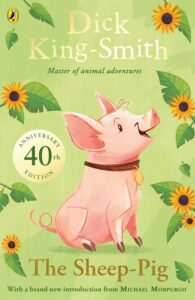
The Sheep-Pig is an animal classic by Dick King-Smith, also known through the film version ‘Babe’. The story is about a piglet who is determined to prove his worth on the farm by showing he can herd sheep just as well as any sheepdog. Under the wing of Fly the seasoned sheepdog, Babe develops his own unique style, choosing respect and manners over forceful snapping to get the sheep to comply. Readers can’t help but root for Babe.

It’s a farming story, so readers should be aware that the text uses the traditional term for a female dog and some discussion of the correct context for the use of this word might be helpful. It’s a much loved story that shows how persistence can help you reach a seemingly impossible goal and leading doesn’t always have to be aggressive.

Chapter book
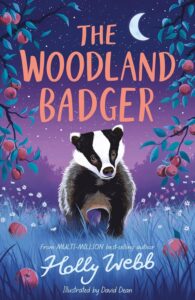
Poppy loves spending time at her mum's allotment and the tangle of wild woodland behind it. They regularly see foxes and hedgehogs, but one special evening, just as they are about to head home, they spot a young badger. It's the first time Poppy has ever seen one in real life, and she's entranced.Then Poppy learns that the woodland has been sold and there are plans to build houses on it. Poppy and her mum are horrified. Is there anything they can do to save the young badger's home?A heartwarming story about family and nature from best-selling author Holly Webb.
Chapter book Dyslexia-friendly
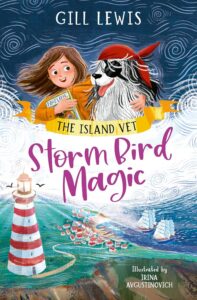
Amidst island tales of long-lost fairies and pirate chickens, Tia discovers the true magic of the elusive storm petrel in this uplifting tale of conservation from Gill Lewis.Long-lost fairies hiding near the lighthouse?Chickens belonging to a sea witch that warn sailors of coming storms?There are a lot of wild stories going about as some tall ships seek shelter in Gull Have Bay. Tia and Nat don't believe any of them to begin with. But when Nat's dad helps unravel the truth, they learn about a seabird that's in danger.Can Tia and Nat find a way to help, and will it allow them to rediscover the magic of the real world all around them in their island home?Particularly suitable for readers aged 7+ with a reading age of 7.

Adventure Stories for Year 3

Chapter book

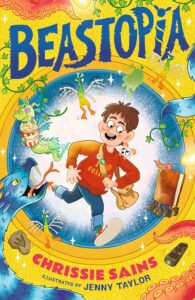
Beastopia is fabulously fun to read from start to finish.

Unfortunately, in Digby’s family, there is a curse where their family pets always disappear on their tenth birthday. It follows the main character Digby and his excitable best friend, Tai, and his sister, Mog, on a mission to find his lost pet mouse, Cheddar. What follows is lots of fun, humour and mild danger.

The book follows the journey of the characters to become apprentice guardians of Beastopia- a haven for magical creatures. Along the way, they take part in challenges with a little bit of danger and mystery and find out about Cheddar and the ‘lost’ family pets. It ends on a cliffhanger that makes the reader immediately want to read the sequel. The book has fun illustrations dotted throughout, which add to the experience of reading.

Mog has diabetes, which is mentioned briefly in the story and can be seen during illustrations, adding to the inclusivity of the story. A great story as a read-aloud story or for independent readers 7+.

Chapter book

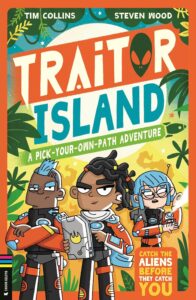
A choose-your-own-adventure style story with oodles of fun. The idea sounds simple enough: imagine yourself just finishing a mission to a distant planet, looking forward to getting home, when the ship’s computer detects an alien aboard. You’re stuck until the source has been found. What do you do? Which one of the other crew members, your former friends, has been transformed?

This is a plot to hook KS2 super sleuths, just like TV’s The Traitors. It requires readers to have their wits about them and to question their own values: would I, would you, stay loyal to friends, or would we focus on our own survival?

Just as there are multiple answers to such questions depending on circumstances and personalities, so there are multiple outcomes (endings) to this story, including some particularly creepy ones. In one, you get to escape and go home, in others, you too are infected. And in one (get this!) the computer… no, I won’t spoil it. Read the book! Enjoy the adventure, do the puzzles (mazes, calculations, spot the difference, etc), and follow different routes until finally you’ve exhausted all possibilities.

An interactive and immersive read to be recommended to fans of the ‘you choose’ genre, as well as to those yet to discover its attraction. One for the library and children’s own bookshelves.

Chapter book

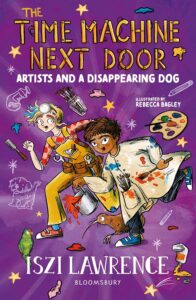
We love this series about time travel and each volume is just right in length and format for 7-9 year olds.

In this latest adventure, Alex and Sunil hop into the machine and blip through different eras associated with art.

The story is a brilliant hook for art history, letting readers meet famous artists up close as Sunil works on his own project. The history facts are woven directly into the pages and this is a fun way to pick up new information as the story unfolds. With the greedy Mr Shaykes constantly trying to loot historical treasures, it’s an entertaining and only mildly perilous adventure that’s sure to be a hit in Lower Key Stage 2.

Chapter book

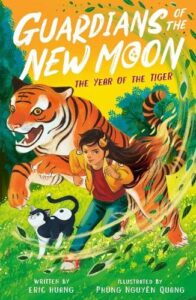
A fun adventure and part of the ‘Guardians of the New Moon’ series, ‘The Year of the Tiger’ focuses on feisty Biao the Tiger.

Ming and Miaow are Guardians of the New Moon and are tasked with making sure Biao, the honorary tiger, is at the Heavenly Palace at the right time for the celebrations for the Year of the Tiger. But Biao has got more important things on her mind – she’s concerned about the destruction of the Western Forest but can’t get anyone, including the emperor, to listen to her.

Biao is extremely passionate about saving the Western Forest but doesn’t always get her ideas across in the right way. There’s an important message in the story about listening to others but also accepting help when you need it, as well as the theme of conservation. This would be a great first chapter book for children as each chapter is relatively short. There are illustrations throughout as well to break up the text further.

Chapter book

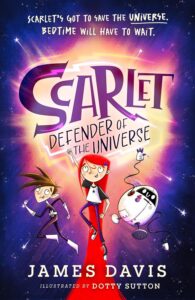
Scarlet is having a tricky time at school, friendship-wise and her younger brother is being annoying. She sees an advert for a ‘defender of the universe’ and, although she’s pretty certain it’s a joke, decides to apply anyway. That’s how she ends up meeting a floating boy called Jasper, going aboard an invisible spaceship and meeting an egg-shaped AI robot called Bot. Scarlet now finds herself jointly in charge of defending the entire universe with Jasper, which involves encountering creatures from other planets and also dolphins wearing suits.

This book is laugh-out-loud funny with silly names, made-up words and bonkers chapter titles. This would make a great read-aloud for Year 3. Children who enjoy funny books and adventures will love reading about Scarlet; the chapters are not too long, and there are illustrations scattered throughout.


Classic Stories for Year 3

Chapter book

A classic book for children, this poignant animal story has been a treasured choice for 7-9 year olds for decades.

Inspired by the author’s own experiences looking after pigs on a farm, this book tells the story of farmer’s daughter Fern, who requests to save Wilbur, the runt of the litter of pigs, and keep him as a pet instead. Wilbur soon befriends a spider called Charlotte, who concocts a fantastic plan to save him when she hears his life is in danger.

Exploring themes of friendship, loyalty and animal life cycles, this beautiful book has earned its place as a classic of children’s literature and is a story that is well-loved and not easily forgotten.

Chapter book

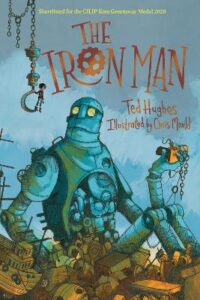
A smashing classic read for Lower Key Stage 2. As you’d expect from a former Poet Laureate, this story about a mysterious metal giant who befriends a farm boy is gorgeously written and hauntingly strange.

The origins of the Iron Man are never fully explained – he just arrives one night, starts feasting on farm equipment, and after some initial misgivings is accepted into the local community.

The book was seen a few different editions and we recommend this version, superbly colour-illustrated in metallic hues by Chris Mould.  It has also been turned into a really lovely animated film.

Chapter book

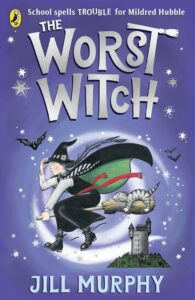
The Worst Witch books have captured the imaginations of millions of young readers who enjoy stories about growing up and discovering magic.

Readers loved Mildred Hubble’s escapades as a trainee witch at Cackle’s Academy, where, however hard she tries, mishaps seem to come her way.

This is a classic chapter book series by Jill Murphy with a new memorable heroine to root for.

Chapter book

Varjak Paw has become a modern classic and an absolute staple of primary school storytimes. The eponymous feline is far from ordinary. Varjak is a Mesopotamian Blue, an exotic and ancient breed descended from the legendary adventurer and hunter, Jalal. As Varjak listens to his grandfather recount the mesmerising tales of Jalal, the fabled ancestor, he begins to visit him in his dreams, inspiring the young kitten with his tales of bravery and daring.

But when a malevolent Gentleman and his two vicious black cats arrive on the scene, Varjak’s comfortable life is abruptly overturned. To save himself, his family, and his newfound friends, Varjak must master the long-forgotten Seven Skills in the Way of Jalal. – a sort of martial arts for cats.

This is a story of loyalty, courage and self-belief that will keep readers hooked from beginning to end and of course, it is a must-read for all animal lovers.

Chapter book

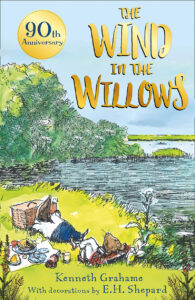
This is a children’s literary classic. Set along the river bank, it recounts the humorous adventures of Toad, who relies on his helpful friends Mole, Ratty and Badger to keep him safe from a series of disasters that he seems to bring upon himself. A suitable classic for primary children.

This is a special edition to celebrate the 90th anniversary of Kenneth Grahame’s classic.


Funny Books for Year 3

Chapter book

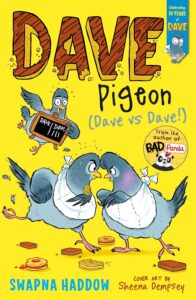
Dave Pigeon is a hugely likeable character, whose hilarious facial expressions are a real credit to the illustrator Sheena Dempsey. This book, with its speech bubbles, illustrations and manageable chapters, will appeal to children wanting to build independence with their reading.

In this latest edition of the popular series, a lookalike threatens Dave’s authority and before long the two competitive birds have to put their wits to the test to prove who really is…well, Dave!

Dave, our feathered friend, once again delivers on laughs, keeping children wanting to read on.

Chapter book

The Treehouse books form an enormously popular children’s book series by Andy Griffiths and Terry Denton.

The series features a fun-loving pair of friends who live in an imaginative treehouse with lots of fun extra rooms. As the series progresses, the treehouse expands and before long contains everything from a movie theatre, dinosaur petting zoo, marshmallow-toasting volcano and a ninja snail academy.

Highly illustrated with comic-style line drawings, treehouse diagrams and speech bubbles, these books are wildly popular with children aged 7 plus. The high image-to-text ratio coupled with its wacky sense of humour have helped the series to earn its reputation for hooking children into reading.

Chapter book

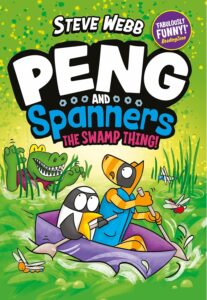
This graphic novel is part of the Peng and Spanners series, which always goes down a treat!

In this volume, the quirky pair of pizza-loving friends set about to solve the mystery of a swamp monster. Like true detectives, they follow the trail, spot clues, interview suspects and generally find themselves in the midst of much hilarity.

Its comic strip style is super appealing and colourful and the story is crammed with jokes and high jinks. This book will fly off the graphic novel shelf and is perfect for fans of the InvestiGators and Sparks in KS1 and KS2.

Chapter book

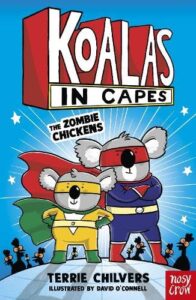
This is the first book in the series and what an introduction to the amazingly funny duo, Bob and Archie, two koalas who have recently got superhero powers. Archie has invisibility powers and Bob has super-strength. I really enjoyed this book and the characters were very likeable.

So far they haven’t had much success rescuing anyone. When there is a robbery at the Museum they have no choice but to intervene. Supervillain Ostrich, Dr Colossus is behind the unusual crime and with the help of their friend, Quinn the aadvark they soon have a plan.

With short chapters, lots of illustrations and funny mishaps, this book is sure to be a favourite with readers.

Chapter book

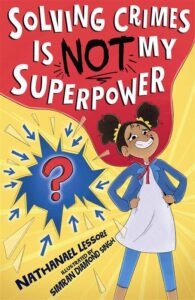
Children will enjoy the humour of the book – from the funny setting of the story in the village of Walsham, where everyone who lives there has a unique superpower, to the humour of the language, names and jokes.

The plot itself raises a smile with the story’s hero, Sara, who is yet to find her superpower, solving the mystery of the disappearance of a trophy, which turns out to be the special treasure that has bestowed the unique superpowers on the town’s inhabitants. The superpowers themselves are the sorts of things that make children laugh.

The story invites children to consider what it means to have a superpower and how, in fact, it is the everyday acts of kindness, inner-strength, friendship and determination that are the real superpowers. Initial ‘prejudices’ against certain characters – for example the studious and clever child in the class – are quickly debunked, showing children the importance of not judging people on simple appearance and behaviours.

This is a fast-paced story that would keep young readers engaged and this is helped by the illustrations of Simran Diamond Singh, which enhance the story. These complement Lessore’s writing and bring the unique characters and their superpowers to life with a comic-like appeal. This is a book that young children are sure to enjoy.


STEM-Themed Favourites for Y3

Chapter book

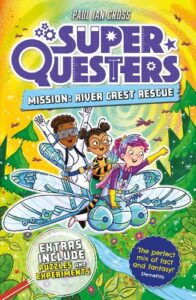
SuperQuesters Mission: River Crest Rescue is an exciting and imaginative chapter book blending fantasy, problem-solving and real-world science into an action-packed adventure. This story is a perfect launchpad for curious young readers who are ready to explore STEM in a fun, creative way.

The story follows three friends who discover a mysterious board game that transports them to the magical world of Questland. There, they become their superhero alter egos. Their mission? To save the village of River Crest from the villainous Mortifer and his mischievous Beaver Bots and Dragonfly Drones. But to win, they’ll need to use science, logic and teamwork.

One of the standout strengths of this book is how seamlessly it weaves STEM learning into the story. Whether it’s solving codes, learning about animal habitats, or understanding plant biology, readers are encouraged to think like scientists and problem-solvers. The interactive puzzles and real-life experiments sprinkled throughout the book keep the learning hands-on and engaging without ever slowing the pace of the adventure.

The clear layout, helpful glossary and visual elements make it especially well-suited for confident readers transitioning into chapter books.

Non-fiction

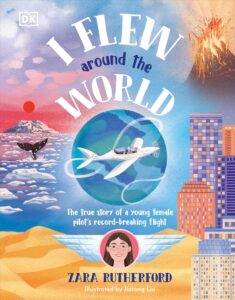
Zara Rutherford’s I Flew Around the World is an incredibly inspiring true story, chronicling her astonishing journey as the youngest female pilot to fly solo around the globe. This book is an illustrated account of ambition and determination in a record-breaking aviation achievement. The story is bound to capture the interest of any junior children fascinated by flight, adventure and exploration.

This colour-illustrated information text bubbles with insights into Zara’s meticulous preparations, the various places she touched down and the various experiences she encountered.  It’s a superb resource for KS2, particularly for those keen on non-fiction or seeking a contemporary female role model in STEM, offering a real-life testament to chasing ambitions and flying high!

Chapter book

Leonora Bolt Secret Inventor is an entertaining STEM-themed narrative and a great story choice for Year 3 and above. The book follows a young female scientist named Leonora, who is passionate about creating new and ingenious inventions to solve the problems of those around her.  Gladys Jose’s illustrations enhance the storytelling experience, as does the good dose of humour woven through the narrative.

Leonora’s secret workshop serves as the backdrop for her endeavours, which become critical in her confrontations with her invention-stealing uncle. What follows is an imaginative adventure with quick-thinking Leonora using her STEM skills and natural wit to triumph.  Readers who love science and innovation will find this an engaging and entertaining storytime choice.

Chapter book

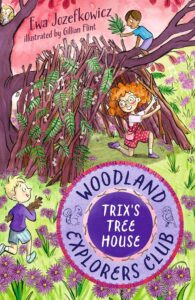
We love this nature themed, short chapter book series, which includes Benji’s Emerald King. This instalment is a fantastic pick for exploring STEM topics like ecology and den-building. When Trix notices that the bees and flowers are disappearing in the nearby woods, she and the explorers team up to restore the habitat.

Presented like a field journal, the story is packed with bug facts, illustrations and wildlife project ideas. The focus on teamwork, exploring and nature make this a superb read for outdoorsy children in Years 3 and 4.

Graphic Novels for Year 3

Graphic novel

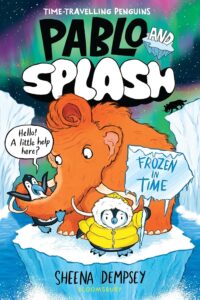
In this episode of graphic novel series Pablo and Splash, the characters plan a holiday, yet are unable to find Professor O’Brain to help them into his time machine. Bustling with jokes and plays on word, this is a joyous, easy read, which will appeal to even the most reluctant of readers. Will Artificial Technology really be able to outsmart this famous duo? Or will they successfully muddle their way through the Ice Age to rescue the Professor?

This comic-style book muddles through many mishaps, meets very questionable cave men and even comes face to face with the world’s cutest sabre-toothed tiger (hang on… aren’t they extinct?).

Both children and adults will love reading to find out whether Pablo and Splash will make it out alive, or be DOOMED in the Ice Age forever.

Graphic novel

The Dog Man books form a wildly popular children’s book series written and illustrated by Dav Pilkey. The series features a half-dog, half-human police officer who fights crime and saves the day in the city.

Written in a graphic novel format with comic-style illustrations and speech bubbles, these books are popular with children aged 6-9. The series has become known for hooking children into reading through visual humour and wacky storylines. Each story in the Dog Man series is told through several short chapters, and the books can be read in any order.

Readers who enjoy Dog Man might also like to explore our Branching Out list of more books like Dog Man.

Graphic novel

This fast-paced, joyous, laugh-out-loud text is a must for any library. Fans of graphic novels, history, or both will find the chaos of this text addictive and hard to put down.

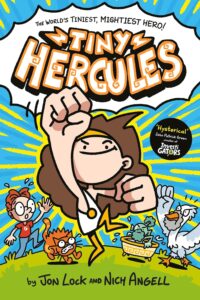
It tells the tale of Tiny Hercules, a jam-jar-sized version of a well-known mythic hero who has to navigate their way through a series of twelve epic quests to make his way home. The re-imagined mythical adventure is full of twists, turns and laugh-out-loud moments that would be perfect for young readers or those who love comic humour.

This was a hit when I placed it in the school library; children were attracted from the outset by the cover and illustrations, and it has been checked out every week since. The last few pages offer instructions on how to draw Tiny Hercules and tease the beginning of the sequel due for publication in 2026. A great addition to any graphic novel collection!

Graphic novel

Written by scientist and activist Trang Nguyen, Saving Sorya: Chang and the Sun Bear is a powerful graphic novel-style book rooted in a real conservationist’s experiences.

The story follows Chang, determined to protect animals, as she trains at a National Park and commits to teaching Sorya, an orphaned sun bear, crucial survival skills for release back into the wild. Chang’s deep companionship with Sorya, who must be released back into the wild, makes for a poignant and fascinating read.

This interesting rainforest story highlights vital conservation work and threats to wildlife. It’s an empowering read for understanding global wildlife protection work, habitats and making a difference. It will appeal highly to wildlife lovers, adventure fans and readers who enjoy the manga style of illustration.

Poetry and Short Stories for Year 3

Poetry

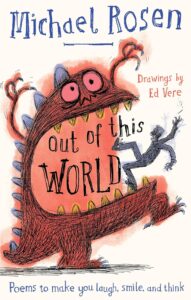
This new collection of poems by Michael Rosen is designed to make you ‘laugh, smile and think’.

The book includes a poem on the life of a red blood cell and its journey round your body, a monster who slowly eats the entire alphabet (how do you speak if you’ve run out of letters?) and a day in the life of a cat – sleeping, eating and manipulating your pet human.

All told with Rosen’s usual sense of humour and ear for rhythm, these poems would be great for reading aloud in class as well as being easy enough to be read independently by a child. The book is beautifully illustrated throughout by the brilliant Ed Vere, who manages to bring Rosen’s imaginings creatively to life.

Perfect for children (and adults) of any age.

Poetry

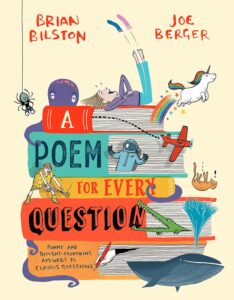
A Poem for Every Question is a clever and entertaining collection that takes the kinds of questions children ask every day and answers them through poetry. Questions such as “What are rainbows made from?” and “What is absolute zero?” are explored in playful, imaginative ways that make learning feel fun and accessible.

Each poem is built around a single question and the topics covered are wide-ranging, including science, geography and history. This makes the book easy to dip into and ideal for sharing, whether in the classroom or at home. The poems often debate and discussion, encouraging children to think more deeply about how to explain the world around them. A particularly strong feature is the short paragraph of factual information that follows each poem. These clear, concise explanations provide a straightforward answer to the question, helping children connect the creativity of the poem with accurate non-fiction knowledge.

The book strikes a lovely balance between being funny and informative. For teachers, it offers a great opportunity to link poetry with cross-curricular learning, while parents will enjoy how naturally it invites shared reading and conversation.

Poetry

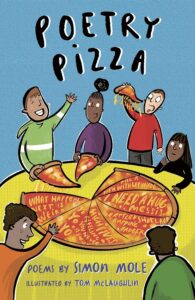
Here, inside a bright and breezy cover, are ninety-three pages of illustrated, imaginative, occasionally quite incisive, and consistently inspiring verse. Inspiring because, if poetry can be this much fun, readers (of any age) will want to have a go themselves! It’s possible some will try to pen a haiku, but probably not the problematic ‘triolet’. Or they might simply take some of Simon Mole’s creative ideas like Mind Map and Cure for End of the Day Blues (to help them relax) or Us in the Car (as a game to play on long journeys).

There are also fun fabrications of dictionary entries, eg ‘Flooble’, and extrapolations of events like ‘The Last Wee’, which are certain to bring a smile to the face.

How many of these poems are based on the author’s own experiences, is not clear (did Dad really fill the bath with lemonade?), but it is clear that Simon Mole has a sparkling sense of humour and a real talent for cooking up a feast. Perform them, use them (eg to craft your own version of LOL with a.n.other abbreviation), share them and enjoy them!

Short story collection

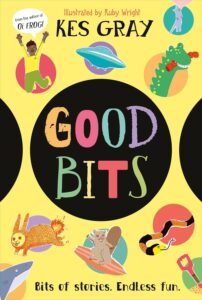
Good Bits by Kes Gray is a wonderful collection of short stories and unique by doing exactly what the title promises: skipping straight to the ‘good bit’!

With each story, readers are plunged directly into the heart of a narrative from the very first sentence and are pulled along at a fast pace before suddenly being faced with an unexpected twist only pages later. It is a brilliant, fast-paced formula that consistently leaves you wondering what might happen next.

This book is perfect for reluctant readers, who crave instant excitement and like stories to get straight to the action, as well as creative children who love letting their imaginations run wild. Showcasing a range of genres – spanning from laugh-out-loud comedy to spellbinding fantasy and high-stakes science fiction – there is a tale here for every type of reader. The writing is creative, utilising rich figurative language that paints incredibly vivid mental pictures for the reader, and each story is complemented by illustrations that further help to bring the text to life.

Good Bits is a must-have addition to children’s bookshelves.

Picturebooks for Year 3

Picturebook

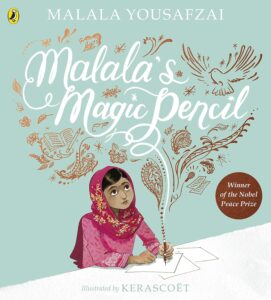
This picture book version of a well-loved autobiography tells the story of Malala’s journey from a young girl in Pakistan to a global activist. Growing up, Malala wished for a magic pencil to fix the problems she saw around her, but she soon discovers that her voice and a real pen are much more powerful tools for change.

The book handles big themes like equality and girls’ educational rights with a gentle and hopeful touch. The beautiful illustrations, with shimmering gold highlights, capture the hope and optimism of Malala’s message.

This is a must-have for the classroom simply to inspire, and also useful as a springboard for discussions in PSHE about equal rights and how one child really can change the world.

Picturebook

There’s so much to like about this colourful picturebook: the lively illustrations, including endpapers; the different fonts which are almost as expressive as the text and conjure up beautifully the scents and sounds of Caribbean culture, the warmth conveyed by artful storytelling, warmth which derives from Faruq’s relationship with the characters who shape his culinary (and boyhood) journey; not to mention the addition of a recipe for lime cookies.

This is a story to make your mouth and your eyes water – as if witness to the work of cooking up a sumptuous family feast and then finding yourself invited too. It’s a book that lends itself to being read aloud in class or at home (and even more so if the dialect sounds authentic). It would also work well in a nurture group setting, allowing the children a hand at making some of the food and as a celebration of different cultures.

Picturebook

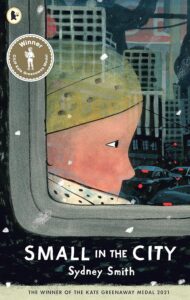
Sydney Smith’s first picture book as both author and illustrator is an absolute stunner and a deserved winner of the Kate Greenaway Medal.  This is an atmospheric story in which a young boy navigates a cold and bustling city, offering gentle advice on the city’s hidden ‘spaces’ such as which alleys to avoid and where to find the very best hiding spots.

What begins as a guide to being small in a big world slowly reveals itself as a message to a lost pet. The illustrations play with light and shade to capture the urban landscape from a child’s perspective, as we know children of course notice different shapes and spaces to an adult observer. A thought-provoking book and a beautiful choice for primary children of all ages to explore empathy and visual storytelling.

Picturebook

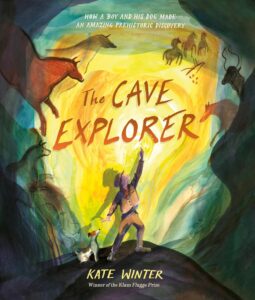
The creator of The Fossil Hunter has struck gold again with this fantastically illustrated narrative non-fiction picture book. It tells the story of Marcel Ravidat and his dog, who discovered the Lascaux cave paintings.

The book is a masterclass in how to successfully weave story and history together – the pages are full of a mixture of narrative and timelines, glossaries and annotated images – all topped off with incredible artwork that leaves just the right amount to the imagination. In this, it reflects the brilliant way in which Winter describes the work of all those who have studied and hypothesised about the art in the Lascaux caves, having to use imagination to infer and fill the gap between what is discovered and what can only be guessed at.

The intrigue and mystery surrounding the cave paintings feels touchable in this book – children will feel like they’ve had an experience and discovered something for themselves (a high point in the book is one of the fold-out surprise spreads illustrating the moment when Marcel lights a match and he and his friends see the cave paintings for the very first time) – which is what the very best science based picture books are all about!

This is an essential classroom addition when teaching about prehistory and the Stone Age!

Picturebook

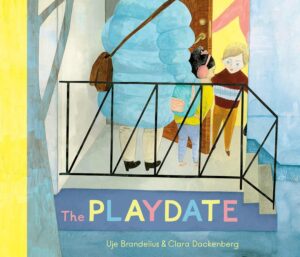
This is a unique and thought-provoking picture book about a girl’s playdate at another house. While the text describes a simple afternoon of games with her friend Henry, the illustrations quietly reveal a different story – the families live in completely different worlds, that Henry has access to (and even discards) toys that she can only dream of having, and the girl’s mum is evidently there to clean.

This is a book to truly ponder over, offering no easy answers or neat resolutions. Children can be prompted to consider the unspoken divide between words and pictures, which mirrors the unspoken class divide between the girl and her playdate companion. A brilliant pick for KS2 to explore subtext, social inequality and throwaway culture, especially as the words and pictures tell two very different versions of the narrative.


Picturebook

This longer picturebook has become a classic that has earned its place in many primary school classroom book corners.

It tells the story of young Gregory as he sets about on his first day in Tobago with his grandparents. At first he can find nothing familiar or desirable, but as he begins to adjust to life in the Caribbean, he soon finds that it is possible to feel right at home in a new culture.

Non-Fiction Books for Year 3

Non-fiction

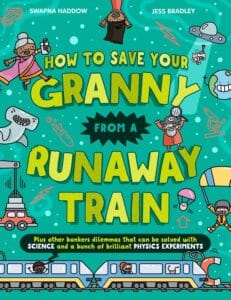
This book is a humorous mix between short comic strip stories and instructions for introductory physics experiments which could be completed at home. The innovation of the book is in the framing of the experiments as a way to think about solutions to the sometimes outlandish problem scenarios set out in the comic strip stories.

There are accompanying discussions which enable the book to work both for children new to experimental science and those with a deeper special interest. The book would particularly suit fans who like the balance of humour and information in Mike Barfield and Jess Bradley’s Day in the Life books.


Non-fiction

A beautiful fold-out book that showcases the wonders of the earth beneath our feet, and one with real wow-factor.

This book is well-suited for introducing rocks and soils or geology topics. Sublimely illustrated, its concertina-style pages fold out into a long cross-section of the Earth: in one side and out the other. Children can spread out around the fold-out page to get a real sense of the depth of the earth’s layers and what you might find in each.

This unusual non-fiction text with a tactile element contains a wealth of information about geology and science, linking to topics of rocks and soils and awesome earth and opportunities for further questions from curious young minds. Just stunning!

Non-fiction

Stunning watercolour images bring Antarctica to life whilst bite-sized information gives children a feel for what it would feel like to stay in Antarctica as a research scientist.

Find out about what clothes to wear, what the research stations are like, the transportation, different types of icebergs and glaciers, the types of research that take place, how the scientists relax in their downtime, the food they eat, the species of animals you will find there, fossils, famous Antarctic explorers and much, much more.

A perfect read for any pupils learning about the coldest place on earth, animals and their habitats or climate change.

Non-fiction
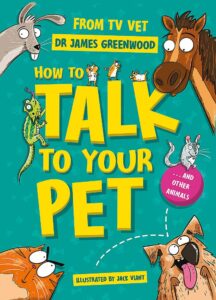
Discover how to talk to your pet, with vet and star of Channel 4's Fur Babies and CBBC's The Pets Factor, Dr James Greenwood.What does it mean when a dog's tail wags round and round like a helicopter? What is a cat is trying to say when its ears are pricked up? And what on earth is a rabbit trying to tell you when it eats its own poo?From cats and dogs to horses, hamsters, rabbits and more, animals all have something to say. Learn how to read the clues your pet is trying to give you, find out what they need, and discover how to communicate with them, too!Buzzing with brilliant facts and packed with hilarious illustrations, this pet companion book is the perfect gift for young animal-lovers.
Non-fiction

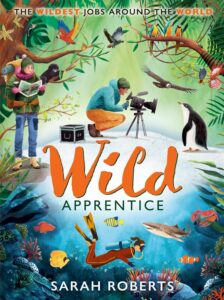
Wild Apprentice is a fantastic and engaging non-fiction book that children will really enjoy reading. It explores some of the wildest and most exciting jobs in the world, including wildlife filmmaker, explorer, climatologist and wilderness medic. Each job is presented in a way that is easy to understand and interesting for readers of any ability. One of the best features of the book is that each job page is set in a slightly different location around the world, some on land, some on (or in) water. This helps children see how these jobs connect to real places and different environments, making the book especially appealing for those who enjoy geography and learning about the wider world.

The addition of a “best and worst” bit for each job is a brilliant touch, as it helps children think about the challenges as well as the rewards of working in these unusual careers.

Wild Apprentice is a great choice for pupils who are interested in geography, natural science, nature and the world around them.


Non-fiction

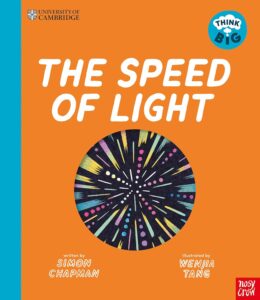
The Speed of Light is a brightly coloured introduction to Einstein’s theory of relativity. It begins with information about who Albert Einstein was and more basic information about how light travels before addressing more complex information about the colour of stars and whether time passes differently if you are moving faster.

Each section of the book contains just enough information to explain without having an overwhelming amount of text on the page, but it doesn’t over-simplify the science. Wenjia Tang’s illustrations are eye-catching and really useful in supporting the real-life examples that are used to explain much of the science.

This is a great introduction for primary school children to some really complex scientific theory, and young readers will certainly feel empowered by that. A useful book to use alongside the light science topic. I think it will inspire a lot of children to investigate some of the theories further!

Non-fiction

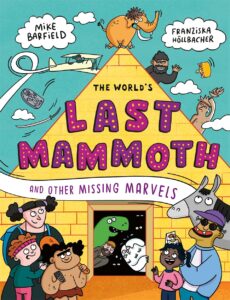
The World’s Last Mammoth and other Missing Marvels is a taste sensation for the eyes and the brain cells! This treasure trove of mysterious facts ranges from amazing animals, mind-boggling buildings to missing people and palaces to name only a few! Fact after fact, sits side by side beautiful illustrations in a vibrant, comic book style.

Whether you want to explore the Hanging Gardens of Babylon, or ponder over the fate of Cleopatra or Genghis Khan, the choice is yours. This book is an amazing collection of “things and stuff” that has long gone from our lifetime but will never be forgotten. There is nothing boring about these facts – only fun and giggles!

SAVE 20% with Peters

Visit our booklists on Amazon

Support independent bookshops

Printable Year 3 Booklists

Can I download a printable version of the Year 3 Booklist?

All of our Year Group Recommended Reads lists come with a printable poster and checklist. Schools are very welcome to display the posters or to share the printable resources with their community.

Printable Poster – Best Year 3 Books PDF

y3 best books


Printable Checklist – Best Year 3 Books PDF

y3 best books checklist

Printable Bookmarks – Best Year 3 Books PDF 
year 3 best books bookmark

About the Year 3 BooksForTopics Booklist

What books do Year 3 children read?

50 best books for y3Year 3 children like books that entertain them and help them to understand the world around them. Year 3 teachers like to provide pupils with reading-for-pleasure choices designed to entertain and delight, as well as books that open up a host of new worlds to curious children. Books provide children of this age group with opportunities to stretch their imagination as well as to consider what life might be like in a myriad of different settings and situations.

Children in Year 3 often enjoy stories about the lives of other people, like Chang’s conservation adventure in Saving Sorya, or the intergenerational cooking fun in Faruq and the Wiri Wiri. Stories like this can help children develop empathy and understand emotions while at the same time increasing language skills and vocabulary.

Animal stories are hugely popular choices in Year 3 too, and many children of this age enjoy gentle wildlife conservation adventures like The Woodland Badger or stories about talking animals with their own secret lives, like the classroom storytime favourite Varjak Paw.

Funny books like Charlie Changes into a Chicken are very popular with this year group, as are short chapter books with highly illustrated elements like The 13 Storey Treehouse or Dave Pigeon. Many parents and teachers report that books like this, with a high image-to-text ratio and plenty of humour, are the ones that first hook their Year 3 children into reading independently.

In addition to independent reading, story time with adults remains important and treasured in Year 3, too, both at home and in the classroom. With shared storytimes, Year 3 children can handle more complex narratives or more deeply emotive tales that can be discussed together with adults, including true classics like Charlotte’s Web or books that touch on wider social or environmental themes, like The Wild Robot.

Should children read to themselves in Year 3?

Year 3 is a great age to encourage children to be reading independently and is often considered the year when independent reading begins to take off, as long as the right books are available.

At the ages of 7 and 8, many children have learned to read short books by themselves and begin to exercise greater freedom of choice over their independent reads at school and home. Furthermore, research shows that reading for pleasure in childhood is a more powerful indicator of future educational attainment than parental socioeconomic status. To facilitate the enjoyment of reading, getting the right book into the right child’s hands at the right time is the key. 

Many children looking for independent reads in Year 3 first gravitate towards highly illustrated short books or graphic novels like Pablo and Splash or Supa Nova, while others simply love a story with entertaining characters like Dave Pigeon or Pablo and Splash. Collecting a series is hugely appealing to children at this age, and series like Dog Man and the 13 Storey Treehouse become popular in Year 3.

Every reader develops differently, and some children will not be quite ready for the leap into independent reading yet. Where this is the case, providing plenty of opportunities to enjoy shared reading or storytime with trusted adults or older siblings is the best thing to do. Some books lend themselves brilliantly to being shared, like enjoying Out of this World poetry by Michael Rosen, or fold-out non-fiction with the “wow” factor, The Street Beneath My Feet.

Try to make plenty of books available to freely browse during independent times, too – even if the words are not all being read, remember that books can still be enjoyed in a myriad of wonderful ways.

Which are the best books for Year 3?
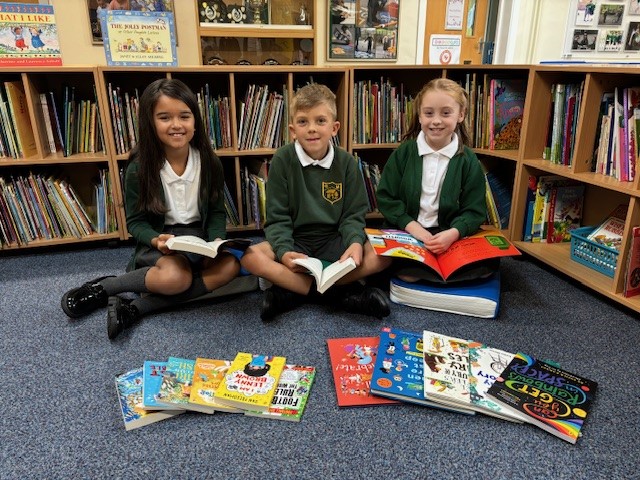
year 3 reading book listYear 3 children should be allowed to have time to choose from different styles, genres and formats. Make the most of library trips to find new books to read, or use our checklists and school bookpacks to help guide choices.

Our team has carefully selected a range of books, specially picked for encouraging reading for pleasure in Year 3, both as independent book choices and for texts to be read aloud by an adult. Some of the stories in the collection will be especially appealing to children looking for an illustrated chapter book series, such as the hilarious Dave Pigeon or Peng and Spanners series, which have memorable characters and frequent visual elements to break up the text. Several stories in the collection are brilliant choices for making children laugh out loud, like Koalas in Capes or Charlie Changes into a Chicken.

Other stories chosen for our Year 3 booklist are more tender-hearted and thought-provoking. We love Andy Shepherd’s story The Boy Who Grew Dragons, all about a young boy who finds a baby dragon hatching from a ‘dragon-fruit’ tree in the garden, or Peter Brown’s popular storytime choice The Wild Robot, which explores themes of technology and nature.  Not all of the stories on the list are longer reads – for excellent picturebook choices suitable for Year 3, we recommend the inspiring picturebook Malala’s Magic Pencil, or the classroom classic Gregory Cool. More picturebooks for this age group can be found on our separate Lower KS2 Picturebooks booklist.

If you are looking for classic stories, you’ll find on our list some real favourites suitable for children aged 7-8, like Ted Hughes’ thrilling and mysterious story of The Iron Man or the poignant farmyard tale of friendship, courage and loss in Charlotte’s Web. Other stories in the collection are part of a much newer series, such as the Pia’s Pet Club series or Nicola Baker’s Whistledown Farm Adventures.

You’ll find a variety of genres and formats included on our recommended Year 3 reading list, from poetry collections like Poetry Pizza to the fact-packed account of The World’s Last Mammoth and Other Missing Marvels. We’ve also included some Y3 graphic novels, such as Pablo and Splash and Tiny Hercules. If you are looking for a short chapter book for an ideal first step into independent reading, try the illustrated adventure Guardians of the New Moon or the interactive, choose-your-own-adventure style Traitor Island. For more ideas, be sure to check out our separate booklist highlighting recommended First Chapter Books.

What are the best non-fiction books for Year 3?

When choosing information books for Year 3, look for highly illustrated non-fiction texts with smaller chunks of text. Non-fiction books that are particularly well-suited to readers aged 7 and 8 include the colour-illustrated How to Save Your Granny from a Runaway Train, the inspiring real-life story of Zara Rutherford in I Flew Around the World, and Yuval Zommer’s beautifully illustrated The Street Beneath My Feet, which provides a real wow-factor to shared reading experiences with its 2.5 metre fold-out spread.

If you are looking for books themed around a particular topic, head over to our KS2 topic booklists.

What other booklists for children in Y3 are available?

Booklists for KS2We offer a selection of resources and booklists catered to the age and stage of 7 and 8 year olds. To explore children’s books centred around popular Year 3 curriculum topics such as Stone Age to Iron Age topic texts, recommended books about Rocks & Soils or stories about Rainforests, or those that align with common interests such as animal stories or children’s space books, browse through the BooksForTopics KS2 topic booklists.

At this age, children usually establish a fondness for a particular series or author. To help parents and teachers discover new story characters that children might adore, our Branching Out booklists featuring a variety of books will come in handy. These carefully selected lists include stories for fans of Beast Quest, books similar to David Walliams’ stories and more books like Dog Man. We also have a list of Accelerated Reader books for Y3.

A great place to start for reading for pleasure recommendations is our list of Best Books for 7 Year olds. Not everybody is ready for longer chapter book stories at the Year 3 stage and some children will thrive on alternative formats. Take a look at our Lower KS2 Graphic Novels booklist or our selection of first chapter books featuring very short or colour-illustrated options for newly independent readers. Y3 children who have not yet caught the reading bug might like our booklist for reluctant readers aged 7-9 or our Top-Notch non-fiction booklist for more options to appeal to different types of readers.  Similarly, more advanced Year 3 readers can look ahead with our list of Recommended Reads for Year 4.

For children’s books showcasing a broader range of characters, cultures and experiences, our collection of Diverse and Inclusive Books for Lower KS2 is recommended for parents and educators seeking diversity and inclusivity.

Finally, we have a number of booklists in our KS2 PSHE collection designed to support the emotional well-being of children in this age group. Head over to our Mental Health Awareness booklist, our list of anti-bullying books, our selection of stories to develop Emotional Literacy or get ready for the next class move with our booklist for class transitions.
Where can I find recommended reading lists for other primary school year groups?

In addition to the Year 3 booklist, you can also find more primary year group reading lists right here! BooksForTopics is a reliable source for discovering recommended books for each Year Group. Our team of experts at BooksForTopics has meticulously curated a selection of top-quality books appropriate for each primary year group, with input and evaluation from our school-based Review Panel. Each booklist includes 50 recommended books and includes a printable poster and checklist. Plus, schools can purchase full sets of each year group list through our partners at Peters.

Here are the quick links to our other primary school booklists:

Purchasing the Year 3 Recommended Reads

Where can I purchase the books on the BooksForTopics Year 3 booklist?

Peters book packs booksfortopics

Booklists you might also like...

Year 3 Booklist: 50 Recommended Reads

Related Resources

[["Printable Y3 Poster","https:\/\/www.booksfortopics.com\/wp-content\/uploads\/Printable-Poster-50-Best-Books-2026-27-Year-3-768x543.png","https:\/\/www.booksfortopics.com\/wp-content\/uploads\/Printable-Poster-50-Best-Books-2026-27-Year-3.pdf"],["Printable Y3 Checklist","https:\/\/www.booksfortopics.com\/wp-content\/uploads\/Checklist-50-Best-Books-2026-27-Year-3-768x543.png","https:\/\/www.booksfortopics.com\/wp-content\/uploads\/Checklist-50-Best-Books-2026-27-Year-3.pdf"],["Printable Y3 Bookmark","https:\/\/www.booksfortopics.com\/wp-content\/uploads\/2026-Bookmark-Y3.png","https:\/\/www.booksfortopics.com\/wp-content\/uploads\/2026-Bookmark-Y3.pdf"],["Purchase Full Y3 BookPack","https:\/\/www.booksfortopics.com\/wp-content\/uploads\/recommended-reads-y3-book-pack.png","https:\/\/peters.co.uk\/book-page\/9789990248265"],["Purchase Individual Y3 Books","https:\/\/www.booksfortopics.com\/wp-content\/uploads\/bookshop-2026-27-recommended-reads-y3.png","https:\/\/uk.bookshop.org\/lists\/year-3-50-recommended-reads-booklist-2026-2027?&new-list-page=true"]]

Subscribe to our newsletter

Your Review

Stone Girl Bone Girl

review

Year group(s) the book is most suitable for:

Year group(s) the book is most suitable for:

Does the book contain anything that teachers would wish to know about before recommending in class (strong language, sensitive topics etc.)?

Does the book contain anything that teachers would wish to know about before recommending in class (strong language, sensitive topics etc.)?

Would you recommend the book for use in primary schools?

yes

Curriculum links (if relevant)

Curriculum links (if relevant)

Any other comments

Any other comments