

A super-fun and cheerful picture book with a gentle message about the emptiness of materialism, Sneaky Beak is a great choice for storytime in EYFS and KS1.
Anyone who has ever been swayed by an advert for a new gadget or service upgrade will easily relate to Bear and Hamster as they learn the hard way that some things in life are great the way they are. Once perfectly content, the duo of animal friends are suddenly given cause to question whether they are missing out on something better when they encounter a smooth-talking avian called Sneaky Beak who has impressive salesmanship and a state-of-the-art catalogue of the latest gadgets. Is your bath bubbly enough?, he causes Bear to wonder. Is your bed bouncy enough, your cereal crunchy enough and are you sure you can ever be satisfied without succumbing to the wonders of a rocket trip to the moon?
Young readers will likely already be aware of the ‘upgrade now’ culture and will quickly tap into the story’s clear message about finding contentment in what they already have. Tony Neal’s bright and eye-catching illustrations (we especially enjoyed the close-up of the animals’ facial expressions) are a perfect match for the tongue-in-cheek, lilting story that uses gentle humour and fun characters to offer – in an unfailingly cheerful way – a cautionary tale for the modern generation.
Reviewed by: Alison (Founder of BooksForTopics) & Florence (aged 6) after attending the Little Tiger Picture Book Showcase.
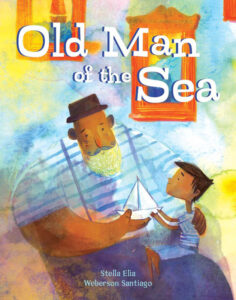
Lantana Publishing brings us a stunning picture book offering from the Brazilian duo Stella Elia and Weberson Santiago.
A tender storytelling moment unfolds between a grandson and his grandpa, who says that ‘every line on my skin tells the story of my life.’ Grandpa’s seafaring tales speak of amazing voyages around the globe, joyfully traversing different continents and collecting new stories as he goes. The stories, the seas and the characters encountered along the way sit somewhere between the boundary of real and magical and it never really matters to the reader either way – because stories are stories and the joy here is in the retelling.
Not in the business of colonising, Grandpa’s love of each place he visits is poured out in his lyrical ode to each continent. The only treasures he collects on his travels are the stories with which he fills his luggage as he packs up and moves on from each place. The artwork is wonderful – capturing the spirit of the adventures and the wide-eyed wonder of the young boy as he sits and listens to Grandpa.
This is a truly lovely picture book that enchants as much as it entertains – an ode to adventures real and imaginary and a gentle plea to encourage loved ones to bring to the surface life stories that long to be retold.
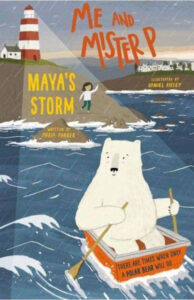
Maya’s Storm is the latest instalment of the ‘Mister P’ series of insightful stories about a polar bear who unexpectedly visits different families facing a range of different real-life situations, from living with physical disabilities to being young carers. Each brilliantly entertaining story works as a standalone and is well pitched for readers in lower KS2 or as a read-aloud to be shared together.
This story features Maya, who once lived in another country but now lives with her new family in a coastal village in England. She lives with Mum, Dad and an older brother and sister. Granny Anne lives in a cottage not far away and helps Maya to create a memory box when she was feeling sad about losing her family. She says that as you get older your memories sometimes disappear so it is important to keep them somewhere safe. Maya thinks Granny Anne is joking, but her Mum and Dad are worried about her as she keeps forgetting things.
One evening, Maya sees something strange out of her bedroom window in the sea. After following some clues, they find a polar bear whose luggage tag tells them that his name is Mister P. Now Maya and Granny Anne must work together to keep Mister P a secret from Mum and Dad, whilst still having many adventures along the way!
Although we are never told exactly what happened to Maya’s family, the book subtly alludes to the fact that she is a refugee and has lost her family. After just the first two pages, children may have many questions about Maya’s past: What happened to her family? Why did Maya have to leave her family? Will she see her family again? The story also sensitively deals with a family member having dementia. The more time that Maya spends with Granny Anne, the more she realises that Granny Anne does seem to be forgetting things. Will she tell Mum and Dad about Mister P and get Granny Anne the help she needs?
Charming illustrations coupled with the short chapters make Me and Mister P: Maya’s Storm accessible and appealing to independent readers experiencing their first chapter books.
Reviewed by: Kirsten Hopwood, Year 3 Teacher

Award-winning picture book creator Oliver Jeffers brings us a modern day ‘painted fable’ about one man’s greedy desire to possess everything. Readers familiar with Jeffers’ books will know to expect colourful, exquisite illustrations and poignant text and this book continues to be marked by the same distinctive style but has a much more minimalistic feel, with sparse text and expenses of white pages demanding of the reader moments to pause and think about the story’s important message.
The central character Fausto is greedy, tyrannical and self-important as he strolls through the landscape, surveying what he sees and declaring that it all belongs to him. “You are mine,” he tells the flower, a sheep, a tree and a lake. With little resistance his new subjects agree to be his, but Fausto finds the mountain less yielding. Fausto stamps his feet in rage and puts up a fight until the mountain bows down to him and agrees to be owned. Looking for something larger to conquer, Fausto turns to the vast blue sea, but his happy tyranny soon turns to ‘anger and importance’ as the sea is altogether more resistant. Resorting once more to foot-stamping, Fausto (unable to swim) is quickly swallowed up by the sea’s depths and the natural world returns to its original serenity. The narrative ends showing the natural elements at peace and by reminding the reader that ‘The Fate of Fausto did not matter to them.’
Minimal text and suggestive illustrations work together beautifully, allowing the reader to fill the gaps. With such an important message about human greed and the destructive nature of materialism, the book refuses to allow the reader to sit back without engaging with the point that sometimes, in the grand scheme of things, less is more.
Jeffers uses traditional lithographic printmaking techniques to create the illustrations, setting neon pinks and yellows against earthier shades of greens, browns and blues. Fausto’s body language brilliantly captures his pomposity and aggression, with toddler-like poses and scribbles of rage contrasting with the controlled, textured strokes of the landscape.
There’s something for young and old in this unusual and thought-provoking tale; humour, warmth and the hint of discomfort that arrives when we recognise aspects of our own attitudes in Fausto’s fable and hope for a better fate for ourselves.
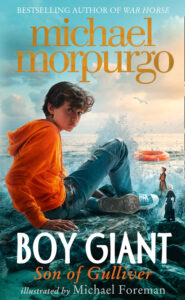
Award-winning storyteller Sir Michael Morpurgo brings his loyal readership a brand new novel this autumn, brought to life with line illustrations by Michael Foreman.
Boy Giant: Son of Gulliver is a heartwarming refugee story about hope and humanity in times of being without a place to call home. Omar is making the perilous journey across the sea to England after his home in Afghanistan has been devastated by war. After seeing his family torn apart, Omar and his mother walk for miles to reach the coastline in order to board a boat heading to a safer place to find refuge. Not having enough money to pay the fare for two, Mother persuades Omar to take the journey to England alone and wait for her there. Uncle Said owns a cafe on Fore Street, Mevagissey and Omar repeats the address over and over so that he doesn’t forget where to wait.
The sea journey is terrifyingly perilous and before long waves are crashing over the sides and Omar watches the boat fill with water as hope of being reunited with mother begins to fade. A powerful sea storm sees Omar losing consciousness and after a while he awakes on the shores of an island. Taking in the crowd of friendly and curious faces staring at him and hearing a few words that he recognises from his limited English, Omar dares to hope that he has reached England’s shores at last. There’s only one problem; the people here are small enough to fit in his hand and he is a mountainous giant by comparison. Omar soon realises much to his dismay that this is not England but the island of Lilliput, which keen-eyed readers may recognise from the story of Gulliver’s Travels set a few hundred years before. Now, the Lilliputians call Omar a ‘Son of Gulliver’ and welcome him with warmth and kindness. But Omar soon discovers that the island is under threat, and the peace-making legacy of Gulliver from the past needs his help to be restored.
This is a gripping story offering an original twist on a well-loved classic. The story of Gulliver is cleverly leaned upon in both structure and narrative and the revisiting of Lilliput is delightful to those familiar with the details and themes of Gulliver’s Travels. Importantly, it does not matter that the majority of young readers will be unfamiliar with the original, as Morpurgo explains all the necessary background through the story.
With important themes of reconciliation, kindness to strangers and the devastating effects of war, this is a thrilling read that raises questions about whether humanity will ever learn from its past as well as being an imaginatively-rendered encouragement to individuals to seek reconciliation over conflict in everyday situations.
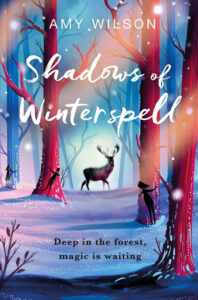
A coming-of-age adventure story rooted in fairy tale and magic. As usual, Amy Wilson’s world-building is second to none as she immerses the reader is a richly-imagined magical world that is at once convincing, delightful and darkly enticing.
Stella feels alone, living most of her life with her Nan in a cottage near the edge of a magical forest. The forest is filled with dangers and haunted by the dark shadows released by the King, who is in mourning after a family loss that occurred years before. Stella helps her Nan to guard the house boundary and stop the dark magic from expanding further. Armed with books, Stella has grown up learning charms, spells and the history of magic and has an imp called Peg for company, but feels a pull towards the unfamiliar worlds beyond the fence.
Tired of being isolated from the human world, Stella secretly signs up to go to school in a nearby town. While Nan disapproves of Stella keeping company with humans, Stella arrives at school and quickly realises that some of her new classmates are not quite what she expected. Before long, Stella finds herself caught up in a complex quest to save the forest from the King’s shadows and to uncover the secrets of her own past.
Wilson’s depiction of Stella as a young teen who struggles with isolation and identity will resonate with any readers who have known a longing to find their place in the world. Fairy tale imagery is peppered through the pages; grandmothers in forest cottages, shiny red apples, elves and fairies in underground homes, hidden-from-sight palaces and necklaces imbued with magic all seamlessly weave in and out of the book’s modern, relatable themes.
Suitable for upper KS2 and lower KS3, this is a refined piece of storytelling that encourages young readers to be brave and follow their own path.
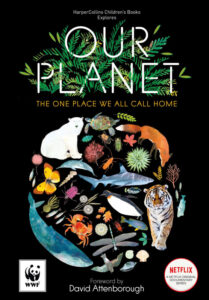

This stunning children’s non-fiction hardback is the accompaniment to the Netflix series Our Planet. This is the kind of book that readers young and old will love to pore over, from the powerful photographs of melting ice caps to the facts and figures about palm oil plantations and endangered sea life. There is so much to learn and think about.
The book has a foreword by Sir David Attenborough. What follows is a visual ode to Planet Earth told through extraordinary photography combined with appealing illustrations that draw in younger readers and help them to understand nature’s amazing interplay of habitats and ecosystems. Small sections of text further explain the images, giving snapshots of animals’ lifestyles as well as presenting hard-hitting facts about the dangers they face. We learn how orangutans have incredible mapping skills to navigate their jungle homes, but also how we lose 100 orangutans a week due to human actions like hunting and deforestation. We find out how beautiful lantern-fish light their way along with 17-metre long oarfish in the high seas, but also how plastic peril and high-seas fishing put the incredible marine life there in danger.
The tone of the book is one to inspire rather than to frighten readers into action. The book is not at all without hope for the future, and the nudge to make personal changes comes through simple tips like choosing products carefully and supporting sustainable fishing. Moreover, with photographs as stunning as these, it is hard for readers of all ages not to feel inspired to take steps to protect the natural world.
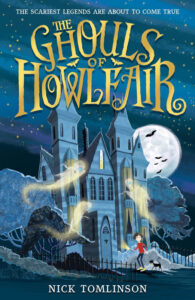
This debut children’s story from Nick Tomlinson certainly lived up to its claim of being “a brilliantly funny and spooky mystery adventure.” I was sucked into the story, hypnotised by the clever use of language and hooked by the well-planned plot which unfolded full of spectral splendour and ghostly gloriousness.
Tomlinson’s description entranced me from the very first page and I have shared numerous examples of clever personification and carefully crafted detail with my class (who are all now queuing up to borrow my review copy). Their gasps at the beauty of language and the illusion of reality created are testament to the skill of the author, and are plaudits that are truly well deserved.
The story follows the adventures of Molly; we find out about her unusual home-life, her eccentric hobby, her difficulties dealing with the loss of her father and her special friendship with Gabriel (their relationship being crucial to the resolution of the tale). The story really is the epitome of a page-turner, with twists and turns aplenty. I ate up all three hundred and thirty-three pages of this book in delicious chunks. The tasty development of the relationships between Molly, her friends and also her adversaries developed through the chapters enticingly, punctuated with piquant flashbacks, hints and red herrings, which kept me hungrily devouring the book until the exquisite resolution.
What I possibly liked most about this debut was the fact that the end – whilst seriously satisfying – feels open. I am hopeful of an equally juicy sequel. I’d be first in the queue to gobble up further ghoulish adventures in Howlfair, and Molly is a character I hope will live on.
Reviewed by: Julie Wells
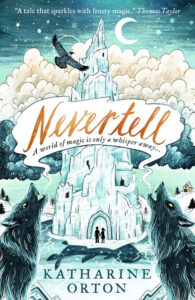
‘Sometimes it takes a little courage to discover magic.’
Lina, a brave and quick-witted eleven-year-old, has lived all her life in a brutal Russian prison camp, hidden away in the perilous, frozen wilderness. She becomes part of a daring escape plot and, along with her best friend, Bogdan, attempts to journey to freedom. However, this is not just a tale of survival against the elements – there have always been rumours of magic, shadow-wolves and evil lurking in the woodlands – but Lina begins a journey of self-discovery and finds she has abilities she never knew about. Lina’s story is also one about personal growth and her character reminded me of Lyra in Pullman’s His Dark Materials trilogy. Other characters’ stories slowly interconnect and are well fleshed out and developed.
I enjoyed this quick-moving story immensely. Lina is instantly likable and easy to empathise with. The initial setting of a Russian labour camp is a unique element which hooked me in further. The magical elements of the story are slowly introduced as the narrative progresses – characters scoff at magic to begin with but all (including some of Lina’s bulking, ruthless fellow escapees) are instantly terrified when they first encounter supernatural elements.
Katharine Orton’s writing is clear and captivating. Nevertell is a magical, snowy adventure, best appreciated snuggled-up on the sofa on a wet and windy afternoon.
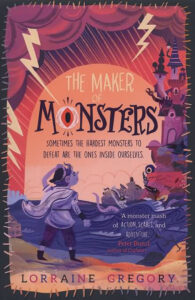
A wild, romping adventure with nods to Frankenstein, The Maker of Monsters is a joyfully imaginative children’s story with very human themes of friendship and acceptance at its heart.
Young Brat lives as a servant in Lord Macawber’s castle. Having been on the castle’s remote island ever since he was washed ashore as an orphaned baby, Brat is quite used to his master’s strange experiments. Without human friends around, Brat’s only company is Lord Macawber’s army of ‘creations’; stitched-together creatures brought to life through the act of necromancy. Most of the monsters are terrifyingly dangerous and locked in cages on the various floors of the castle, but Brat forms loyal friendships with a couple of the more placid mini monsters.
When Lord Macawber brings to life his most fearsome monster ever and intends to send his army on a vengeful attack of a nearby city, it falls to Brat to find a way to warn and save the inhabitants. What follows is a fast-paced adventure as Brat races against the clock (and against a whole heap of other obstacles, including prejudice, imprisonment and a city that creates outcasts at every opportunity) to stop the monsters wreaking havoc.
I enjoyed the mix of magic and mayhem, the harmless humour and the breadth of imagination poured into the characters and setting. But the real heart of the story is Brat’s own journey to face the metaphorical monsters within himself. Never having been met with true acceptance or kindness before, Brat’s story demonstrates the transformative power of positive human connection for both individuals and wider society.
A fun, gothic adventure filled with thrills and imagination, The Maker of Monsters will surely be a winner for readers in Years 3-6.
review
Year group(s) the book is most suitable for:
Year group(s) the book is most suitable for:
Does the book contain anything that teachers would wish to know about before recommending in class (strong language, sensitive topics etc.)?
Does the book contain anything that teachers would wish to know about before recommending in class (strong language, sensitive topics etc.)?
Would you recommend the book for use in primary schools?
yes
Curriculum links (if relevant)
Curriculum links (if relevant)
Any other comments
Any other comments