Recommended children's booklists sorted by age or topic

Topic: Reading for Pleasure

Nominated for “Favourite Books of 2020” by: Jacqui Sydney (Year 5 teacher and English lead)

Jacqui says, “I love both of the Eerie-on-Sea books and my class does too. I’ve never known books to engage children like they do – even my more reluctant readers. Packed with action and brilliantly drawn characters, they are must haves in upper KS2 – well-written with great description and powerful vocabulary that are a joy to share.”

Paris Cat is a fun and exuberant picture book that provides a glimpse of the arts and music scene in Paris in the 1930s.

Cat doesn’t want to spend all of her life fighting over fish heads from the local poissonnerie with the rest of her large extended family. She wants to get out and see more of the world, so she leaves the narrow, smelly alleyway in which she’s been living and goes to explore the rest of Paris. On her journey, she meets the legendary figures of Edith Piaf and Josephine Baker and discovers a world of glitz, glamour and music and dance. But will her new found fame bring happiness or is there another option for Cat?

This is a warm, delightful story about seeking out new experiences and following your interests and passions. Dianne Hofmeyr’s writing features a sense of musicality and rhythm- ‘the scrimp scrimp of scissors and the whirr whirr of sewing machines’- that suits the theme of music and performance in the storyline. Similarly, Piet Grobler’s lively illustrations brilliantly evoke the movement and energy of this historical period. The endpapers feature a map of Cat’s journey around Paris, pointing out the important settings in the story plus major landmarks in the city (and the many poissonneries). This means that it’s a great text for teachers focusing on general map reading skills or a more focused unit on Paris or France. The map is written in French which also allows teachers to link to language work in MFL – perhaps designing maps for their own fictional city and labelling in French.

During Cat’s journey she visits Madame Delphine’s atelier where a range of glamorous outfits are being made. This would be a wonderful opportunity to explore fashion design and manufacture during this period and potentially to produce some simple sewing projects. Paris Cat is a warm, enjoyable story with plenty of exuberance to enjoy and lots of possibility for cross-curricular links in the classroom.

Reviewer: Jenny Holder

Sky Pirates is the first middle-grade title from Alex English – and what a story it is to launch her into the children’s book limelight!

The first in the Sky Pirates series, this story introduces us to Echo Quickthorn, who lives in the kingdom of Lockfort. Echo is an orphan, but lives inside the castle after being taken in by the King. Echo yearns for adventure and to find out about her real family. There is one major problem: the people of Lockfort know that nothing exists outside of the Kingdom’s wall apart from barren wasteland, an idea that the King supports entirely, and no-one would ever question the thinking of the King. One evening, a mysterious airship carrying Professor Daggerwing lands within the castle grounds, just outside Echo’s window. The Professor talks of his home and adventures from distant lands, which begins Echo’s journey into the unknown wasteland, all in pursuit of the truth about the world outside of Lockfort and her family. However, Echo’s journey may not be as straight forward as she expects, with rumours of formidable Sky Pirates and their tyrant leader nearby…

This was such an enjoyable, well-paced book and I found the story idea to be really refreshing. Echo, as the main character, is likeable and relatable: her confidence and self-belief grow as the story progresses, even when she faces tricky challenges or tough decisions to make. There are plenty of memorable secondary characters too, but one that really stands out is Gilbert, who is Echo’s best friend. Gilbert is a lizard who he acts as Echo’s moral compass and I really liked how Alex English brought him to life through his expressions and quirky actions. Gilbert is bound to be as huge-a-hit as Echo and a favourite character for many readers.

This book is highly recommendable for upper Key Stage Two and I cannot wait to read the next instalment of Echo’s adventures!

Reviewer: Hayley Warner

Chapter bookDyslexia-friendly
dyslexia-friendly

If you are already a Tom Palmer fan, you will know to expect from After the War – a touching, concisely told yet never dumbed-down, story of childhood during wartime. If you are new to his books, then prepare to be astounded. Tom Palmer has a rare talent for making the truth of the past accessible to children without watering down the horrific facts or emotional impact, a skill already demonstrated in his previous books, Armistice Runner, D-Day Dog and Over the Line, but in its best evidence yet here.

After the War opens with a foreword explaining the factual basis to this story of the ‘Windermere boys’, 300 refugee children who were temporarily relocated to Cumbria at the end of WWII after being rescued from concentration camps. This is hugely helpful in settling the reader into what to expect of the story ahead and flagging up the timely theme of treatment of refugees.

The story begins in the summer of 1945, as a plane descends into the Yorkshire hills, carrying Jewish child survivors of the Holocaust. Yossi, 15, is traumatized, anxious, untrusting, always alert to danger. Through flashbacks, we gradually learn Yossi’s story, from the day war suddenly arrived in his sleepy Polish village in the form of a German bomber, through being interned in a Jewish ghetto and being forced to work in a clothing factory to his eventual destination, the concentration camps of Auschwitz and Theresienstadt. Balancing between the flashbacks to the horrors of the past and the hope of the future is the present, where the boys gradually settle into Yorkshire life, a place where they learn food is not scarce, uniformed men can have kind eyes, and boys can ride bicycles again.

With Tom’s trademark very short and super-readable chapters, the direct text lets the story shine through straight and true, without ever being overly simplistic in either intent or vocabulary. After the War would make a fantastic class reader for Year 5/6, although I doubt any teacher could make it through without a wobble in their voice at least once a chapter. I spent the majority of the book with a lump in my throat, either at the things that children had been through or at the small touches of kindness shown to them by the local community, which gradually help them to open up to the world again.

The WWII genre is a crowded market, but After the War elbows its way to the front as a stunning reflection on the impact of war, perfectly pitched for a UKS2 audience.

Nominated for “Favourite Books of 2020” by: Richard Simpson (Year 6 Teacher)

Richard says, “Brilliantly written book about an oft-forgotten and not addressed aspect of the war…what happened to those who survived. Powerfully but sensitively dealt with, with moments that will stay with you long after reading it.”

A real treat for booklovers and not-yet-book-lovers alike, all about the irresistible magic of the world of books!

This book is a wonderful addition to the classroom library. There is a lot of repetition of language to support readers in being gently led through the story and the symmetry of the beginning and the ending is lovely. The charming illustrations bring the story to life and the book itself needs to be rotated while being read, which keeps it engaging and furthers the sense of adventuring inside the book.

This picture book about the charms of reading will turn normal days into book days all year round.

Flick adores her older brother Jack. She loves his sense of fun, his passion for puzzles and riddles and the feeling that she gets from the special sibling bond they share. There’s been an empty space in Flick’s heart ever since Jack headed off to Peru on a gap year trip, but at least Flick knows that Jack is immersed in exciting adventures. When the shock news arrives of an earthquake in Peru, nobody is able to contact Jack and Flick’s world falls apart. Through a blur of panic and confusion, Flick pieces together fragments of a puzzle to try to find Jack – centred around a special key that Jack left behind with the initials S.F. written on it.

As the family anxiously waits for news of Jack, Flick sets the wheels in motion for her own investigation, desperately trying to track down the mysterious S.F.. Along the way, she discovers a host of other friends and family members who are meaningful in Jack’s world, each with their own tale to tell of how kind and special her brother is to them.

True to style, Ewa Jozefkowicz weaves a multi-layered narrative of self-discovery that explores the riches of family bonds and the value of listening to the stories of other people. There’s a mystery to solve, a story-within-a-story and plenty of intrigue, and I particularly enjoyed how beautifully the sibling relationship was portrayed. This is a heartwarming third novel from Ewa Jozefkowicz that will resonate with middle-grade readers who enjoy delving into stories with a real-life feel or are looking for a bit of a mystery to get stuck into.

Non-fictionPicturebook

You’ll want to take a while to hang out with this new non-fiction text, especially if you’re batty about facts!

The Bat Book by Charlotte Milner follows in the footsteps of The Bee Book and The Sea Book to highlight to children important ecological issues faced by our planet, this time focusing on the world’s only flying mammals and their importance to our global ecosystem. With the aim of exploring the topsy-turvy world of often unnoticed ‘tiny superheroes’, this book identifies important biological features of bats (such as how similar their wing skeletons are to human hands) and how amazingly well adapted the 1300 different species are to surviving in habitats all over the world. The book then turns its attention to how bats are important to humans, common myths about bats, the challenges that particular species face and actions to help endangered bats.

Bats are often villainised in children’s stories (my four-year-old’s first question when opening this book was ‘do they eat people?’), but this book helps to address misconceptions and emphasises what fascinating, varied and important creatures bats are. Bats assist with pest control, spread seeds through the forests, and help to pollinate hundreds of different species of plants around the world.

The Bat Book is an appealing book for curious readers to pick up and can be enjoyed as a cover-to-cover read or as something to dip in and out of, with a clear contents page, subject headings and an index to aid navigation. The images, diagrams and overall design style make it accessible to younger readers but the facts have enough depth to engage and challenge older readers too, making The Bat Book a worthwhile choice for primary school libraries.

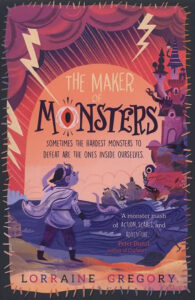
A beautifully atmospheric tale about a family of monsters who take in a human brother and sister. An examination of what really makes a monster. The characters have stayed with me since reading and I want to know what they are doing now.

Mirabelle is part of ‘the family’ living in the House of Rookhaven – but they are no ordinary family. Led by Uncle Enoch, the members of the family are not what they first appear: Mirabelle doesn’t age; Odd can come and go through portals as he pleases; Dotty and Daisy are twins who can walk through walls. The house is separated from the outside world by the Glamour and only Dr. Ellenby and Mr Fletcher (humans from the local village) can pass through by using a special key. That is, until siblings Jem and Tom accidentally find their way through a hole in the Glamour. Mirabelle finds them among some bone-eating plants and takes them up to the house, much to the resistance of the rest of the family. However, Tom is very ill, and the family have no choice but to let him recover at the house. The hole in the Glamour has also let through something much more threatening to the family than humans…

The Monsters of Rookhaven shows that people are not necessarily what they first appear to be, and that people’s actions often have good intentions behind them, even if the outcome is not what they had hoped. It’s a gripping story that explores the theme of difference and evokes empathy through the eyes of a delightfully imaginative cast of characters. With magic, monsters, friendship and hope, this is a wonderful middle-grade read. Páidraig has created a truly extraordinary story filled with a rich darkness and not in the way you would expect. Thematically it feels relevant to the world we live in today in how easily vulnerable members of society can become the target for others’ fears and frustrations with their lives. Hauntingly beautiful, I just can’t stop thinking about it.

With The Pear Affair comes a detective story set in the sixties, complete with a search for a missing person, hidden tunnels, and a plot to ruin lives for the gain of a few.

The gripping pace of this story makes this a hard story to put down and the many threads and questions form a very satisfying ending that the reader is not expecting. All of this is set against the beautiful backdrop of Paris, complete with its beautiful hotels, shops and landmarks, its smells and colours, and its exciting hidden depths. A very satisfying read.


A wonderfully heartfelt story filled with nuance, empathy and hope from award-winning author Onjali Rauf. This story highlights the topic of homelessness and explores the spectrum of attitudes that people hold towards homeless people, as well as exposing a number of common prejudices.

Hector is a troubled young boy – labelled as a bully and a menace, he is stuck in an endless cycle of rule breaking and serving detentions under teachers who tell him how troublesome he is. Hector’s parents have little time to pay him attention after school – in fact the only attention that really feeds him is the incitement of his two friends, who cheer him on as he makes school life miserable for others.

Looking for a new way to impress his friends, Hector sets his sights on a homeless man who is often found sitting on a bench in the nearby park. Spotting an easy win, Hector hijacks the man’s trolley of possessions and aims to hide it in the trees. Something goes awry, and when the trolley ends up at the bottom of a lake the repercussions of his actions hit Hector in surprising ways that threaten to bring him into greater trouble than ever. Annoyed, Hector waits until opportunity arises and ramps up his plan to get revenge on the homeless man.

In the mean time, an intriguing spate of robberies in central London have brought the homeless community into public scrutiny. As a number of threads weave together, Hector finds himself wrapped up in a crime-busting mystery as well as unwittingly embarking upon a journey of personal change that enables him to better see the world through the eyes of others. Each character he meets helps him to see the value in real human connection beyond labels. There’s Thomas, the homeless man with a heartbreaking background story; the Catwoman, who demonstrated to Hector the value of community connection and collaboration; and Mei-Li, Hector’s classmate who shows him what it means to treat others with a grace and respect that breaks barriers and brings about the treasure of moving beyond surface appearances. Before he knows it, Hector finds himself the hero of his own story for the first time ever – both for the exciting and dangerous part he plays in busting a high profile criminal pursuit but also for his own personal journey of compassion and learning to reach out to others.

Onjali Rauf’s beautifully relatable storytelling is perfect for highlighting social issues in a way that fully engages young readers. The community of homeless people is portrayed vividly and intriguingly – from the sounds and smells of the soup kitchen to the night bus route to the system of painted symbols, their world is painted with dignity and compassion. As with her previous novels, Onjali Rauf addresses important ‘real-world’ topics with open-heartedness and the sense of triumph in knowing that big changes can start with small people.

Subscribe to our newsletter

Your Review

Stone Girl Bone Girl

review

Year group(s) the book is most suitable for:

Year group(s) the book is most suitable for:

Does the book contain anything that teachers would wish to know about before recommending in class (strong language, sensitive topics etc.)?

Does the book contain anything that teachers would wish to know about before recommending in class (strong language, sensitive topics etc.)?

Would you recommend the book for use in primary schools?

yes

Curriculum links (if relevant)

Curriculum links (if relevant)

Any other comments

Any other comments