Recommended children's booklists sorted by age or topic

Format: Poetry

Inspiring poems to connect with nature.
This collection of 50 poems will spark a love of nature, bring calm and happiness and let the outside in.

Beautifully illustrated, it is filled with poems for children to read alone or enjoy with the whole family.

With poems about the seasons, senses, wildlife, weather and the joys of mud, it’s the perfect gift book for children to treasure.

From poet, Daniel Thompson, author of Being You: Poems of Positivity – 2023 City Kids Green Awards Winner and selected for the Reading Agency’s 2023 Summer reading challenge.

Product De

Popular children’s poet Joshua Seigal brings a brilliant new book of entertaining poems, offering a great selection of poems to make you laugh, make you think or just let you enjoy for the sheer delight of it.

Using challenging vocabulary and a range of poetry styles, these short poems are perfect for children who like a giggle without having to look too hard to find one. Seigal writes about a range of relatable topics from school to friendships, about pets and even their fleas. The collection will fly off the classroom bookshelf in KS2 and is perfect for dipping in and out of during independent reading time or for teachers to read aloud to a class during spare moments of the day.

With such a range of fun poems, there are lots of opportunities to look at different forms of poetry, playing with words and experimenting with rhyme.

Sometimes it only takes a stranger in a dark place… to say we have the right to be here, to make us warm in the coldest season. In 2019, Neil Gaiman asked his Twitter followers: What reminds you of warmth? Over 1,000 responses later, Neil began to weave replies from across the world into a poem in aid of the UNHCR’s winter appeal. It revealed our shared desire to feel safe, welcome and warm in a world that can often feel frightening and lonely.

Sales of every copy of this book will help support the work of UNHCR, the UN Refugee Agency, which helps forcibly displaced communities and stateless people across the world.

Now publishing in hardback and illustrated by a group of artists from around the world, What You Need to Be Warm is an exploration of displacement and flight from conflict through the objects and memories that represent warmth. It is about our right to feel safe, whoever we are and wherever we are from. It is about holding out a hand to welcome those who find themselves far from home. Featuring new, original illustrations from Chris Riddell, Benji Davies, Yuliya Gwilym, Nadine Kaadan, Daniel Egnéus, Pam Smy, Petr Horácek, Beth Suzanna, Bagram Ibatoulline, Marie-Alice Harel, Majid Adin and Richard Jones, with a thought-provoking cover from Oliver Jeffers.

A two-colour graphic novel about speaking-up and standing out when you feel different. Perfect for fans of Raina Telgemeier

How do you find your voice when everyone around you is telling you to be quiet?

Frankie is different, and so is her best-friend, Sam. So when they both start secondary school, it’s tough. Particularly when there are so many rules to follow, like: No talking in class! Be quiet in the hallways! Silence for assembly!

Frankie doesn’t know how she’ll manage, because constantly talking is how she copes. So when she gets the chance to compete in a Battle of the Bands contest, Frankie couldn’t be more excited. Except, to have a band, you need to have band members. And to have band members, you need to be good at making friends…

Can Frankie learn to find her voice and stand out?

A unique perspective on Autism, told with humour and heart.

Brought to life with glorious colour artwork in a distinctive blue and orange palette.

Perfect for fans of Raina Telgemeier.

You should not judge a book by its cover, however in this case, the vibrant colours and hilarious picture of the alpaca with an ice cream on top of his head and his wings is a perfect picture to grab an early reader’s attention whilst also having a high quality text to enjoy.

When reading aloud, it gave lots of giggles and on every page were fun illustrations and pictures which helped with understanding the story and in bringing it to life for the reader. It was fun reading the book aloud as each line rhymes throughout and as soon as I finished this book, the request was to read it immediately again!

It has a strong message about accepting oneself and celebrating who you are. It would be an excellent addition to a KS1 reading corner and also to be enjoyed being read aloud from Early Years; it is the perfect book to read aloud or for readers who are beginning to read early chapter books.

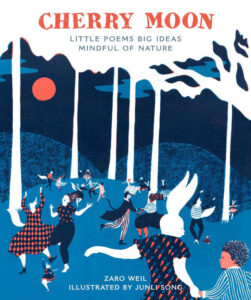
A beautiful collection of poems about mindfulness from a diverse range of poets, suitable for all age groups. There are a few poems included that were familiar to me, but most were new to me and I enjoyed discovering them. I loved the illustrations bringing the poems to life and I thought these could also inspire follow-up work in the classroom.

This would be a great book to use for a whole-school focus on poetry as each year group could use a different poem. The poems could be used during PSHE lessons, during mental health week, or as inspiration for children’s own poems in KS2.

The biographies of all the poets and illustrators at the back of the book were a lovely touch and would encourage children to learn more about them.

Red Sky at Night, Poet’s Delight is the third poetry collection from Alex Wharton, who is Children’s Laureate Wales. Within the collection are many poems covering a range of themes from sports, weather and objects to animals and oak trees. There is a poem for everyone within this book.

The poems in the book showcase a good selection of what poetry looks and sounds like in different forms. They range widely in length (there are examples of one-verse and multiple-verse poems) and theme. There are some laugh-out-loud poems as well as poems that encourage any reader to celebrate their individuality and uniqueness. There are poems within this collection that could internalised and performed out loud and others that could be used to encourage a reader to create their poem in a similar style. Furthermore, the presentation is playfully brought alive by the illustrations for Ian Morris.

There is one poem – ‘Young Oak’ – which tells the poetic story of an oak tree near Wharton’s home, and of the nature and events it witnesses through the years and seasons. This is quite unlike any poem I have read before, both in terms of content and length, and would be a lovely choice for a discussion or poetry study in any Key Stage Two classroom.

Overall this was an enjoyable collection of poems that will no doubt inspire any reader to create their own.

This beautiful verse novel follows a girl in the transition period from primary to secondary school. The individual poems that make up the story play wonderfully with shape, rhythm and language and deliver a range of styles mirroring the complex emotional themes.

The book includes topics of domestic violence, bullying and homelessness discussed from a child’s perspective. These are handled sensitively, and there is an overall sense of positivity and optimism.

It’s a powerful, empathetic book, particularly suited to year 6.

This book showcases a James Carter poem about inventions. The rhyming text takes the reader through the range of inventions we now have in our modern world. It is the colourful and vibrant illustrations that jump out at the reader in this book. They complement the rhyming text which focuses on the range and types of inventions from the start of time.

The end pages of this book should not be ignored and could provide an interesting discussion point for predictions about what this book will be about and for trying to make connections between the different items shown.  The font size and text layout guide the reader as it moves in and around the colourful illustrations. Teachers who are focusing on the topic of materials will find lots to explore in the text, particularly thinking about which everyday objects and items are made from – children may not be aware that glass is made from sand for example.

The end of the book has a nod towards the need for recycling the many things we create, and this may be a useful jumping-off point to talk about sustainability. The book also encourages children to be inventive and to create something new out of something old.

In this captivating collection of poetry, celebrated poets Ted Kooser and Connie Wanek, along with illustrator Richard Jones, explore the wonders of nature in a spirited and magical way – and invite our imaginations out to play.
This stunning gift-book contains thirty exquisite poems by celebrated US poets Ted Kooser and Connie Wanek, beautifully illustrated by artist Richard Jones. A freewheeling romp through the world of imagery and metaphor, this quietly startling collection is framed by the four elements and divided into thoughtfully-curated sections, exploring art and reality, fact and fancy. Look around: what do you see? A clown balancing a pie in a tree, or an empty nest perched on a leafless branch? This charming compendium of the fleeting and unexpected turns the everyday – towering trees and tiny tadpoles; roaring fires, lazy afternoons, and pillowy white marshmallows – into poetic gold. A brilliant and timeless collaboration that evokes both the mystery and grandeur of the natural world and the cosy, mundane moments of daily life, this wonderfully illustrated collection is the go-to gift book of the season for poetry fans of all ages.

Subscribe to our newsletter

Your Review

Stone Girl Bone Girl

review

Year group(s) the book is most suitable for:

Year group(s) the book is most suitable for:

Does the book contain anything that teachers would wish to know about before recommending in class (strong language, sensitive topics etc.)?

Does the book contain anything that teachers would wish to know about before recommending in class (strong language, sensitive topics etc.)?

Would you recommend the book for use in primary schools?

yes

Curriculum links (if relevant)

Curriculum links (if relevant)

Any other comments

Any other comments