Recommended children's booklists sorted by age or topic

Home > Blog

Resource Available: No resources

Reading for pleasure awards

Entries open for the HarperCollins Reading for Pleasure Awards 2026

Enter the 2026 Reading for Pleasure Awards
HarperCollins UK is pleased to announce that entries for The Reading for Pleasure Awards 2026, now in their 9th year, are open. The awards are run in association with The Open University and UK Literacy Association (UKLA).

2026 marks the National Year of Reading, a UK-wide campaign to inspire more people to ‘Go All In’ and make reading a regular part of their lives. HarperCollins is proud to support this year-long campaign with a range of promotional activity, including The Reading for Pleasure Awards. 

Farshore’s consumer insight research has shown that children’s enjoyment in reading is at an all-time low, so it’s more important than ever to highlight, recognise and celebrate those teachers and schools to share best practise both within and beyond the school setting.

At BooksForTopics, we wholeheartedly support this aim and we know that many members of our community are demonstrating excellent practice in boosting Reading for Pleasure in schools.

These awards recognise and celebrate those teachers, schools and educators that successfully promote and encourage children’s reading for pleasure, both within and beyond the school setting.

Reading for Pleasure Awards Categories 

The categories in the awards are as follows:

  • Early Career Teacher (0-3 years in teaching)
  • Experienced Teacher (3 years plus)
  • Whole School
  • School Reading Champion (  e.g., Librarians/other educators) 
  • Community Reading (immediate and/or wider community, from local area to local authority)
  • The HarperCollins Author’s Choice Award is chosen by the guest judge as their personal favourite and will win a virtual visit from that author

Reading for Pleasure Awards Judges 
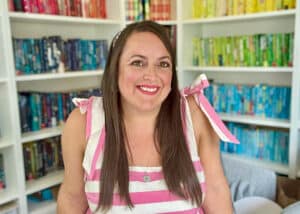
This year, bestselling author and Authorfy founder Mel Taylor-Bessent will be joining the judging panel. Mel Taylor-Bessent is the author of The Christmas Carrolls and the Race to Imagination Island series. She founded Authorfy, an online platform connecting children worldwide with their favourite authors through videos and literacy resources used in schools everywhere. She has been featured in the Blue Peter Book Club, shortlisted for the Ruth Rendell Award for championing literacy in the UK, and been an author ambassador for both the Schoolreaders charity and the Reading Agency’s Teachers’ Reading Challenge. Mel said:

‘I’m constantly blown away by the commitment, creativity and care teachers put into their reading for pleasure initiatives. We all know the magic of storytelling and the power of the perfect book recommendation, so I’m thrilled to be a judge for the Reading for Pleasure Teacher Awards, where teachers and librarians have gone above and beyond to inspire their pupils in ways that are imaginative and hugely impactful.’ 

Alongside Mel Taylor-Bessent, the judges for this year’s awards will be Joy Court, co-founder of All Around Reading, Teresa Cremin, Professor of Education at The Open University, Alison David, Consumer Insight Director at Farshore, Martin Galway, Head of School Programmes at National Literacy Trust, Lee Newman, Executive Publisher at Collins, Cally Poplak, Managing Director of HarperCollins Children’s Books and Farshore, and David Reedy, reading expert and former President of the UK Literacy Association.

How to Enter

The deadline for entries is midnight, Sunday 14th June, using forms found via this link: https://collins.co.uk/blogs/the-book-squad-blog/reading-for-pleasure-awards-how-to-enter

The winners will be announced on Saturday 17th October at the Open University Conference in Milton Keynes.

More information about the awards and all the details on how to enter can be found here: https://collins.co.uk/pages/reading-for-pleasure-awards or https://ourfp.org/share-your-practice/

Winners receive £250 worth of books of their choice, selected from HarperCollins Children’s Books, Farshore, Barrington Stoke and Collins and twenty copies of Help Your Child Love Reading by Alison David.

———————
BooksForTopicsWhere next?


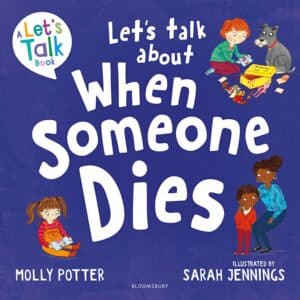
Part of the Molly Potter ‘Let’s Talk’ series, this useful book takes a matter-of-fact approach to bereavement, using language appropriate for the primary age group. It is an important addition to the many children’s books on this topic that are metaphor-based; this text provides an honest, factual and straight-to-the-point guide to approaching the death of a loved one. It answers practical questions such as ‘What might you feel when someone dies?’ and ‘What happens at a funeral?’ in age appropriate ways without being patronising.

The book recognises that there are different views on what happens after death without offering an opinion. It is a brilliant tool for adults to read together with children facing the prospect of recent or future bereavement. The book also provides a framework for adults to know how to broach the subject, with extra guidance for parents and caregivers in the back.

With a lovely section at the end on ways to remember the person who died, this is a vital resource for every school’s toolkit.

Stephen Davies booksfortopics blog

Guest Blog: Stephen Davies

Author of Myths, Mummies and Magic in Ancient Egypt

Children’s author Stephen Davies celebrates the rise of the ‘comic strip myth’

Magic Myths

During a recent school visit, I was shown around the library by an enthusiastic and knowledgeable librarian.

“And this is our graphic novel section,” she said, gesturing to an almost entirely empty bookcase.

There was no need to ask where all the books had gone. They had been checked out, and were being voraciously devoured by readers of all ages.

The increasing popularity of comic books and graphic novels is well documented, as is their increasing respectability. Thanks to the National Literacy Trust (and to dedicated practitioners like Lucy Starbuck Braidley and Lucas Maxwell) we can assert with confidence that comics are good for the brain. Bring them into school libraries by the bushel, and into the classroom, too.

Comic Strip History

My specific interest is the use of comics in the history classroom. As a children’s author, I love finding ancient myths and imagining how to retell them in comic strip form.

Sometimes, adaptation is easy. Take Horus and Set from Ancient Egypt, for example, who vied for the throne of Egypt in a series of Taskmaster-like challenges.

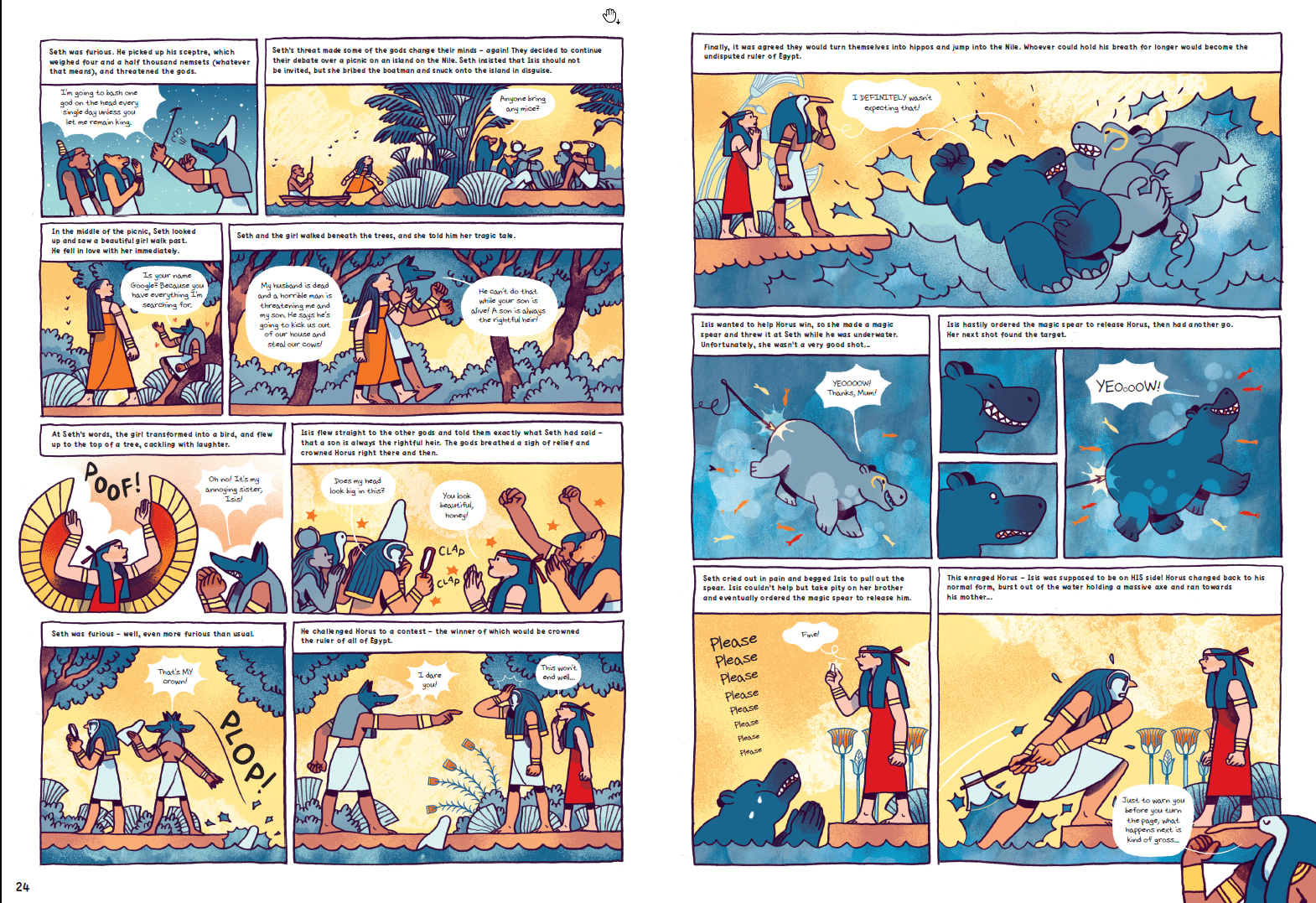
The first challenge was this: Horus and Set would transform themselves into hippos, jump into the Nile and hold a breath-holding contest. Whoever could hold his breath for longer would become the undisputed ruler of Egypt.

Firstly, what a great scene – surreal, imitable (at least the breath-holding bit) and inherently funny, especially when Horus’s mum tries to sabotage the contest by throwing a magic spear at Set’s hippopotamus-bum.

Secondly, why would you tell that story as anything other than a comic strip? It’s as absurd as Dog Man. It’s as anarchic as Bunny vs Monkey. Even in Plutarch’s retelling, it has plenty of fast-cut, dynamic story beats. It’s simply begging to be a comic strip.

Laugh or Learn?

If we use comic strip myths in the history classroom, one pressing question arises. Do we want children to laugh or do we want them to learn?

My approach in the Comic Strip Myths series is to tell each story fairly plainly in the narration boxes at the top of each panel, and to confine the jokes to the pictures and speech bubbles.

That way, the twenty-first century lols will complement the historical content, rather than undermining it.

Sourcing the Stories

Take a motorised felucca upstream from Aswan and you will see the rocky island of Sehel rising out of the river. Moor your boat, pick your way between colossal granite boulders, and you’ll find a rock face carved with a pharaoh worshipping three Egyptian gods. Beneath the image run thirty-two neat columns of hieroglyphs, telling the story of King Djoser and his brilliant advisor Imhotep.

I say advisor, but Imhotep was also a priest and a magician. The story (carved 2,300 years ago and retold in Myths, Mummies and Magic) features a secret library, a dangerous river journey and a magical showdown between Imhotep and an Assyrian sorceress.

I think this is what excites me most about comic book mythology – sourcing some of the oldest, wackiest stories in the world and bringing them into twenty-first century classrooms.


Stephen Davies is the author of three books in the Comic Book Myths series:

Myths, Mummies and Magic in Ancient Egypt (illustrated by Núria Tamarit)

Norse Myths, Monsters and Viking Voyages (illustrated by Seaerra Miller)

Myths, Gods and Gladiators in Ancient Rome (illustrated by Laurie Avon)


Win a copy of Myths, Mummies and Magic in Ancient Egypt!

In partnership with our friends at Big Picture Press, we’ve got three copies to give away.

To enter, fill in the form by 11.59pm on Tuesday 26th May 2026. The giveaway is open to UK entrants only, and full T&Cs can be found here.


Thank you to Stephen for visiting the BooksForTopics blog this week to discuss the place of comic strip myths in the classroom.

Stephen Davies is an award-winning children’s author known for bringing historical settings to life. His ‘Comic Strip Myths’ series combines meticulous research with primary-appealing storytelling to engage readers.

You can purchase Myths, Mummies and Magic in Ancient Egypt from Amazon or Bookshop or read our panel’s review here.

Readers may also be interested in the following booklists:

best children's books about egypt

Browse our curriculum topic booklists for more inspiration.


booksfortopics website

Where next?
> Visit our Reading for Pleasure Hub
> Browse our Topic Booklists
> View our printable year group booklists.
> See our Books of the Month.
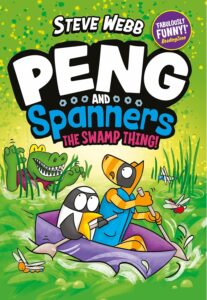
This graphic novel is part of the Peng and Spanners series, which always goes down a treat!

In this volume, the quirky pair of pizza-loving friends set about to solve the mystery of a swamp monster. Like true detectives, they follow the trail, spot clues, interview suspects and generally find themselves in the midst of much hilarity.

Its comic strip style is super appealing and colourful and the story is crammed with jokes and high jinks. This book will fly off the graphic novel shelf and is perfect for fans of the InvestiGators and Sparks in KS1 and KS2.

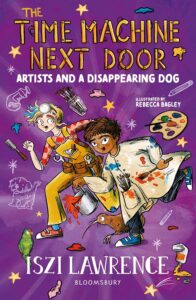
We love this series about time travel and each volume is just right in length and format for 7-9 year olds.

In this latest adventure, Alex and Sunil hop into the machine and blip through different eras associated with art.

The story is a brilliant hook for art history, letting readers meet famous artists up close as Sunil works on his own project. The history facts are woven directly into the pages and this is a fun way to pick up new information as the story unfolds. With the greedy Mr Shaykes constantly trying to loot historical treasures, it’s an entertaining and only mildly perilous adventure that’s sure to be a hit in Lower Key Stage 2.

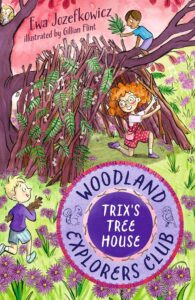
We love this nature themed, short chapter book series, which includes Benji’s Emerald King. This instalment is a fantastic pick for exploring STEM topics like ecology and den-building. When Trix notices that the bees and flowers are disappearing in the nearby woods, she and the explorers team up to restore the habitat.

Presented like a field journal, the story is packed with bug facts, illustrations and wildlife project ideas. The focus on teamwork, exploring and nature make this a superb read for outdoorsy children in Years 3 and 4.

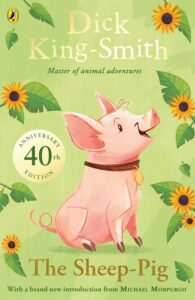
The Sheep-Pig is an animal classic by Dick King-Smith, also known through the film version ‘Babe’. The story is about a piglet who is determined to prove his worth on the farm by showing he can herd sheep just as well as any sheepdog. Under the wing of Fly the seasoned sheepdog, Babe develops his own unique style, choosing respect and manners over forceful snapping to get the sheep to comply. Readers can’t help but root for Babe.

It’s a farming story, so readers should be aware that the text uses the traditional term for a female dog and some discussion of the correct context for the use of this word might be helpful. It’s a much loved story that shows how persistence can help you reach a seemingly impossible goal and leading doesn’t always have to be aggressive.

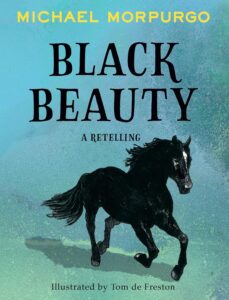
Michael Morpurgo is well loved for his modern animal stories, making him the perfect author to introduce Anna Sewell’s classic horse book to a new generation of readers.

This beautiful new hardback version, with artwork by Tom de Freston, brings a deeply empathetic voice to Black Beauty. The retelling captures the galloping drama of the original, from the stable fire to the backdrop of the Crimean War, while bridling a narrative that will keep modern primary readers hooked all the way by shifting the emphasis onto animal welfare.

A moving retelling of a true children’s classic that is perfect for the Upper KS2 book corner.

This is the junior, and easy to hold, version of Insectarium: A Museum in a Book, a brilliant non-fiction resource that brings the world of insects into the classroom in a way that’s both educational and visually captivating.

With stunning, detailed illustrations that show insects up close, this book offers a unique opportunity to explore these tiny creatures as if visiting a museum, without ever leaving the room.

The book is divided into galleries, each dedicated to a different group of insects, providing children with key facts and fascinating details about their habitats, behaviours and anatomy. For KS2 science lessons, Insectarium is a fantastic tool for introducing the diversity of the insect world with clear, engaging content that’s rich in information.

An incredible debut that beautifully explores the complexity of relationships. Heartwarming, tender, authentic, poignant and unforgettable.

Subscribe to our newsletter

Your Review

Stone Girl Bone Girl

review

Year group(s) the book is most suitable for:

Year group(s) the book is most suitable for:

Does the book contain anything that teachers would wish to know about before recommending in class (strong language, sensitive topics etc.)?

Does the book contain anything that teachers would wish to know about before recommending in class (strong language, sensitive topics etc.)?

Would you recommend the book for use in primary schools?

yes

Curriculum links (if relevant)

Curriculum links (if relevant)

Any other comments

Any other comments