Recommended children's booklists sorted by age or topic

Publisher: Barrington Stoke Ltd

Chapter bookDyslexia-friendly
dyslexia-friendly

If you are already a Tom Palmer fan, you will know to expect from After the War – a touching, concisely told yet never dumbed-down, story of childhood during wartime. If you are new to his books, then prepare to be astounded. Tom Palmer has a rare talent for making the truth of the past accessible to children without watering down the horrific facts or emotional impact, a skill already demonstrated in his previous books, Armistice Runner, D-Day Dog and Over the Line, but in its best evidence yet here.

After the War opens with a foreword explaining the factual basis to this story of the ‘Windermere boys’, 300 refugee children who were temporarily relocated to Cumbria at the end of WWII after being rescued from concentration camps. This is hugely helpful in settling the reader into what to expect of the story ahead and flagging up the timely theme of treatment of refugees.

The story begins in the summer of 1945, as a plane descends into the Yorkshire hills, carrying Jewish child survivors of the Holocaust. Yossi, 15, is traumatized, anxious, untrusting, always alert to danger. Through flashbacks, we gradually learn Yossi’s story, from the day war suddenly arrived in his sleepy Polish village in the form of a German bomber, through being interned in a Jewish ghetto and being forced to work in a clothing factory to his eventual destination, the concentration camps of Auschwitz and Theresienstadt. Balancing between the flashbacks to the horrors of the past and the hope of the future is the present, where the boys gradually settle into Yorkshire life, a place where they learn food is not scarce, uniformed men can have kind eyes, and boys can ride bicycles again.

With Tom’s trademark very short and super-readable chapters, the direct text lets the story shine through straight and true, without ever being overly simplistic in either intent or vocabulary. After the War would make a fantastic class reader for Year 5/6, although I doubt any teacher could make it through without a wobble in their voice at least once a chapter. I spent the majority of the book with a lump in my throat, either at the things that children had been through or at the small touches of kindness shown to them by the local community, which gradually help them to open up to the world again.

The WWII genre is a crowded market, but After the War elbows its way to the front as a stunning reflection on the impact of war, perfectly pitched for a UKS2 audience.

Nominated for “Favourite Books of 2020” by: Richard Simpson (Year 6 Teacher)

Richard says, “Brilliantly written book about an oft-forgotten and not addressed aspect of the war…what happened to those who survived. Powerfully but sensitively dealt with, with moments that will stay with you long after reading it.”

Chapter bookDyslexia-friendly
resources-availabledyslexia-friendly

This is a thought-provoking novel that explores the connection between children and the natural world, published in Barrington Stoke’s ‘super-readable’ and dyslexia-friendly style. The book is short and unintimidating and taps into important issues that interest and concern young readers, making it a suitable choice for children in the 7-9 age bracket and also for older, less confident readers.

Izzy and her friend Asha live in London and feel like there is no space to play. Looking for a new space to roam freely, the friends stumble across a derelict gasworks building and soon discover that among the rubble there is a growing miscellany of wildlife already finding shelter there, including a wolf. Unsure whether to approach the wolf, the children can see that the creature is suffering an injury and is in desperate need of help. The children need to tap into their connection with the wild as they attempt to save the wolf and speak up for creating a new nature reserve in the city.

The bond between children and nature is strikingly portrayed in the story and there is an encouragement too for young people to make heard their unique perspective when it comes to ‘rewilding’. Gill Lewis has created an important and moving story about how essential it is to retain dedicated outdoor spaces for people and wildlife to roam freely within the context of busy urban landscapes, because there is a little bit of wild inside us all that otherwise risks being lost in the crowdedness of modern life.

Chapter bookDyslexia-friendly
dyslexia-friendly

Although Sam has a long-term illness, all he wants is the chance to lead a normal life. So he is thrilled when he finally gets his mum and dad to let him go on the school trip to the Scottish Highlands. Sam’s desperate for an adventure and wants to prove to everyone that he’s just as strong as his friends. But when some of the boys from his class take a reckless risk in order to win a challenge, the trip turns out to be more dangerous than Sam could have imagined. Particularly suitable for struggling, reluctant or dyslexic readers aged 8+.

Hari is a dreamer with an unusual talent. He spends the few coins he earns washing cars on cinema trips to watch (and learn from) his beloved Bollywood films. Then one day Hari’s gloriously fancy footwork is spotted by Mr Ram, a man on a mission to resolve conflicts near and far. Hari so entrances everyone with his magical dancing that soon he is travelling all over the world and his electric feet bring harmony to all who see him dance. Particularly suitable for struggling, reluctant or dyslexic readers aged 8+.

Chapter bookDyslexia-friendly
dyslexia-friendly
 Popular children’s author Nicola Davies returns with another wonderful book that draws out the special relationship between children and animals – this time with a festive twist. Published in Barrington Stoke’s ‘super-readable’ and dyslexia-friendly style, this is a short chapter book that readers will find easy to pick up and hard to put down.

Jake stands out from many of the other children at his school and Christmas is a time that is especially difficult for him, with the bright lights, loud noises and changes in routines causing him a great deal of anxiety. When Jake befriends a lost dog, which he calls Susan, a beautiful bond begins to form that helps Jake to stay calm and cope with the difficulties he faces. After a while, Susan’s real owners turn up to reclaim their missing dog and Jake and his family need to find a way forward while their world feels like it has fallen apart.

This is a touching and inclusive story that is well suited for the 6-8 age bracket or for less confident readers in the upper primary years. Readers will find the story engaging and are likely to feel deeply empathetic towards Jake. The narrative sensitively explores the idea that Christmas is not an easy time for everybody, while also drawing out festive values of family, kindness and compassion for those in need.

Noah Scape loves dinosaurs and spaghetti with tomato sauce. But Noah doesn’t always get what he wants and when school doesn’t revolve around dinosaur facts and lunch isn’t always his tried and tested favourite, well… enough is enough! It’s time for him to stop wishing and to decide on exactly what he needs; a world full of Noahs! Particularly suitable for struggling, reluctant or dyslexic readers aged 8+.

Chapter bookDyslexia-friendly
dyslexia-friendlybook-of-the-month

Sonal has chosen ‘family’ as the topic for her school photography project. She thought it would be easy but she’s already regretting it. She can’t get everyone to focus so that she can take a group photo and even the individual snaps feature different members of her family looking at screens of various kinds. Sitting with her grandfather and sadly comparing her photos and family albums from the past shows just how much the digital world has taken over their lives. Egged on by her wise and long-suffering grandpa (who we suspect has thought for a while that a digital detox was in order), Sonal devises a plan for a family camping weekend without any devices at all.


From there, the warmly engaging story follows the innocently well-meaning but accident-prone heroine, whose exploits provide amusement while inviting empathy. Serena Patel captures the rhythms and cadences of modern family life brilliantly, wryly presenting an antidote to the perfect families often seen on social media. I thoroughly enjoyed the realistic perspective on parental and sibling relationships where squabbles and disagreements are normal.

Like the rest of the Barrington Stoke series, it is accessible but well-written and unpatronising, with black and white illustrations that work well with the lighthearted tone of the writing. It would make a great start to discussions of the mismatch between reality and social media profiles within the context of families. The more we expose this in schools the better, and this book does so in a gently unthreatening way.

Recommended as a read for pleasure for children in Year 4 and upwards who are developing reading stamina.


Chapter bookDyslexia-friendly
dyslexia-friendly

Shona has always loved words. She even has her very own strange word thesaurus! When her and her classmates learn that some languages are dying out, Miss Bates tasks them with becoming top-class word detectives, proving to themselves and their families that there are many beautiful languages still thriving, even within their own classroom. Particularly suitable for struggling, reluctant or dyslexic readers aged 7+.

Chapter bookDyslexia-friendly
dyslexia-friendly

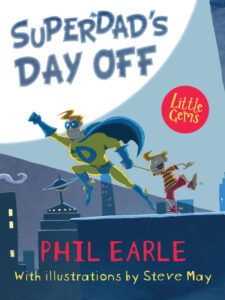
An unexpected family secret has hilarious consequences in this action-packed story from Phil Earle and illustrator Steve May – perfect for superhero fans.

Plane crashes, robberies and fires were not what Stanley was expecting on a day out at the seaside with his nan and the other residents of her care home! Nan doesn’t know about his superpowers, so Super Stan can’t step in to help as it would blow his cover.

Luckily, though, another mysterious superhero seems to be on hand, saving the day. But who could it possibly be?

Chapter bookDyslexia-friendly
dyslexia-friendly

Thinking and talking about war with children is difficult. Is war exciting? Are all soldiers brave? Is playing war games violent? When is killing other people justified?

These are the sorts of questions raised by Jack, the eleven year old boy at the centre of Tom Palmer’s new story, D-Day Dog. Jack’s dad is a reserve soldier about to be called up to Afghanistan and Jack couldn’t be more proud. At school, the class is preparing for a trip to Normandy to visit the site of the D-Day landings and Jack is already really excited.

But as Jack learns more about war, through learning about the life of his new Syrian classmate Kasandra and reading about WW2 Private Emile Corteil and his dog Glen, he begins to question everything he thought he knew about war.

This is such an important book to read to all children who are learning about war and the impact it has on the lives of the people and animals involved. Through the voice of Jack, Tom Palmer sensitively yet unflinchingly discusses the consequences and emotions involved in warfare. Brilliantly researched, the book is full of fascinating facts which are woven together to create a truly moving and gripping read.

Dyslexia-friendly in a clear, uncluttered font, this is a must-read for all 9-12-year-olds, not just in this year on the commemoration of the D-Day landings. Reading aloud to a whole class would allow the children to discuss the plot and the questions as they are unveiled through the story. It would also work well as a read-alone book or one to read at bedtime. But, do leave time for conversations afterwards. The ideas and issues contained within this simple and compelling story are too important to gloss over.

Subscribe to our newsletter

Your Review

Stone Girl Bone Girl

review

Year group(s) the book is most suitable for:

Year group(s) the book is most suitable for:

Does the book contain anything that teachers would wish to know about before recommending in class (strong language, sensitive topics etc.)?

Does the book contain anything that teachers would wish to know about before recommending in class (strong language, sensitive topics etc.)?

Would you recommend the book for use in primary schools?

yes

Curriculum links (if relevant)

Curriculum links (if relevant)

Any other comments

Any other comments