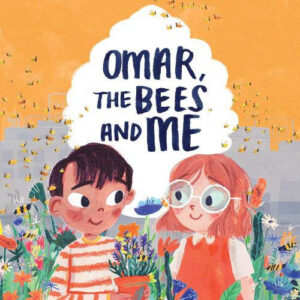
A spring-infused delight of a story, where two children rally the whole community in creating a bee corridor to help encourage local wildlife, while celebrating their cultural diversity and customs.
As with any good picture book, there are so many layers to this book. The main theme throughout is that of sustainability. The children of Class One encourage the members of their community to plant wild flowers in order to boost the numbers of bees in the area. They help deliver envelopes of seeds to all the houses between the school and park. This book helps children understand how vital bees are in order to pollinate and provide food. It will inspire children to think about how they can create bee corridors in their local community too. Katie Cottle’s illustrations bring another layer of vibrancy to the story. They radiate warmth and joy.
There are also other aspects of story that can be explored, such as developing friendship, cultural identity and LGBTQ+ representation. When Omar brings honey cake to Show and Tell and explains that his grandpa used to keep bees ‘a long way away’ among the ‘apricot trees and jasmine bushes’, it sparks the idea of creating a bee corridor – but, more than that, it brings an opportunity for Maisie and Omar to connect and build a friendship. It also gives Omar – the new child in the class – a chance to show his Syrian heritage as well as an opportunity for their teacher Mr Ellory-Jones and his husband to help to deliver the envelopes of seeds with the class in a true community project.
The end pages are gorgeous and filled with essential bee facts and a recipe for a delicious honey cake. This book is perfect for all children to explore and a great starting point for so much learning.
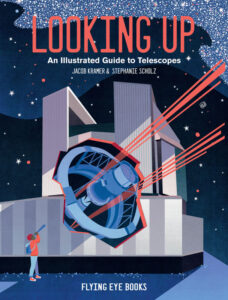
Looking Up from Flying Eye Books is a highly visual non-fiction book exploring the history and science of telescopes. Unique among the myriad of non-fiction titles covering the topic of space, this book has a real STEM focus as it explores the ins and outs of how telescopes have enabled people to learn to magnify objects from a great distance and given insights into human understanding of the universe.
Spanning back through history, Looking Up zooms in on significant people who have contributed to the evolution of telescopes as we know them. Galileo developed ‘a tube with lenses’ that enabled viewers to see the craters of our Moon and the moons of other planets. From there, a series of thinkers and innovators have taken up the baton to develop the technology in incredible ways. International collaboration in scientific discovery is emphasised in the book, as an array of prominent telescopes around the world are celebrated – including the Keck Observatory in Hawaii, the VISTA telescope in Chile, and the James Webb Space Telescope (a collaboration developed by NASA, the European Space Agency and the Canadian Space Agency).
With a vivid and bold design style, this book is perfect for curious minds, science-lovers and those with an emerging interest in all things STEM.
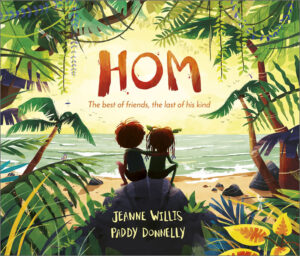
Imagine Stig of the Dump meets Robinson Crusoe… and then craft it into picture book form and add all the usual wit, warmth and intrigue of Jeanne Willis’ stories – and you’ll be close to what we have in Hom.
Hom is the story of a young boy who ends up shipwrecked on an island. There he discovers Hom, an unusual but peace-loving little creature who is the last of his kind. Perhaps he is an early human who has survived from ancient times (is Hom short for Hominid?), or maybe simply a yet-undiscovered creature of nature.
The pair become friends, playing and running together, building go-karts and teaching each other what they know about survival. The boy discovers that they are more alike than different, and when a rescue ship arrives, he makes the bold decision to stay put and protect Hom. The boy knows that it would be dangerous for Hom to be discovered by other humans – although the reader is addressed as a trustworthy confidant and invited to be in on the secret from the start.
This is a touching story of friendship, protecting others and respecting the age-old affinity between humans and the natural world. There’s a gentle message about protecting the vulnerable things of our planet, and another about overcoming apparent differences. Nevertheless, the playful tone of the story and Paddy Donnelly’s vibrant, luscious island scenes in which the friends are seen playing, sheltering and adventuring, make this an accessible all-age story with many layers to unwrap.
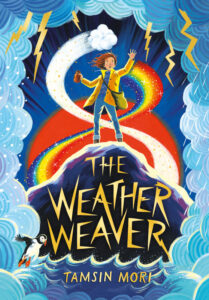
The Weather Weaver is the first book to be published by Tamsin Mori. A self-declared childhood nomad, Mori’s love of her maternal home of Shetland is evident from the start.
Finding herself dumped on the Isle of Shetland while her parents work away on a research vessel, Stella soon finds that life with her recently bereaved Grandpa does not match the sunny memories of her earlier childhood. As she grapples with her Grandpa’s never-ending anger and disappointment she is befriended by the unlikely figure of Tamar, an eccentric old woman. Afraid to appear rude, Stella sets off on the seemingly unfeasible mission of catching a cloud, little realising how dramatically her life is about to change…
The story tackles the effect of bereavement and separation with sensitivity, without feeling like it has been sugar-coated in any way. Mori delicately weaves the story as Stella faces her own fears and rebuilds the relationship she once had with her Grandpa, gaining strength in her self-belief along the way. Mori also manages to balance the reality of life as we know it, with that little bit of magic spun throughout, leaving the reader (or at least this one!) gazing at the clouds, wishing they could weave the weather too.
In schools, the story would be good as a basis for a discussion on the basis of myth and legend or as a PSHE opener on the possible effects of bereavement or separation on those left behind. This would also make a great book to keep pupils hooked at the end of the day with just enough mounting peril to keep them wanting more without scaring those more sensitive souls.
My only complaint of the book is the number of late nights I succumbed to as I really didn’t want to put it down! I don’t know if Mori plans to write a sequel, but I truly hope so.
review
Year group(s) the book is most suitable for:
Does the book contain anything that teachers would wish to know about before recommending in class (strong language, sensitive topics etc.)?
Would you recommend the book for use in primary schools?
yes
Curriculum links (if relevant)
Any other comments
Any other comments