
Recommended children's booklists sorted by age or topic

Publisher: Oxford University Press

It’s party time at The Number Tower in this hilarious new story about a group of number friends. Three is very excited about having a birthday party. But when the other Digits arrive, things don’t go to plan. There isn’t space for everyone to sit or enough cake to go around. Can the Digits find a way to save the party and give Three the best birthday ever? Perfect for understanding greater and less, double and half – you can count on the Digits to make numbers fun!

Popular picturebook creator Yuval Zommer returns with a beautifully illustrated modern fable with an environmental theme, which sees the ‘wild’ take on its own animal-like character (perhaps a dog or a wolf), artistically made up of trees, shrubs, rivers, plains and all sorts of details from the natural world. The Wild faces challenges caused by human activity, and the beauty and freedom of the Wild clearly decline as the story progresses. Despite the striking damage caused to the Wild, there is still scope for the Wild to be cared for and to thrive again if collective action is taken and the tone at the end is hopeful and encouraging in a manner appropriate to the age of the target audience.

I loved the illustrations and that ‘the wild’ is in the shape of an animal. It serves as a really good reminder of how the land is there for living creatures to enjoy but that they also have to respect the wild and take care of it. It then shows how humans have taken advantage of the wild and taken too much from it, damaging the wild rather than caring for it. I also love the message at the end that one voice alone is not enough, but many voices can get across a message about climate change and the damage that has been done to the wild. Too often, you hear people say that one person making a change won’t make a difference to climate change, but the end of the book points out that every change in someone’s home or in someone’s city will make a difference, which is an important message.

This stunningly illustrated story could provide a gentle introduction to climate change for younger children but would also be very thought-provoking for older children, already aware of climate change. The book would be a good choice for assemblies and PSHE time across the whole school, or to include in classroom libraries for children to enjoy and muse upon at their pace.

Emerald and the Sea Sprites is a fun, short chapter book about a mermaid princess and her stepsister. With green and black illustrations, we follow Emerald and Delphina on an adventure to find sea sprites after they sneak out of the palace. There’s also a pet octopus called Inkibelle. It’s a lovely story about siblings bonding, learning to share, and the importance of leaving creatures in their natural habitat. It also has a quiz at the back of the book and some ideas for things to make and do, as well as a fabulous sparkly cover! In the same world as Isadora Moon and Mirabelle, Emerald will be loved by fans of those books.

If your class is studying lifecycles in science this book will really help you. It’s the story of a tiny tadpole who, as the story progresses, slowly transforms in to a frog. It is set in a rainforest so would also suit topics about habitats. The pictures in the book bring the text alive and are full of detail about the animals and the rainforest. The book also has flaps that you can lift up to explore the information further. At the back of the book, for example, one of the folded-out pages tells you about amphibians and looks at different tropical frogs.

This is a fun book and those interested in animals will love it.

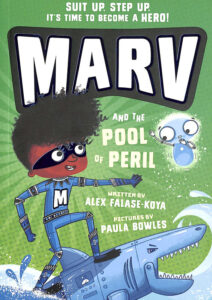
It’s an exciting day for Marvin and his classmates because they are visiting the Natural History Museum. Marvin and Joe can’t wait to see all those dinosaur skeletons up close, but they get more than they bargained for when supervillain Leo turns up and brings the Dino skeletons to life! With the help of his loyal sidekick, a super-intelligent robot called Pixel, it’s time for Marvin to become superhero Marv. Marv must use all of his newfound superhero skills if he wants to stop Leo and save his classmates from the gang of marauding dino skeletons running riot!

Half vampire, half fairy, totally unique!

Isadora is special because she is different. Her mum is a fairy and her dad is a vampire and she’s a bit of both.

Isadora has been invited to a sleepover, which is always fun, but this time it’s even more exciting because she will be staying at her mermaid friend’s house under the sea! It’s so much fun spending time with her watery friends, but while she’s there Isadora meets a mermaid called Emerald who doesn’t seem to be having such a nice time. In the middle of the night, when everyone else is fast asleep, Emerald finally reveals to Isadora what has been troubling her. Can Isadora help Emerald sort out her problem? It’s the beginning of an amazing underwater adventure!

This book is the 5th offering of the Marv series, a new tale where an ordinary boy once finds that his super-hero skills are in very much in need and this time, it is to save his school from trifid-style plants and the supervillain Violet Vine.

The story starts with Marvin as the ordinary school boy, working hard but not achieving the win he thought deserved in the school-garden design competition. But as soon as work starts on the garden, the school and its pupils are under threat from invading vines, and Marvin has no choice but to transform into Marv the superhero. He has to act quickly and win this time if he is to save his best friend, his teacher, the whole school from being strangled or eaten by gigantic venus-flytraps. Along with his sidekick robot Pixel, they become involved in a fast-paced, action-packed range of scenarios where finding a weakness is the only way of defeating an almost invincible enemy.

The book is packed full of illustrations that accompany the action and the story contains themes of friendship, forgiveness as well as endless determination. It also has humour; the headteacher is simply not impressed with the behaviour of these plants!

Although this is fantasy fiction complete with magic potions and half-witches, Mirabelle’s friendship troubles and their competitive spirit, inspired by a famous female footballer, strike a realistic chord. Some readers might also identify with the temptation to cheat, but then discover “there’s magic in doing something you love and working hard at it to be as good as you can be.”

The concluding quiz is like icing on a yummy cake that’s shared among friends and leaves them feeling happy and eager for more. Harriet Muncaster’s Isadora Moon and Emerald books are firm favourites with KS1 girls in particular, so this title will undoubtedly be popular. And, librarians note: once hooked, children will probably want to progress to Victoria Stitch. Note, too, that the author’s website has lots of creative ideas and interesting questions.

Join the Digits for another action-packed adventure!

When the Digits start squabbling over whether odd or even numbers are best, Ten challenges everyone to a football match to settle the argument. Ideal for understanding odds and evens – you can count on the Digits to make numbers fun! This playful picture book series about a group of number friends is ideal for developing early maths skills.

Picturebook

Ray is a spectacular picture book which explores a story of adventure, while addressing fears of the dark and the unknown.

Throughout the tale, Mouse takes a lovely walk outdoors when time escapes him and the sun begins to set. He quickly becomes ‘terrified’ and sobs by himself until a helpful firefly appears and asks Mouse to follow him. His reassuring words ‘I’m Ray and I’ll light your way’, are repeated throughout the story as different creatures join Mouse on a quest back home through the darkness. There are many simple, yet fun opportunities for children to retell the story. For example, a story map is used to tell the way back home: ‘My house is past the woodpile, around the cactuses, up by the pond and just beyond the rocks’.

Alex Latimer’s illustrations beautifully capture a contrast between dark and light. On each page, the animals confuse a shadow for something frightening, only for the firefly to reveal that things are not always what they seem. The silhouette of a snake turns out to be just an innocent log pile. Similarly, a frightening shadow of a bear transpires to be just a cactus- phew!

Children can both enjoy and identify with the fears cleverly alleviated through this story, with many opportunities to join in. Latimer creates the story through rhyming couplets, reminiscent of many classic children’s stories. With a clever twist at the end, this story can be enjoyed by children, teachers and parents as a bedtime story or teaching tool.

Subscribe to our newsletter

Your Review

Stone Girl Bone Girl

review

Year group(s) the book is most suitable for:

Year group(s) the book is most suitable for:

Does the book contain anything that teachers would wish to know about before recommending in class (strong language, sensitive topics etc.)?

Does the book contain anything that teachers would wish to know about before recommending in class (strong language, sensitive topics etc.)?

Would you recommend the book for use in primary schools?

yes

Curriculum links (if relevant)

Curriculum links (if relevant)

Any other comments

Any other comments