Recommended children's booklists sorted by age or topic

Publisher: Allen & Unwin

This story tells the tale of Robert Falcon Scott’s Expedition to Antarctica in an attempt to be the first to reach the South Pole. This expedition – The Terra Nova – is told in detail in the story, including the stories of the men who followed him. The very first sentence, ‘If you’re into happy endings, you’d better look elsewhere,’ is an instant hook and sets a precedent for what may come.

The story explores important themes of perseverance, responding to failure and keeping hope in difficult times.

This book would make for a great reference tool when learning about the different polar regions and Scott as one of the great British explorers, as well as an exciting and perilous adventure story for ages 10-14. Scott’s previous expeditions are also mentioned, including the expedition with Earnest Shackleton, and photographs from the expedition are also included.

Join maverick inventor Steve Mushin as he tackles climate change with an avalanche of mind-bending, scientifically plausible inventions to rewild cities and save the planet.

Jump into his brain as he designs habitat-printing robot birds and water-filtering sewer submarines, calculates how far compost cannons can blast seed bombs (over a kilometre), brainstorms biomaterials with scientists and engineers, studies ecosystems and develops a deadly serious plan to transform cities into jungles, rewilding them into carbon-sucking mega-habitats for all species, and as fast as possible.

Through marvellously designed and hilarious engineering ideas, Mushin shares his vision for super-high-tech urban rewilding, covering the science of climate change, futuristic materials and foods, bio reactors, soil, forest ecosystems, mechanical flight, solar thermal power and working out just how fast we could actually turn roads into jungles, absorb carbon and reverse climate change.

Developed over seven years, Ultrawild is an optimistic book about creative thinking, science, technology, engineering and maths (STEM) and the potential for massive change. Filled with laugh-out-loud design-ridiculousness, it aims to empower and excite a new generation of designers, scientists, engineers and ultra-wild thinkers.

Deep in the ocean, far beyond the reach of even the brightest sun, the earth quakes. Hagfish scatter and snailfish flutter. Lava pillows flash and fade, rumpling the seabed as a new volcano births a mountain. Where hot meets cold, a chimney forms. Here begins a colony of unexpected creatures. Other chimneys grow and cool, grow and cool, while the mountain stretches ever upwards. A rumble becomes a roar and the sea boils. Lava fireworks the sky. A new island is born.

More volcanoes erupt under water than exist on land. In the vein of Iceberg and Tree – combining deep scientific research, lyrical language and stunning illustrations – Volcano is the next exploration of the natural world from the CBCA award-winning team of Claire Saxby and Jess Racklyeft.

This quality hardback, with its tactile cover, would grace any school foyer, library or bedroom bookshelf. It conveys a real sense of adventure, shared by the authors and explorers who have experienced Antartica in the raw, thanks to the stunning illustrations and often poetic prose.

It’s factually fascinating, as well as comical in places (for example the wanted poster for Carol’s lost toy mouse; not to mention fish whose appearance is laughable, and talk of Weddell seals sounding like an electronic orchestra), and is dotted with references to famous names (e.g. Shackleton) and literature (e.g. The Rime of the Ancient Mariner) and traditions (e.g. reverencing Neptune).

In addition to using a range of scientific vocabulary (e.g. anthropogenic, isobars, pertinacity), the book also evokes a response which invites rich description: impressive, sculpted, surreal, perilous, dazzling, ethereal, opalescent and immense. At times, you want to be there, in a place ‘so dry that, when you walk on rocks, they tinkle like fairies’ bells,’ but at others (in a Force 11 gale), you’re glad you’re not.

These features, together with its visual appeal, make Into the Ice a great prompt for storytelling and, although it appeals to a wide age range, it is a peephole into the world of deserts and explorers, which are covered in the KS1 curriculum. It concludes with an urgent message for us all – we must take care of Antarctica!

The front cover of this coastal-themed picturebook is very attractive, and the quality – of paper and binding – is immediately evident. It invites exploration and interaction too: the cover is slightly textured and some of the pages scalloped. The storyline is very simple and easy to follow, created using a repeated and progressive rhyme. There’s also a lovely reveal just before the end, which might well inspire others to follow in the girl’s footsteps and create their dragon from beautiful beachcombing finds.

Each illustrated spread, like any thriving rock pool, is worthy of close inspection. The tiny ‘handwritten’ annotations – a treasure trove of information for young nature enthusiasts – blend in so well that it is easy to miss them at first glance. Other details are hidden in plain sight too (what’s in those clouds on the penultimate page?), providing added delight for the keen-eyed reader. Children will likely warm to the busy pages immediately

. A book to be enjoyed at home, or alone in the book corner, rather than in a group, and one whose appeal will grow as successive children leaf through its pages and share the seaside treasure they’ve found.

A Beginner’s Guide to Choosing the Perfect Pet is the ideal book for children who like humorous tales.

This ‘guide book’ for children details all the reasons a range of animals would or would not make the perfect pet. It will have readers laughing out loud at some of the advice given, especially if it is taken too literally.

The illustrations by Tommy Doyle add extra meaning to each page and the ending will have children gasping and chuckling in equal measure.

Alex LOVES art and will do anything to win the National Young Cartoonist Competition. She’s got the talent, but what should she draw? Then along comes Hi, an alien from the Planet Wendy. Hi has his own project: to learn about Earth’s leaders for his Earth Studies class. Maybe they could swap information and help one another?

This fabulously funny, out-of-this-world adventure story from Fiona Katauskas, includes lots of powerful messages about friendships and who to follow. School can be a scary place when you are one of a kind, and this quirky narrative takes you on that journey to find the answers.

Readers of sci-fi and comedy will love this combination full of extraordinary twists, turns and events to keep you turning those pages!

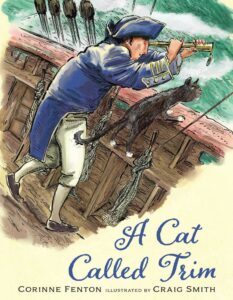
This delightfully illustrated picture book is based on the real-life story of a cat called Trim and his loyal guardian Captain Matthew Flinders.

Captain Matthew Flinders was an English navigator and cartographer who was born in 1774 and circumnavigated the world, adding detail and description to the first discoveries. The story starts when Trim was born aboard the ship HMS Reliance; as a little kitten he finds himself overboard in choppy seas. His bravery and resilience shines through and he is able to swim back to the ship and climb a rope back to safety. As a soggy little kitten, he quickly becomes a favourite of Captain and crew. He took advantage of his position by enjoying the best of the food and revelled in the attention bestowed upon him. What follows is an insight into her life aboard the various ships that he travels on, with each page detailing the name of the ship or voyage, and ultimately the circumstances under which they part company.

The illustrations are detailed, life like and in keeping with the style of the period; the colours are vibrant and appealing. The vocabulary and language used make it a great book to read aloud, and would suit an audience of primary children. The story jumps to voyages and a somewhat open ending allows for maximum discussion.

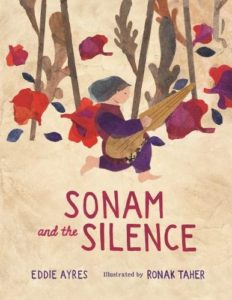
Sonam and the Silence is set in Taliban-ruled Afghanistan during a time when music was banned in the country.

The book tells the story of Sonam, a 7-year old girl who sells chewing gum in Kabul. She discovers music for the first time and uses it as a way to cope with the other, more frightening noises of the city. She meets an old man who gives her an instrument called a rubab. Sonam’s older brother finds out and forbids her to play, taking the instrument away from her. This book is a sensitively-told tale of a child focusing on something positive in an otherwise negative and controlling environment.

The illustrations in the book are magical with interesting use of colour. They really bring the words to life and I spot new details every time I look through the book.

Sonam and the Silence doesn’t deal directly with war, but more the idea of control and something being forbidden. There would be so much to discuss as a result of reading this book with almost any age group, but particularly what it means for something to be forbidden. How would the children feel if they weren’t allowed to do something they enjoy anymore?

It is an important story to tell and one that we can all learn from, no matter how old we are.

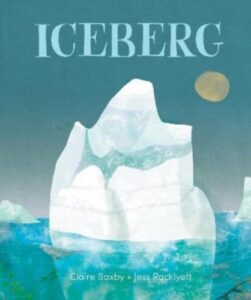
In the final freeze of an Antarctic winter, green tails wave across a star-full sky, as if to farewell endless nights. If this world looks empty, look closer … Penguins trek across the ice to their winter homes. As the temperature warms, birds fly above on their long migrations. And with the advent of summer, beneath an iceberg, the sea is teeming with life. Ocean, sky, snow and ice – minute greens and giant blues – dance a delicate dance in this evocative portrayal of the life cycle of an iceberg.

Subscribe to our newsletter

Your Review

Stone Girl Bone Girl

review

Year group(s) the book is most suitable for:

Year group(s) the book is most suitable for:

Does the book contain anything that teachers would wish to know about before recommending in class (strong language, sensitive topics etc.)?

Does the book contain anything that teachers would wish to know about before recommending in class (strong language, sensitive topics etc.)?

Would you recommend the book for use in primary schools?

yes

Curriculum links (if relevant)

Curriculum links (if relevant)

Any other comments

Any other comments