It’s easy to feel lost in the flood of so many new children’s books available. Each month, we pick five of our recently published favourites.
Check out our Review Panel’s top picks for you to read in October 2019…

It’s easy to feel lost in the flood of so many new children’s books available. Each month, we pick five of our recently published favourites.
Check out our Review Panel’s top picks for you to read in October 2019…
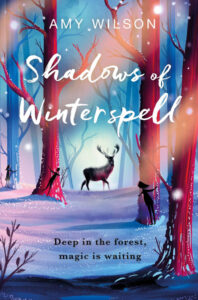
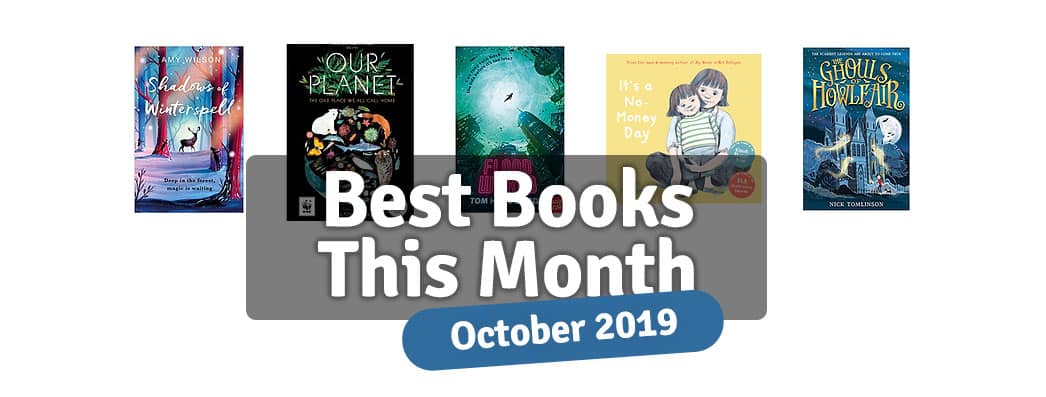
A coming-of-age adventure story rooted in fairy tale and magic. As usual, Amy Wilson’s world-building is second to none as she immerses the reader is a richly-imagined magical world that is at once convincing, delightful and darkly enticing.
Stella feels alone, living most of her life with her Nan in a cottage near the edge of a magical forest. The forest is filled with dangers and haunted by the dark shadows released by the King, who is in mourning after a family loss that occurred years before. Stella helps her Nan to guard the house boundary and stop the dark magic from expanding further. Armed with books, Stella has grown up learning charms, spells and the history of magic and has an imp called Peg for company, but feels a pull towards the unfamiliar worlds beyond the fence.
Tired of being isolated from the human world, Stella secretly signs up to go to school in a nearby town. While Nan disapproves of Stella keeping company with humans, Stella arrives at school and quickly realises that some of her new classmates are not quite what she expected. Before long, Stella finds herself caught up in a complex quest to save the forest from the King’s shadows and to uncover the secrets of her own past.
Wilson’s depiction of Stella as a young teen who struggles with isolation and identity will resonate with any readers who have known a longing to find their place in the world. Fairy tale imagery is peppered through the pages; grandmothers in forest cottages, shiny red apples, elves and fairies in underground homes, hidden-from-sight palaces and necklaces imbued with magic all seamlessly weave in and out of the book’s modern, relatable themes.
Suitable for upper KS2 and lower KS3, this is a refined piece of storytelling that encourages young readers to be brave and follow their own path.
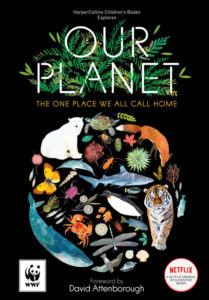
This stunning children’s non-fiction hardback is the accompaniment to the Netflix series Our Planet. This is the kind of book that readers young and old will love to pore over, from the powerful photographs of melting ice caps to the facts and figures about palm oil plantations and endangered sea life. There is so much to learn and think about.
The book has a foreword by Sir David Attenborough, who says ‘You will be among the next characters who can, if they wish, tell the most extraordinary story of all – how human beings in the twenty-first century came to their senses and started to protect Planet Earth’.
What follows is a visual ode to Planet Earth told through extraordinary photography from the series combined with appealing illustrations that draw in younger readers and help them to understand nature’s amazing interplay of habitats and ecosystems. Small sections of text further explain the images, giving snapshots of animals’ lifestyles as well as presenting hard-hitting facts about the dangers they face. We learn how orangutans have incredible mapping skills to navigate their jungle homes but also how we lose 100 orangutans a week due to human actions like hunting and deforestation. We find out how beautiful lantern-fish light their own way along with 17-metre long oarfish in the high seas, but also how plastic peril and high-seas fishing put the incredible marine life there in danger.
The tone of the book is one to inspire rather than to frighten readers into action. The book is not at all without hope for the future, and the nudge to make personal changes comes through simple tips like choosing products carefully and supporting sustainable fishing. Moreover, with photographs as stunning as these, it is hard for readers of all ages not to feel inspired to take steps to protect the natural world from our own destructive actions.
With something to offer to the whole primary age range and beyond, this is the kind of nonfiction book that inspires and informs in equal parts and is one to treasure in classrooms and homes.
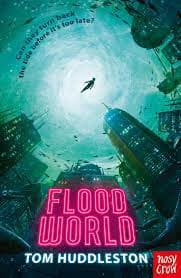
A fast-paced futuristic adventure story with a cinematic feel. Imagine London in the future, when rising sea levels have submerged half of the city. Privileged citizens live in the central zone, protected by a huge wall. Meanwhile the less fortunate scrape a living in The Shanties, a squalid area of flooded tower blocks and rickety boardwalks. In this fractured world, the only thing that unites the inhabitants from inside and outside the wall is their fear of a different race: The Mariners. Shanty children Kara and Joe find themselves embroiled in a world of danger. As they struggle first to escape and then to protect their neighbourhood, they are forced to confront their prejudices and discover that the world is more complicated than they thought…
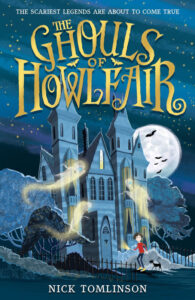
This debut children’s story from Nick Tomlinson certainly lived up to its claim of being “a brilliantly funny and spooky mystery adventure.” I was sucked into the story, hypnotised by the clever use of language and hooked by the well-planned plot which unfolded full of spectral splendour and ghostly gloriousness.
Tomlinson’s description entranced me from the very first page and I have shared numerous examples of clever personification and carefully crafted detail with my class (who are all now queuing up to borrow my review copy). Their gasps at the beauty of language and the illusion of reality created are testament to the skill of the author, and are plaudits that are truly well deserved.
The story follows the adventures of Molly; we find out about her unusual home-life, her eccentric hobby, her difficulties dealing with the loss of her father and her special friendship with Gabriel (their relationship being crucial to the resolution of the tale). The story really is the epitome of a page-turner, with twists and turns aplenty. I ate up all three hundred and thirty-three pages of this book in delicious chunks. The tasty development of the relationships between Molly, her friends and also her adversaries developed through the chapters enticingly, punctuated with piquant flashbacks, hints and red herrings, which kept me hungrily devouring the book until the exquisite resolution.
What I possibly liked most about this debut was the fact that the end – whilst seriously satisfying – feels open. I am hopeful of an equally juicy sequel. I’d be first in the queue to gobble up further ghoulish adventures in Howlfair, and Molly is a character I hope will live on.
Reviewed by: Julie Wells


© BooksForTopics 2015-2024
review
Year group(s) the book is most suitable for:
Year group(s) the book is most suitable for:
Does the book contain anything that teachers would wish to know about before recommending in class (strong language, sensitive topics etc.)?
Does the book contain anything that teachers would wish to know about before recommending in class (strong language, sensitive topics etc.)?
Would you recommend the book for use in primary schools?
yes
Curriculum links (if relevant)
Curriculum links (if relevant)
Any other comments
Any other comments