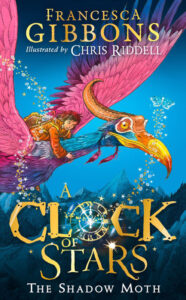
There are many things Imogen should be doing. She should be nice to her sister and her mother’s new boyfriend. There are also things she definitely should not be doing- like following a strange moth into a deserted, overgrown garden. But Imogen rarely does as she is told and now she has landed herself and her little sister Marie in a whole load of trouble. The strange moth leads them through a door in a tree to magical world where monsters are not just the stuff of nightmares. There is a real prince (spoilt and unloved), a huntress, a bear, a king and a villainess. The two sisters are trapped in this land with no way back.
This is the first of a trilogy and a debut book by Francesca Gibbons. It is a classic fantasy story, full of detailed characters and thrilling adventure. Some of the more minor characters are truly exciting and and I’m hoping they appear in the next book. The clockmaker himself and the beautiful, magical clock were deeply intriguing, and I wanted to find out more about both. A familiar theme in fantasy is whether the monsters are more or less monstrous than some of the people. In this story it a close-run thing. Some of the acts of violence on both sides are quite shocking and it is not a story for the fainthearted.
A highlight of this book is the illustrations by the well-known illustrator Chris Riddell. His style is instantly recognisable, and he brings the main characters to life with his detailed line drawings.
This book is a brilliantly original fantasy – not quite like anything else, but very much in the line of classic fantasy story telling. I will be looking forward to reading the next instalment.
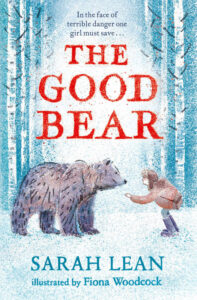
The Good Bear is a superb story to snuggle up with in the winter months, exploring themes of families, relationships and ‘togetherness’ through the tale of a young girl and a life-changing visit to the Norwegian winter. Thea, the main character, retells her story as a first-person narrative and sets the scene for the action to come through the first chapter, where she is beginning to settle down to tell her tale to her daughter as a part of a long-standing Christmas tradition.
In her story, set 30 years before, Thea receives an invitation to spend the Christmas holidays with her estranged father, who works as a carpenter and lives with his wife and her children in Norway. As she arrives, there is news that a bear has escaped from a circus and may be hiding in the forests near to where she is staying.
Thea’s complex emotions towards her father are sensitively and honestly written; particularly Thea’s anger towards Henry’s new family and their seemingly perfect life. Thea’s relationship with the bear is central to the story and gives the book a sense of Christmas magic that is warm and gentle; a welcome contrast to the more overtly tinsel-filled Christmas books.
A beautiful story brimming with winter magic.
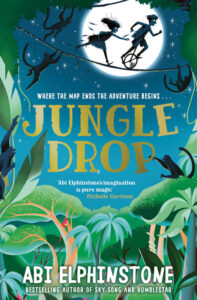
Our community members in schools tell us time and again how popular Abi Elphinstone’s stories have been in schools among pupils and teachers. Not so long ago, Sky Song whisked readers in upper KS2 away on a magical fantasy adventure through frozen landscapes and last year, Rumblestar landed to introduce the Unmapped Chronicle series with a bang. The latest book, Jungledrop, follows in the Unmapped Chronicle series but also reads well as a standalone adventure for those who missed Rumblestar.
Jungledrop tells the story of a set of obnoxious and self-assured twins called Fox and Fibber Petty-Squabble. The pair are fiercely competitive with each other, desperate to prove their own worth to the family businesses at any cost. They’ve got a lot to learn and the narrator assures the reader early on that they will learn to be brave and kind if we stick with them for a while – in fact, they are even on a path to save the world from the power-hungry antagonist Morg the Harpy.
Quickly hurled into an adventure they never meant to be part of, the twins find themselves in the glow-in-the dark rainforest kingdom of Jungledrop. Abi Elphinstone excels at fleshing out her fantasy worlds with thrilling and entertaining characters; in Jungledrop the twins meet a host of fantastical creatures, including their dry-humoured companion Heckle the parrot, Doogie Herbalsneeze (the jungle apothecary) and Iggy Blether, the unicycle-riding unmapper. The exotic landscape is also populated with imaginative plants like the gobblequick trees and a treetop highway for easy jungle commuting.
There’s a real sense of adventure in the story, with danger never being far away, and the fantasy elements are well- balanced against a voyage of empathy. The narrative offers the reader insights into the way in which the twins’ backgrounds, experiences and upbringing have contributed to their unpleasant behaviour and tendency towards dishonesty, selfish ambition and distrust of others’ intentions of kindness. Through their adventure, Fox and Fibber learn a lot about what it really means to be strong and how working together with courage and kindness is what makes kingdoms thrive. In the background to the story, there’s a gentle stirring of themes of environmental conservatism, as characters must act communally to preserve their kingdoms from threats of destruction.
A must-read for lovers of fantasy adventures and those who love a story that stirs the imagination.
This is a new middle grade story from Harriet Muncaster, best known for her popular Isadora Moon series.
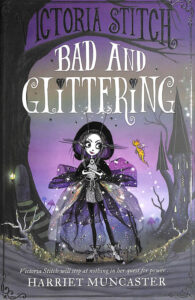
Victoria Stitch and Celestine are twins, both hatched out of a diamond in the fairy-like world of Wiskling Wood. Here, babies hatched from diamonds usually become Queen, but this particular diamond had a fault which made the twins ineligible for the crown. Victoria Stitch, however, cannot accept that she will never be Queen and she embarks on a series of attempts at gaining the throne. She is the complete opposite to her sister, as Celestine is perfectly happy to be an ordinary citizen and is looking forward to getting on with her life once she leaves school.
Wisklings are fairies, born from jewels and living safely in the wood, protected by magic. They have wands and blooms (enchanted flowers) to fly on. The whole world of the wood is described in delightful detail and it seems that most Wisklings are satisfied with their life there – except Victoria Stitch, who will stop at nothing to achieve her ambitions.
The illustrations are instantly recognisable as Harriet Muncaster’s trade-mark style – simple line drawings that convey so much, set in cool purples and blacks. They are a highlight of this book, along with the map at the front. The story is perfect for earlier fans of Isadora Moon who are ready to move on to something more. A longer read than the Isadora Moon books, it is also darker (though there was always a bit of danger with a half fairy, half vampire character) and contains elements of plotting, murder and jealousy. Despite that, the overall tone of book is sweet and stylish, and even the dissatisfied Victoria Stitch has qualities that you can’t help but admire.
The ending is left open for further stories and the series will no doubt find instant success among Harriet Muncaster’s impressive fan base.
This much-anticipated third novel by Sophie Anderson is a triumph, standing up to its predecessors The House with Chicken Legs and The Girl Who Speaks Bear in the richness of its story weaving and scope of imagination.
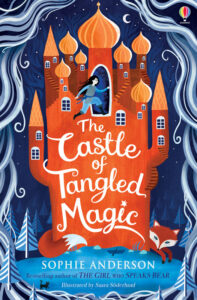
Castle Mila is Olia’s family home – a majestic castle passed down in her family history from generation to generation. The castle is as mysterious as it is impressive – with secret rooms, impenetrable domes and hidden passageways that long to be explored – and is the perfect abode for a curious and adventurous protagonist like Olia, who wishes to leave no stone unturned when it comes to seeking out magic and who can’t wait to share it all with her baby sister Rosa once she is old enough. The castle has stood for 500 years, so when a storm threatens, Olia is sure that the castle should be able to withstand it even if it may mean cancelling the special feast planned in the great hall. But wise old Babusya – who is always well-tuned in to the world of magic and spirits – isn’t so sure, feeling that there is something different about the nature of this impending storm.
After the storm passes, part of the top of the castle has partially collapsed down into the great hall, revealing a hidden staircase that leads to one of the castle’s domes. The Aurora Dome has always fascinated Olia, believing it be a place of hidden magic. Allured by its potential and confused by Babusya’s mysterious instructions about unlocking the castle’s magic, Olia is soon swept away on an adventure through a magical door in the dome that leads to a whole new land of forbidden magic.
What ensues is a thrilling quest introducing a host of magical characters, as Olia finds true courage within herself and a new conviction in her own agency to pursue what she believes is important. The cast of characters is delightful, and pleasingly there is even an appearance from a particular house that is fondly familiar to fans of Sophie’s previous books. An interesting and topical theme emerges gently through the story, as Olia explores the concept of how to deal with the shameful actions of ancestors from generations before – actions that have caused long-lasting consequences for the individual liberties of a whole group of characters. Should we cut off things of the past and remove all memories of them, wonders Olia, or embrace our history while looking for ways to put things right?
Sophie Anderson masterfully introduces Russian folklore to new readership while exploring themes with true relevance to the modern middle-grade readers – identity, social justice, conviction of belief, what it means to find a home and the role individuals play in make the world a better place for others.
With beautiful illustrations by Saara Sodurlund bringing its magic to life, this is an enchanting and exciting tale is not to be missed.
Nominated for “Favourite Books of 2020” by: Eibhlín Ní Chearbhaill (librarian) and also by Rosanna Kinsella (Assistant Headteacher and SENCO)
Eibhlín says, “Exciting to read. The house with the chicken legs appeared late on in the book…much to my delight. I love talking to the children about Sophie Anderson’s books. There is so much going on in this wonderful book”Rosanna says, “A magical adventure of courage and love, rooted in folklore.”
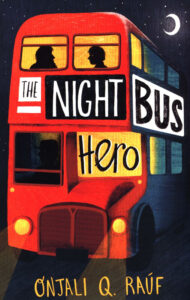
A wonderfully heartfelt story filled with nuance, empathy and hope from award-winning author Onjali Rauf. This story highlights the topic of homelessness and explores the spectrum of attitudes that people hold towards homeless people, as well as exposing a number of common prejudices.
Hector is a troubled young boy – labelled as a bully and a menace, he is stuck in an endless cycle of rule breaking and serving detentions under teachers who tell him how troublesome he is. Hector’s parents have little time to pay him attention after school – in fact the only attention that really feeds him is the incitement of his two friends, who cheer him on as he makes school life miserable for others.
Looking for a new way to impress his friends, Hector sets his sights on a homeless man who is often found sitting on a bench in the nearby park. Spotting an easy win, Hector hijacks the man’s trolley of possessions and aims to hide it in the trees. Something goes awry, and when the trolley ends up at the bottom of a lake the repercussions of his actions hit Hector in surprising ways that threaten to bring him into greater trouble than ever. Annoyed, Hector waits until opportunity arises and ramps up his plan to get revenge on the homeless man.
In the mean time, an intriguing spate of robberies in central London have brought the homeless community into public scrutiny. As a number of threads weave together, Hector finds himself wrapped up in a crime-busting mystery as well as unwittingly embarking upon a journey of personal change that enables him to better see the world through the eyes of others. Each character he meets helps him to see the value in real human connection beyond labels. There’s Thomas, the homeless man with a heartbreaking background story; the Catwoman, who demonstrated to Hector the value of community connection and collaboration; and Mei-Li, Hector’s classmate who shows him what it means to treat others with a grace and respect that breaks barriers and brings about the treasure of moving beyond surface appearances. Before he knows it, Hector finds himself the hero of his own story for the first time ever – both for the exciting and dangerous part he plays in busting a high profile criminal pursuit but also for his own personal journey of compassion and learning to reach out to others.
Onjali Rauf’s beautifully relatable storytelling is perfect for highlighting social issues in a way that fully engages young readers. The community of homeless people is portrayed vividly and intriguingly – from the sounds and smells of the soup kitchen to the night bus route to the system of painted symbols, their world is painted with dignity and compassion. As with her previous novels, Onjali Rauf addresses important ‘real-world’ topics with open-heartedness and the sense of triumph in knowing that big changes can start with small people.
review
Year group(s) the book is most suitable for:
Does the book contain anything that teachers would wish to know about before recommending in class (strong language, sensitive topics etc.)?
Would you recommend the book for use in primary schools?
yes
Curriculum links (if relevant)
Any other comments
Any other comments