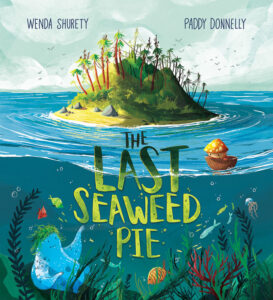
The Treeple lived up high in the trees. They liked to build houses of sticks, climb with lemurs and make papaya pies.
But most of all, the Treeple loved to make things.
The Seaple lived deep down in the ocean. They liked to build houses out of shells, swim with the fishes and bake seaweed pie.
But most of all, the Seaple loved to watch nature.
The Treeples aren’t bad but they are thoughtless. They continue to make things without thinking about whether or not they need them and when they run out of space on the land, they decide a good place to put it would be in the ocean. This is when the problems start for the Seaple.
This is a lovely book to use as an introduction to caring for the environment and why we need to make sure that we don’t drop plastic and litter. The Seaple go on to reuse and recycle items that the Treeple had discarded. This would be a great conversation starter and would encourage children to think about everyday items that could be reused and how we can recycle products and what could be made from them.
The illustrations by Paddy Donnelly are beautiful and really add to the mood of the story. The worlds of the Treeple and Seaple come alive and the characters are very engaging. A section at the back of the book gives ideas on how everyone can help to be an ocean hero and keep the seas and beaches clean. A donation of 3% of the cover price goes to the Marine Conservation Society.
Nell lives with her clan in the cave. Her best friend is a small cave bear, who will grow very large as he gets older. One day Nell overhears some of the adults talking about giving Cave Bear away as a gift for another clan. Nell is horrified and decides to run off with Cave Bear. They follow the stream from their village in search of somewhere they can be safe. On the way they meet mammoths and other less friendly clans and a fierce wildcat kitten. All the time Nell is searching for a way that she can remain with Cave Bear.
This is a very charming story, filled with gentle humour and a very mildly scary level of adventure. The pictures are drawn in much the same way in a blue wash and create a sense of the story and the jokes in the text. There are also allusions to other well-known stories like Bear Hunt and Winnie the Pooh.
The final pages have instructions for how to look after a cave bear and this was possibly my favourite bit of all. Martin Brown is the illustrator for the Horrid Histories series and some of that humour has definitely rubbed off on this book.
This is a heart-warming story about friendship and is going to be the first in a series about Nell and Cave Bear. I think it will prove a popular choice among children who are just starting to read independently as it is not too long or difficult.
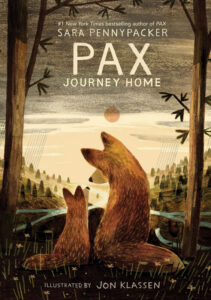
Fans of Sara Pennypacker’s Pax will be thrilled to see the arrival of the long-awaited sequel this month.
A year ago, Peter met his former pet fox, Pax, for what he assumed was the last time. Since then Pax has been happy as part of a new family in the wild. Thirteen year old Peter, on the other hand, has now lost not just his mother and his beloved pet but also his father, killed in the war. That just leaves his grandfather, who makes him feel inadequate. He’s determined to bury his feelings of guilt, hurt and loss by striking out alone and shunning close relationships.
He sets off to join the Water Warriors, cleaning up water that has been contaminated by the war near to his old home. Meanwhile, unbeknownst to him, Pax is travelling in the same direction – towards Peter but also towards the contaminated water. Slowly, surely, inevitably, their paths collide.
Told alternately from the points of view of Peter and Pax (although always in the third person), this story will break your heart and warm it at the same time. It’s a superb and sensitive portrait of how emotions can become tangled and how grief can become toxic. It draws you into the vivid tale of companionship between boy and fox and compels you to ponder the complex relationships between loss and guilt, loyalty and love.
Despite being a sequel to Pax, it stands alone very well, although I would recommend reading the books as a pair. Doing so heightens the pathos of watching Peter follow the emotionally self-destructive path set by his father and, ultimately, finding healing and redemption through love.
The emotional content of the book makes it ideal for broaching difficult subjects like bereavement and mental wellbeing. The setting and context link it to environmental issues, most of all the importance of water. The story as a whole is a joyous read – perfect reading for pleasure material. I read it with tears running down my face and since I’ve finished it, I’ve felt somewhat bereft myself.
review
Year group(s) the book is most suitable for:
Does the book contain anything that teachers would wish to know about before recommending in class (strong language, sensitive topics etc.)?
Would you recommend the book for use in primary schools?
yes
Curriculum links (if relevant)
Any other comments
Any other comments