Recommended children's booklists sorted by age or topic

Publisher: Templar Publishing

Picturebook

This is one of the first books I bought for my first child. I read it on repeat and we both absolutely loved it. 

Rhythmic, hopeful, soothing, sweet and special!

The Circular Square is a clever picturebook that will engage young children with its humour and illustrations.

The concept and language used by the author, Simon Philip, mean this is an ideal text for Early Years children. The rhyming story describes all of life’s ups and downs and how these shape us, quite literally.

The character of Square does not like his edges or straight sides but chooses to focus on the positives of life. As he does that, he slowly becomes more rounded without even noticing.

This story has a wonderful message about having a positive mindset and showing resilience.

A new and exciting murder mystery from debut author Niyla Farook, takes on the thrills, twists and turns of a family estranged that then (thankfully) reunites.

Twins Ani and Riri are two parts of a very different puzzle – one loud and ready for adventures, the other quiet, preferring reading to talking. But when needs must, they have to put their differences aside to solve a very different problem. Secret sleuths will LOVE Niyla Farook’s funny middle-grade murder mystery featuring the twins, Ani and Riri, who investigate the death of a local café owner. The girls must put their differences aside and learn to use each other’s strengths and skills when their very own father becomes a suspect. Can they work together, protect their family and solve the mystery?

Perfect for fans of Murder Most Unladylike and HIGH RISE MYSTERY, Farook has bridged that gap between junior chapter books and something with a little more bite to it! This mystery will not fail to keep the pages turning, and the reader guessing!

Number 7 Evergreen street is an absolute joy to read.

The book begins with Penelope Petersham, who lives in a flat in an old, grey building. However, as the story unfolds you meet the wonderful and diverse people sharing the building with her, who add colour and sparkle to the seemingly dull surroundings.

One day however, Penelope begins to worry about the strange yellow diggers and cones arriving outside her flat. Her and the occupants of the flat begin to fear that the building will soon be destroyed. However, Penelope and her friends work together, using their own special talents to try and save their home from the Mayors very big plans.

This story celebrates the power of communities working together and the importance of making friends. At the end of this tale, you see how nature and a little bit of love can make a small flat something very special indeed.

Long before anyone had designed a rocket, the Montgolfier brothers were making hot air balloons. In October 1783, they became the first people to experience controlled flight. Balloon to the Moon starts there and leads to Neil Armstrong’s ‘small step’ and beyond. But why stop there?

Learn about the great innovations of the past, then get ready for BLAST OFF into an unknown but exciting future.

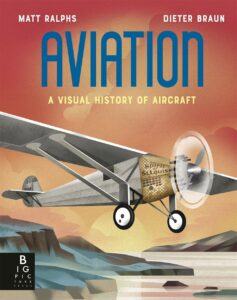
Discover some of the most incredible flying machines of all time in this lift-the-flap book by the bestselling, award-winning Stephen Biesty. With amazingly detailed drawings and over 40 flaps, young readers can meet some of the early aviators and their pioneering aircraft, peek inside a luxury flying boat and see the inner workings of a space shuttle. Packed with fun facts, this is the perfect introduction to planes and helicopters from all over the world.

This story is a perfect bedtime or calming story, which is full of facts for curious readers about sleep. Each page is a fantastic two-page spread with a focus on a different animal. The facts are accessible for an early reader and are presented in small, readable chunks, where there are no more than a few sentences in each paragraph across each page.

There are well-known animals in this book, such as cats and dogs, but also less well-known ones, such as giraffes, kangaroos and sea otters. The sea otter section was very popular with a Year 2 class as the children enjoyed that sea otters hold paws with each other whilst they sleep, so they do not float away. In each section, there is a question linked to sleep and bedtime. This interaction with the reader, such as ‘What do you do before you go to bed?’ could lead to a discussion with a class or child. This lovely story ends with five top tips for getting a good night’s sleep. It is a perfect time to discuss with your class or child about bedtime routines and what we do to get ready for sleeping.

A truly wonderful read.

I love Sam Usher books, and this one does not disappoint. The lovely, whimsical story of the boy sailing across the ocean with his grandfather is sure to be a winner. The illustrations, in a fairly muted palette in some places, are just delightful and children will enjoy the black-and-white jokes in the story.

The whole idea of sailing away in a bathtub is so wonderfully absurd and children will recognise the game being played, whilst at the same time enjoy the fantasy element.

Central to the story is the relationship between the boy and his grandfather. Grandfather is immensely practical and helps solve the problem and the boy takes after him in many respects. Their relationship is one of easy familiarity. Grandfather is a key carer, as are many grandparents these days, so the situation is familiar to many children.

There is of course something so sweet about penguins that they feature many times in stories for children. These penguins are just as adorable and whilst it reminded me a bit of Oliver Jeffers’ books, the story was still original, and it made me smile.

Recommended for Foundation Stage (Nursery and Reception). I will be reading this one to my Rhyme Time group.

A wonderful book explaining the thought and care that goes into choosing a child’s name. In this story a little girl recalls the love that went into her parents giving her a special name. Sitara explains how she feels when people cannot pronounce her name correctly.

I think many of us, including me, can relate to Sitara’s frustrations when people could not pronounce our name or dismiss our feelings. This story suggests ways people can try and get to know someone’s name. The beautiful and colourful illustrations by Asa Gilland elevate this story and will keep the readers captivated. A useful and meaningful addition to any bookshelf or collection.

This large-format book, Insectarium: A Museum in a Book, is a brilliant non-fiction resource that brings the world of insects into the classroom in a way that’s both educational and visually captivating.

With stunning, detailed illustrations that show insects up close, this book offers a unique opportunity to explore these tiny creatures as if visiting a museum, without ever leaving the room.

The book is divided into seven galleries, each dedicated to a different group of insects, providing children with key facts and fascinating details about their habitats, behaviours and anatomy. For KS2+ science lessons, Insectarium is a fantastic tool for introducing the diversity of the insect world with clear, engaging content that’s rich in information.

Subscribe to our newsletter

Your Review

Stone Girl Bone Girl

review

Year group(s) the book is most suitable for:

Year group(s) the book is most suitable for:

Does the book contain anything that teachers would wish to know about before recommending in class (strong language, sensitive topics etc.)?

Does the book contain anything that teachers would wish to know about before recommending in class (strong language, sensitive topics etc.)?

Would you recommend the book for use in primary schools?

yes

Curriculum links (if relevant)

Curriculum links (if relevant)

Any other comments

Any other comments