Recommended children's booklists sorted by age or topic

Publisher: Priddy Books

A compassionate guide to understanding cancer, written by a medical oncologist for children aged 10-14.

This is a book for children affected by the Big C. Whether they have cancer, or they know someone with cancer, they will have a lot of questions. And even for adults cancer is a really hard thing to talk about! Luckily Dr Sanjay Juneja is an expert at having these tricky conversations.

In this book, featuring sensitive illustrations by Anna Shepeta, readers will get the answers to questions such as:

Why does some people’s hair fall out when they have cancer?
How can I support someone with cancer?
What can I expect in hospital?

Taking a fact-based approach, the book will explain what cancer is, highlight the different types of cancer, introduce the medical staff that help patients on their journey, and look at different types of treatment.

This honest and reassuring resource helps kids and families navigate cancer diagnosis and treatment together. It’s also made by experts. Author Dr Sanjay Juneja takes care of people with blood diseases and cancer. Dr Ben Pickwell-Smith, the consultant on this book, is a Clinical Lecturer and Medical Oncology Registrar at the Leeds Teaching Hospitals NHS Trust.

Also available in this critically-acclaimed series: We Need to Talk About Vaginas, We Need to Talk About Divorce, We Need to Talk About Death

Whether you are just getting started with learning the basics or want some tactical advice to improve your game strategy, this book has you covered.

The illustrations are engaging and fun and the explanations are clear and broken down into small steps to make them easy to understand. There are lots of mid-point set ups for you to test your knowledge, suggested steps to securing a check-mate as well as lots of facts and history about the game itself, famous champions and alternate versions of the rules.

This was a really interesting read for game and non-fiction fans and will appeal to children, teens and adults alike.

Hugo D Cook’s passion for Ancient Egypt meals out of every page in this fascinating book.

Starting with the origins of Ancient Egyptian life to tombs and mummies, to Kings and Queens, ending with the magic of the Egyptians, this fictional style of non-fiction writing will delight any reader.

Sona Avedikian’s vivid illustrations Bering to life the thrilling tales, fascinating characters and puzzling pyramids.

The perfect introduction to Ancient Egypt or to add value to an existing knowledge base. What a fantastic book!

Colourfully illustrated, ‘Robots’ begins with a timeline of the history of robots, going back much further than you might think. The book then goes through what a robot is and the difference between robots and AI. It clearly explains how different types of robots work – from robots that can help the environment to those that are designed to move around, as well as those that can help with farming.

This engineering-themed non-fiction book also provides information about the different jobs that robots can do, such as assisting in factories and hospitals. Finally, the book covers the ethics of robots as well as what the future of robotics might be. There is a handy glossary at the back explaining some of the more technical vocabulary associated with robots.

A fabulous read for KS2 children and a great book to have in the classroom as AI becomes more a part of everyday life.

Queens of the Jungle by biologist Dr Carly Anne York is a beautifully illustrated book, with artwork by Kimberlie Clinthorne-Wong, that challenges the myth of the “King of the Jungle” and showcases the incredible strength, intelligence, and adaptability of female animals. Dr York takes readers on an educational journey, highlighting female animals’ pivotal roles in their ecosystems. The book begins with the well-known lionesses, debunking the misconception that male lions are the sole providers and protectors. Instead, readers learn about the lionesses’ collaborative hunting efforts and their vital contribution to the pride’s survival.

The book features a diverse array of species, each chosen to illustrate unique aspects of female animal behaviour. From the wise orca grandmothers leading their pods to the all-female lizard species that defies traditional reproductive roles, the book is packed with intriguing facts that will captivate young readers.

This fantastic and interesting animal-themed non-fiction book can be used to introduce students to topics such as animal behaviour, adaptation, and biodiversity and encourage discussions about the roles of different species in their ecosystems.

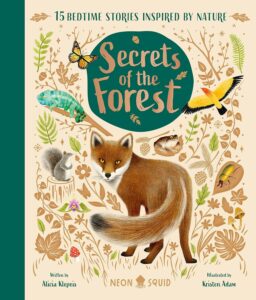
A beautifully illustrated collection of 5 minute bedtime stories about the wildlife found in woods around the world.

Every forest contains a thousand secrets… In this charming anthology of stories by Alicia Klepeis readers will be guided into forests to meet the amazing animals that live there. In one story a squirrel hunts for an elusive acorn it buried earlier in the year, while another looks at an Alaskan wood frog as it freezes itself alive to survive a harsh winter. Children will be thrilled by the tale of a reindeer that gets separated from its herd in the snowy woods of Scandinavia, and marvel at a chameleon changing colour in the forests of Madagascar.

Other stories feature elephants, wild cats, pangolins, badgers, foxes, monarch butterflies, otters, walking fish, a tree that can live for thousands of years, and even forest-dwelling penguins! All of these creatures and their habitats are brought to life with impressive skill by illustrator Kristen Adam.

Each story in Secrets of the Forest is based on the real biology and behaviour of these amazing wild animals, and at the end of each tale readers will find out more about the science that inspired the story. So as they drift off to sleep, they will know a little bit more about the world around them.

The cover features a timeless design with colourful foil and a cloth texture, making this book the perfect gift.
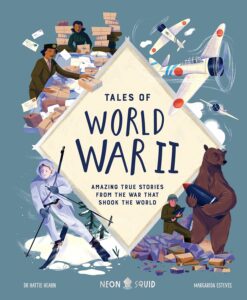
This book was a gem of a read. It has become my favourite book about World War 2 and was very popular with my Year 6 class. It is a large hardback and was bigger than expected (154 pages of tales), which was a wonderful surprise!

The contents page is full of what the true tales will be about, in addition to telling us about the key events of the war, in chronological order. The clues in the titles led to natural discussions and predictions about what the tale could be about, and were sometimes a red herring as they thought ‘The Guinea Pig Club’ would be about guinea pigs; however, it was a twist they were not expecting.

As a class, pupils enjoyed voting for a tale to share, with favourites being ‘A Bear Called Wojtek’ and ‘Rip the Rescue Dog’ – as stories of animals in the war are of particular interest to children and they were shocked to learn that a bear was enlisted into the Polish army as a private and fought alongside the soldiers! Each page is a visual delight, with some smaller illustrations, to whole page illustrations – it is a book that could be shared under a visualiser to get a full impact or for small groups to share.

Even those who know a lot about the Second World War will find something new in this book. A must-have for any class learning about World War 2.

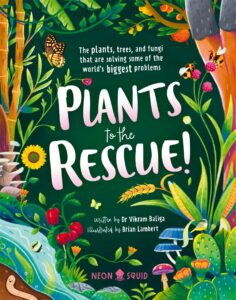
In the ongoing fight against climate change, plastic pollution and diseases, scientists are turning to an unlikely ally – plants! Everyone knows plants are pretty cool. They create oxgyen for us to breathe (fairly essential) and provide us with trees to climb. But it turns out that plants can do a whole lot more than that too! Get ready to be amazed when you find out about the spinach that can detect landmines AND send emails and the glow-in-the-dark plants that might one day light your home.

Perfect for anyone who loves nature and wildlife, as well as the scientists of the future – you won’t look at plants and trees in the same way again!

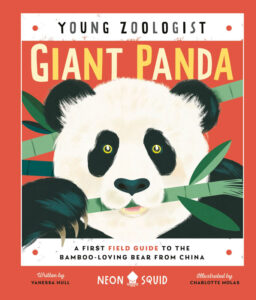
A ‘First Field Guide’ to the bamboo-loving bear from China.

Panda’s don’t hibernate; 43% of their time is spent napping; they poo up to 40 times a day; they are classed as carnivores but, over time, have evolved to eat mostly bamboo; the males compete to do the tallest handstand; they are now restricted to five mountain ranges in China; and they are generally good neighbours. There’s plenty in these 32 pages to learn and amuse.

I can see this book being very popular across the entire primary school. KS2 children will glean facts and figures on habitat, diet, habits, development, conservation and classification, when researching for writing assignments or exploring curriculum topics (e.g. animal biology, habitats, different ecosystems). It could also be used by teachers as an example of how a non-fiction text is presented, with its inclusion of headings, Contents, Glossary and Index. KS1 children will enjoy the funnier snippets of information, and learn from the bold illustrations, as much as from reading the text.

In summary, this well produced book, with its striking cover andadorable end papers, is a good addition to any primary school library and many a classroom book corner. The small, hardback format may even lend it an advantage over less durable, more unwieldy volumes.

What’s not to love?

Reviewer: Jane Rew

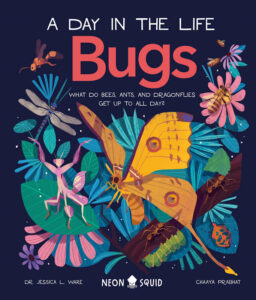
Bugs (A Day in the Life) is set over a 24-hour period, during which you get to meet the coolest insects on earth and follow the lives of individual bugs as they fly, hunt, hide, and scuttle their way through their day.

Bug expert Dr Jessica L. Ware introduces characters from cicadas to butterflies in the style of a nature documentary, with a sprinkling of simple science explanations which is perfect for future zoologists. This book is jam-packed with facts and fun science; my class could not wait to find out the next incredible insect on the daily journey.

The book invites readers to become witnesses of incredible moments of nature, including a dragonfly escaping a hungry frog and a gigantic comet moth with superpowered wings. It really shows us what an incredible place Earth is and how the smallest of insects behave.

The book is beautifully illustrated by Chaaya Prabhat through vibrant and bright colours. The clear Contents, Glossary and Index pages really support children’s learning of how to navigate through nonfiction texts – a very important skill to develop. Children of all ages who love insects will be able to access this book at differnet levels, from the very young being able to study the illustrations through to older children exploring the facts and linking them to the wider ecosystem.

A perfect book to allow the reader to spend the day with the most fascinating insects on the planet.

Reviewer: Helen Wilson

Subscribe to our newsletter

Your Review

Stone Girl Bone Girl

review

Year group(s) the book is most suitable for:

Year group(s) the book is most suitable for:

Does the book contain anything that teachers would wish to know about before recommending in class (strong language, sensitive topics etc.)?

Does the book contain anything that teachers would wish to know about before recommending in class (strong language, sensitive topics etc.)?

Would you recommend the book for use in primary schools?

yes

Curriculum links (if relevant)

Curriculum links (if relevant)

Any other comments

Any other comments