Recommended children's booklists sorted by age or topic

Publisher: Otter-Barry Books Ltd

In the bustling world of Elizabethan London, Jack is an orphan boy making his living as a street singer. But his beautiful voice attracts attention and he is snatched away to join the Blackfriars singing troupe. When the boys give a concert at the royal court, Jack is spotted by William Shakespeare.

At the Queen’s command, Jack starts work at the Globe Theatre, fetching, carrying, helping, learning. But Shakespeare has plans for this talented boy. In those days boys played the parts of women and girls on stage, and the playwright needs a “special boy” who can act and sing as the proud Queen Titania in his magical new play, A Midsummer Night’s Dream. Is Jack up to the challenge?

An attractively presented book with dynamic use of full colour cartoon people and speech bubbles throughout, this is an in-depth look at the practices of food harvesting, distribution and consumption, including up-to-date information on ultra-processed foods, climate change and future developments.

Although advertised on the publisher’s website as being suitable for 4+, and also looking fairly young in presentation, the text feels more advanced. It assumes a fair amount of reader background knowledge, both because the sentences require inference, and also because of the opinionated tone of the text – there are no modifiers of ‘some people think’- opinion is stated as fact. Moreover, occasionally, the speech bubbles of the cartoons are hard to decipher in terms of positioning and nuance, so the reader may not be sure where they fit and if they are fact or opinion. Saying that, there is a lot of information provided, including processing, packaging, cooking, food banks and food waste, issues of distribution and so much more.

It is worth stocking in the school library, but this is a book that warrants explanation and discussion. It will certainly provoke it.

‘Blue Jelly and Strawberries’ is as delightful as the title suggests. This is a joyful poetry book brimming with short, easy-to-read poems, which are to be enjoyed by anyone aged 3 to 103!

These short poems are best enjoyed when read aloud, as there are many with rhyming couplets (to be read with a rhythm), onomatopoeias (enjoy moo-ing and neigh-ing) and riddles which will leave little ones howling in laughter.

This is a perfect poetry book to bring love and joy to reading. I would recommend this as a first poetry book to promote how poetry can be fun among younger readers.

Little Rhino is lost in the big, crowded city and he’s afraid his mummy will never find him, far from home, with no tall trees, yummy leaves or green grass anywhere.

Maya wants to help but what can she do to make her home a place that Little Rhino’s mummy will come to? Can Maya and everyone around her turn their homes and their city into a welcoming green space, with flowers, plants and trees – somewhere a little rhinoceros could call home?

This enchanting story shows how kindness, determination and community spirit can come together to bring about real change and make our cities greener.

It’s a hard life for the hens at their chicken farm, in the crowded cages, and one little hen becomes too tired to lay even one more egg.

But then – “We’ll take care of you, little hen. We’re taking you home with us!” What a difference!

Now there’s grass, worms, bugs, puddles, friends and – FREEDOM. The little hen is given a name – Gwen – and a rainbow coloured vest to keep her warm while her feathers grow back.

Little Gwen is so happy in her new home, and one day she gives everyone a wonderful surprise….

This delightful picture book with captivating illustrations is a perfect, gentle introduction to animal rights and well-being.

Boing! A Bouncy Book of Bugs is a colourful anthology of poems all about a variety of bugs and minibeasts, including butterflies, spiders and even dung beetles! The poems are catchy, memorable and often rhythmic, which are perfectly accommodated and supported by the colourful images on each page.

There is a variety of poems in this book in terms of length and type – shape poems, riddles and acrostic poetry are just some examples included, as well as other poems with longer or repetitive verses. This further helps to make the book accessible to all and would support it being used across Key Stage 1 into Lower Key Stage 2.

Children would certainly enjoy the opportunity to listen to and perform many of these poems aloud, as well as use them for inspiration to write their own poems. This book is a nice introduction to some poetic features, including rhyme, repetition and alliteration. Interestingly, as well as a poem on each page, some pages include interesting facts about specific bugs or minibeasts.

This is a fun and interesting addition to the poems and would certainly appeal to any budding nature enthusiast or scientist, as well as to those who enjoy poetry.

‘Squeak! Squawk! Roar!’ is a brilliant collection of animal poems about all types of animals from insects to pets, farm animals to wild animals and everything in between. The poems would be great to read aloud in the classroom to children of any age and older children will enjoy reading them independently as well. I love that there is a range of types of poems including rhyming and not rhyming, varying in length, and different layouts on the page. This provides lots of opportunity for children to have a go at imitating different types of poems themselves, choosing their own animal to write about. There are also some poems where children can guess which animal the poem is about. The illustrations throughout the book are also a lovely touch.

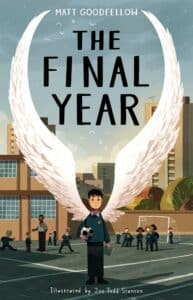
The First Year by Matt Goodfellow is the highly anticipated sequel to the emotionally powerful The Final Year. The previous book has made a profound impact on readers and significantly boosted the popularity of verse novels for Key Stage 2. The First Year follows into KS3, on as Nate navigates the ups and downs of his first year of secondary.

Matt Goodfellow explores the themes of family bonds, resilience, finding one’s voice, the power of language and the influence of supportive (and unsupportive) adults in school. This sequel is just as emotive – perhaps even more – as Nate is torn away from the familiar comfort and safety of primary school and finds himself thrown into the stark environment of secondary. The story also celebrates the joy of new friendships and the strong sense of belonging Nate shares with his brothers and friends.

This is a verse novel where the story unfolds through poetry. Some of the shortest and most sparse poems are the ones that evoke the greatest depth of emotion, with the white space on the page providing the reader with a moment to reflect and process – but only a moment, as this is really a page-turner that makes you greedy to read on.

Free as a Bird by Barroux is a beautifully illustrated picture book that tells a heart-warming story of compassion, friendship, and the plight of refugees.

Jonas, a lighthouse keeper, and his friend Blue, a whale, rescue a tired and bedraggled bird from the sea. The bird has fled from a far-off country, escaping war and danger, and is in desperate need of a safe haven. He misses his home – the smell of jasmine and the trees full of sweet fruit. The narrative is simple yet powerful, making it accessible for young readers while also exploring the complexity of migration. The bird tells his story to Jonas and Blue – his journey to escape danger. A journey that symbolizes the struggles faced by refugees everywhere. The kindness shown by Jonas and Blue highlights the importance of empathy and providing refuge to those in need. There are some similarities between this book and ‘The Journey’ by Francesca Sanna, with Barroux’s use of an actual bird giving it a simpler tone and introducing the notions of refuge and migration through the animal world. Barroux’s illustrations are beautiful: the use of watercolour creates a soft, inviting atmosphere – sploshes of muted colours that complement the story’s gentle tone.

The story is simple but the language sophisticated – using descriptions such as ‘knife-edged waves’ and the ‘veil of war’. This book highlights the importance of kindness and understanding and is a perfect tool for parents and educators to discuss topics like migration, war, refuge and the power of community with children in a sensitive and age-appropriate way. It’s a powerful reminder that even in the darkest times, there is always hope and the possibility of finding a place to call home.

We Can! by Alexandra Strick and Steve Antony is an uplifting picture book that invites children to imagine and work towards a better, safer, greener, and kinder world.

The story centres around 15 diverse children who come together to organise the We Can! Festival. Through their journey, they model teamwork, creativity, and kindness, showing how small, meaningful actions can ripple outward to inspire change. From green activities like seed planting to mural-making, mindfulness, and random acts of kindness, the book is packed with practical and age-appropriate ideas for positively impacting the world. Teachers will appreciate how the narrative weaves these activities into a rich tapestry of themes such as sustainability, inclusion, and the importance of community.

What makes We Can! particularly special is its authenticity. The book is rooted in the contributions of real children whose hopes, dreams, and suggestions shaped its creation. This collaboration shines through in the book’s genuine tone and relatable ideas, reminding readers that every child has a voice and the power to make a difference. Steve Antony’s illustrations capture the joyful energy of the children and their festival inclusively and engagingly. The colourful artwork is brimming with detail, making it perfect for shared reading sessions where children can spot new elements with each revisit. The diversity of the characters reflects a wide range of abilities, backgrounds, and experiences, ensuring every reader can see themselves represented.

This book is a joy to read and a practical springboard for discussions and accessible and actionable activities in the classroom. Its emphasis on collective action and creativity makes it ideal for PSHE lessons, eco-club projects, or as inspiration for school-wide initiatives like kindness days or sustainability topics. We Can! is a book that doesn’t just tell children they can make a difference—it shows them how, step by step, idea by idea. As a joyous call to action, We Can! deserves a place in every school library and classroom. By fostering creativity, compassion, and community, it’s a book that helps us all believe that, yes, we can!

Subscribe to our newsletter

Your Review

Stone Girl Bone Girl

review

Year group(s) the book is most suitable for:

Year group(s) the book is most suitable for:

Does the book contain anything that teachers would wish to know about before recommending in class (strong language, sensitive topics etc.)?

Does the book contain anything that teachers would wish to know about before recommending in class (strong language, sensitive topics etc.)?

Would you recommend the book for use in primary schools?

yes

Curriculum links (if relevant)

Curriculum links (if relevant)

Any other comments

Any other comments