Recommended children's booklists sorted by age or topic

Home > Curriculum Topic Booklists > Geography Topic Booklists > South America Topic Booklist

South America Topic Booklist

childrens books about south america

Best Children’s Books About South America

South America boasts a rich cultural heritage and history alongside stunning landscapes. Introduce young readers to this fascinating topic with this list of the best children’s books about South America.

From the lush Amazon rainforest, through the majestic Andes mountains, to the ancient ruins of Machu Picchu, the geography of South America offers much to explore, as does the history of its people from ancient times to the rich diversity of its modern population.

Whether you are looking for an exciting chapter book adventure like My Name is River, a unique picturebook tale like The Story of the Recycled Orchestra of Paraguay, or a beautifully illsutrated non-fiction title like Amazon River, we’ve got you covered. This booklist features the best children’s books to help young explorers study the topic of South America…

South America Topic Booklist Quick Links

Add to Favourites
Please login to bookmark Close

Visit our booklists on Amazon

Support independent bookshops

SAVE 20% with Peters

Chapter books about South America

Chapter book
Dylan's mum thinks he's on the school Geography trip. Dylan's teacher thinks he's at home with the flu. In fact he's 30,000 feet up in the air on the way to Brazil. When Dylan's farm is snatched away by a huge global company, he can't just sit back and watch. But the journey to rescue his home takes him deep into the heart of the Amazon. With Floyd, a friend he's not sure of, and Lucia, a street kid armed with a thesaurus and a Great Dane puppy, he uncovers dark and dangerous secrets and learns some surprising truths.
Chapter book Dyslexia-friendly
Chichico is thrilled when a talent scout spots him during a kick-about with his friends Davi and Ana, and he is asked to try out for Santos Brazil. But without a pair of football boots, how will Chichico ever been taken seriously? Loyal Davi steps in and sets out on a mission to solve Chichico's problem. But Davi's actions soon risk ruining Chichico's dreams forever...A little football story with a big heart from award-winning author Geraldine McCaughrean.
Non-fiction
Simon is packed and heading off to a region of the Amazon Basin in northern Bolivia. Despite its size, it's a fragile biome, of mixed forest and river habitats. Simon plans to document his journey down the River Enatahua, but things go wrong right from the start: a rucksack is missing, along with his canoe ...Simon Chapman, winner of the Blue Peter Book Award, brings geography to life, and his Expedition Diaries are a great way to introduce the world's biomes and habitats to children, direct from someone who's actually been in them - sometimes up to his neck! These books are perfect for sparking interest in this key school topic.
Chapter book

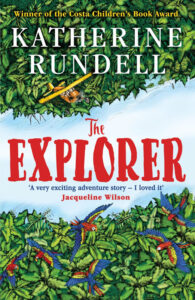
Winner of the Costa Children’s Book Award 2017, ‘The Explorer’ is set in the Amazon and follows the story of Fred, whose plane accidentally crashes into the rainforest canopy.

The Explorer is an exciting and gripping adventure that sees four children learning to survive as they journey through unfamiliar and challenging circumstances. This book transports you to a richly drawn land, and you will find yourself right there with the children as they follow a map to a lost city, eating tarantulas and swimming with river dolphins.

Katherine Rundell’s The Explorer is a perfect class read for children learning about rainforests, the Amazon, friendships, resilience and much more. Exquisite writing from Katherine Rundell; teachers report that the quality of discussions that ensued in classrooms was inspiring.

A must-read for children before they leave primary school!

Chapter book Dyslexia-friendly
Carlos's mother works for IBAMA, Brazil's Environmental Authority. As head of a specially trained task force, her role is to protect the Amazon from the farmers, loggers and miners who are illegally destroying the precious rainforest. It's a dangerous role and when she upsets some of these land-grabbers, they decide to teach her a lesson by kidnapping her son, Carlos.Taken deep into the Amazon, Carlos manages to escape his captors only to find himself trapped by the fast-moving fires. Will he be able to outrun the flames as the world around him burns to the ground? The terrifying reality of illegal deforestation and the destruction of the rainforest is revealed in this powerful and gripping Amazonian adventure from bestselling author Steve Cole. Particularly suitable for struggling, reluctant and dyslexic readers aged 8+.

Chapter book

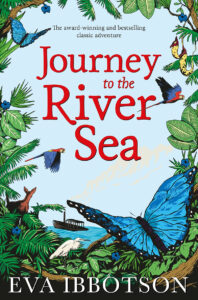
Winner of the Smarties Book Prize Gold Award, this is a very popular choice for KS2. It tells the story of a small girl called Maia, who journeys down the Amazon River with her strict governess, making friends and enemies along the way. It is rich in descriptive language in both its depiction of the Brazilian jungle and in its descriptions of complex and cruel characters that will stay with you long after you close the book.

This is a wonderful yarn, featuring not just one but two high-spirited female role models. Maia, a determined heroine, overcomes numerous challenges and a questionable step-family, whilst her governess, Miss Minton uses hidden talents and inventiveness to outwit incompetent villains and defy stuffy conventions. Both characters challenge small-minded colonial-types and lazy stereotyping as they embrace the adventures offered in this new extraordinary world.

The plot rattles along at a good pace and paints brilliant scenes of life along the Amazon. Maia’s true friends are unconventional and engaging, contrasting well with the nastiness of the Carter family. Ibbotson’s humour and storytelling skill ensure that the book never preaches but encourages us to travel with ‘courage and an open mind’. Much needed advice for young readers today!

Picturebooks about South America

Non-fiction Picturebook

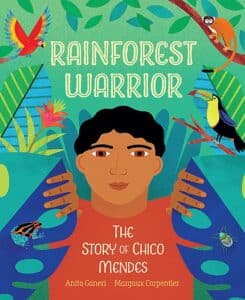
The Story of Chico Mendes is a story that is perfect for children in KS2 learning about rainforests, as well as inspirational figures who have changed the world for the better.

Chico Mendes is a hero that everyone should know about. Chico was a rubber tapper who stood up for his community and the importance of preserving the Amazon rainforest. Being an environmental activist, Chico worked tirelessly to help others and was recognised for his efforts by being awarded for his work towards protecting the rainforests by multiple countries. Tragically, Chico was murdered whilst working for this cause due to his efforts to support the rubber tappers, waking up the world to the plight of the rainforest destruction and protesting about the clearing of the forest.

Each page features beautiful coloured illustrations to support the text in each section. It is a recommendable book for use in sharing why it is important to protect the rainforests and also about highlighting the difference one person can make. There are plenty of interesting Amazon rainforest facts and a supporting glossary with technical language.

This is a special book to be shared with a class and an excellent addition to rainforest topic texts or classroom libraries.

Picturebook

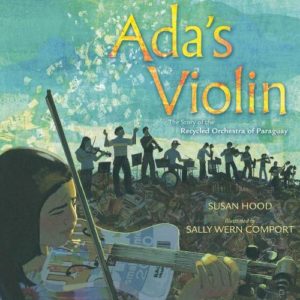
Every now and then you find a picture book that is so much more than just a book with pictures. This is one of those books, telling the true story of the Recycled Orchestra of Paraguay through words and quite breathtaking illustrations. This book is complex enough for older children and deals with extreme poverty as well as the joy of music while the pictures, showing both light and shade, stay in the mind long after reading. The faces of the children linger; the contrasts of colour making everything vivid and snatching you into the book, giving the reader the tiniest glimpse of what life is like in one of the poorest slums on Earth. The problem is solved with the use of rubbish, turning something that is clearly blighting their lives into something of huge benefit. The reader is left with a sense of the enormous ingenuity that must have gone on to recreate the instruments the children needed to play. The very end of the book takes you into reality as the author explains the true story and there is even a photo of the children with their instruments.

This is a remarkable book because it has the scope to be used as the basis for so much different work in schools. The story alone is unusual, the illustrations show notable use of colour and shade. The topic of the book could be used in music or Geography, or recycling topics. I’d never heard of the Recycled Orchestra of Paraguay before, but this book has made me glad to learn that such a wonderful organisation exists.

Picturebook

Pelé by Maria Isabel Sanchez Vegara is one of the books in the best-selling series, Little People, BIG DREAMS. These books explore the lives of people who achieved great things, but focus on when they started out as children with a dream.

This book looks at one of the greatest footballers of all time, Pelé – Brazil’s all-time King of Football. It is perhaps different from other books about him as it highlights not only his incredible football skills, but his work off the pitch helping those who needed it most. The book traces his early life from growing up on the poverty-stricken streets of Rio’s suburbs, to becoming a UNESCO goodwill ambassador and scoring over 1000 goals as a professional footballer. Readers will enjoy reading about Pelé’s childhood memories of playing football with a ball made from a sock stuffed with newspapers and tied with string. They will learn how at sixteen he was selected to play for his national team in the World Cup and that his early dream of leading his country to victory was realised as that year Brazil won the World Cup for the first time ever.

The book goes on to show that Pelé was an inspirational hero off the pitch too, working to unite people through the game and to give his voice to the underprivileged. The stylish illustrations will appeal to children through their use of bold lines and strong colours. At the back of the book there is a photographic timeline and a detailed biography of the man who has been described as the greatest footballer who has ever lived. Inherent in the book is the inspiring message about dreaming big and using given talents and skills for the benefit of others.


Picturebook

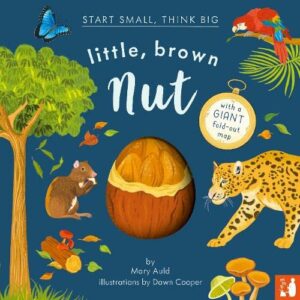
Little Brown Nut is the newest addition to the series, ‘Start Small, Think Big’ covering growth and life cycles. This non-fiction picture book tells the story of the Brazil nut tree and shows why the rainforest is important to local people and the wider world. The book features full-colour illustrations, a textured cover with a peep-through hole and giant fold-out map, and covers themes of life cycles, tree germination, photosynthesis and habitats,

The reader is instantly transported through the peep-hole cover into the Amazon Rainforest to experience the story of the brazil nut, as told through first-person (or first-nut!) narrative. The journey spans from the nut falling from its tree, to encountering a wide variety of animals on the forest floor and being buried to finally meeting humans, who will use the nuts they gather in the forest in different ways. The non-fiction/story blend explains the life-cycle of the nut with questions for the reader to explore further, such as ‘Can you see…?’ sparking interest and interaction. The interaction continues through to the end pages, with an impressive six-page fold-out section inside the back cover that will go down a treat in the classroom (including a life-cycle diagram and map of South America) and an I-Spy type game to encourage readers to have a second look.

The main text is aimed at emerging readers, with additional information for confident readers and shared reading with an adult. We particularly like learning new vocabulary, eg: agouti (rodent-like guinea pig of the rainforest) and that it’s filled with facts about how something as small as a single brazil nut is so interconnected with both its local habitat and the wider world. Schools will value this as an interactive non-fiction text that immediately captures children’s interests as well as one that aids learning in topics about rainforests, life cycles and habitats.

Non-Fiction about South America

Non-fiction
Find out about Argentina with this fun and engaging first information book. Topics include the country's geography, major cities, people and interesting places. For children following Book Bands, it is suitable for children reading at band 8, purple.The Info Buzz series, for age 5+, helps children develop their knowledge and understanding of the world by covering a wide range of topics in a fun, colourful and interactive way. The books have a lively design, engaging text and photos, questions to get children thinking and talking and teaching notes. Each title is written in conjunction with a literacy consultant and features book band guidance and downloadable activity sheets online.
Non-fiction
An engaging and visually exciting look at some of South America's major cities.This series offers readers of 9 and up an engaging and visually exciting look at some of the world's major cities.Cityscapes draw in the reader with facts about the iconic buildings that help to shape each city's unique identity. Data-packed pages give the essential details about each featured city, including where to go, what to do and things to eat on a visit, as well as information about the city's history.The cities of South America covered in the book are Rio de Janeiro, Brazil; Bogota, Columbia; Santiago, Chile; Caracas, Venezuela; Quito, Ecuador; Buenos Aires, Argentina; Cuzco, Peru; Montevideo, Uruguay; Georgetown, Guyana; La Paz, Bolivia; Paramaribo, Suriname; Santa Cruz, Bolivia; Lima, Peru; Manaus, Brazil; Cuenca, Ecuador; Potosi, Bolivia; Cartagena, Columbia and Asuncion, Paraguay.Titles in the 6-book series feature the cities of Africa, Asia, Australasia, Europe, North America and South America.
Non-fiction

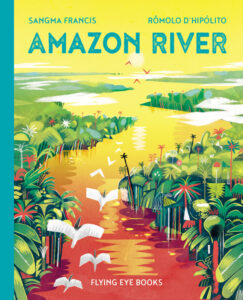
If you know Flying Eye publishing house’s output, you will know before you even see this book that ‘Amazon River’ is a beautiful object, that the art will be as thoughtful as the writing, the quality of paper as important as the factual information.

Reading this to a class as the launch of a topic on the Amazon/Rainforests will undoubtedly whet the children’s appetite to learn about this astonishing and awe-inspiring place. The introduction is amply matched by the end piece, ‘A River of the World’, which sums the book up perfectly, as well as acting as an excellent discussion starter on the interconnectedness of our planet.

In between these two marvels, the main body of the book is divided into 4 main themes: water, wildlife, people and life on the river. These pages tread the tightrope between concision and depth expertly. Despite a background as a geographer, I learnt many new facts such as the difference between clearwater, blackwater and whitewater. The summaries of a wide range of exciting and unusual animals are also superb, as are more summaries of the Legends of Pirarucu and Naia, star of the water.

‘Amazon River’ is a stunning way to engage children with an important and breathtaking part of the world. It could easily be used as the centrepiece of a topic, and would inspire much engagement with the natural world and our place within it.

Non-fiction
Far off the coast of Ecuador lies a group of volcanic islands unlike any other. Home to species as diverse as giant tortoises, salt-snorting marine iguanas, and the birds that made Charles Darwin famous, the Galápagos are a living laboratory for scientists working on the most urgent problem of our times: How can humans exist in harmony with nature on the only planet we are ever likely to have? Karen Romano Young, author of Antarctica: The Melting Continent, again takes to the field, visiting the archipelago to observe its environments first-hand and to interview the people who are lighting the way for the rest of us. Illustrator Amy Grimes brings Karen’s experience into vivid visual life for those of us who haven’t been there – yet.

SAVE 20% with Peters

Visit our booklists on Amazon

Support independent bookshops

Booklists you might also like...

Subscribe to our newsletter

Your Review

Stone Girl Bone Girl

review

Year group(s) the book is most suitable for:

Year group(s) the book is most suitable for:

Does the book contain anything that teachers would wish to know about before recommending in class (strong language, sensitive topics etc.)?

Does the book contain anything that teachers would wish to know about before recommending in class (strong language, sensitive topics etc.)?

Would you recommend the book for use in primary schools?

yes

Curriculum links (if relevant)

Curriculum links (if relevant)

Any other comments

Any other comments