
Author & Illustrators

Can You See the Stars Tonight is a gentle tale that brings the topic of light pollution into sharp focus for young readers.
This picture book tells the story of a spirited young girl, Nora, who, alongside her companion Puffin and her two dads, embarks on a mission to help lost baby puffins, or pufflings, find their way back home. The story begins with Nora, an avid stargazer, noticing that the stars outside her window are dimmer than the ones in her books. This curious observation quickly turns into a call to action when a puffling crashes through her window in a panic—one of many that have been disoriented and blown off course by the lights of the town. What unfolds is a heartwarming and determined journey, as Nora and her family set off to Puffin Island to investigate.
Through her discovery that pufflings rely on the natural guidance of the moon and stars, Nora learns how the town’s bright lights are disrupting this instinctive navigation. The solution isn’t found in grand gestures, but in small, thoughtful actions: making light shields, closing curtains, and rallying her classmates and neighbours to reduce unnecessary artificial light.
The book’s illustrations are charming—soft, expressive, and full of character, particularly the puffins, who are irresistibly cute. This book does more than tell a story—it encourages young readers to notice the world around them, to ask questions, and to believe in their power to make a difference, no matter how small they may seem.
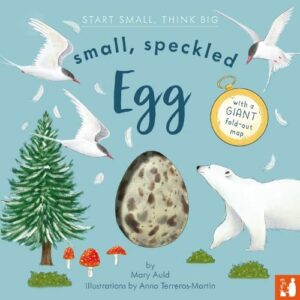

This beautifully illustrated non-fiction book begins with an Arctic tern and her newly laid small, speckled egg in its grassy nest. It goes on to illustrate how the baby bird develops inside the egg, then its life from a small, fluffy chick through its life cycle up until full adulthood where the now-adult tern lays its own egg, ready for the process to begin again. It covers the trials and tribulations of a wild bird’s life, from the dangers posed by predators to the long, exhausting migration journey.
The book is full of fascinating facts about the lives of Arctic terns, including their diet, how they catch food and how they fly. It concludes with a large fold-out page illustrating the life cycle of the Arctic tern as well as a map showing its migration routes. As an added point of interest it also includes a list of animals to look for when reading the book.
This book would work equally well as a book for storytime or as a reference book. With stunning illustrations and easily accessible text, this would be a fantastic addition to any primary classroom, but especially Key Stage 1 and Lower Key Stage 2 when looking at life cycles, birds and/or arctic animals.
review
Year group(s) the book is most suitable for:
Year group(s) the book is most suitable for:
Does the book contain anything that teachers would wish to know about before recommending in class (strong language, sensitive topics etc.)?
Does the book contain anything that teachers would wish to know about before recommending in class (strong language, sensitive topics etc.)?
Would you recommend the book for use in primary schools?
yes
Curriculum links (if relevant)
Curriculum links (if relevant)
Any other comments
Any other comments