Recommended children's booklists sorted by age or topic

Age Group: KS3 (Ages 11-14)

Chapter book, Dyslexia-friendly
dyslexia-friendly

I really liked Jellybean. It’s a super quick read, but it actually packs a punch. It’s all about dealing with anxiety and that awful feeling of just not wanting to go into school, which I think a lot of children (and adults!) can relate to. However, the central theme is severe anxiety and school avoidance (EBSA).

Teachers should be aware of this in case it triggers conversations with children currently struggling with attendance or anxiety, but it is ultimately a hopeful story.

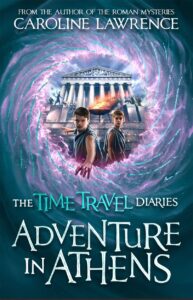
Adventure in Athens is an educational adventure that whisks readers back to ancient Greece. When Alex, a London schoolboy, is recruited by a mysterious billionaire to travel through time, he suddenly finds himself in classical Athens surrounded by philosophers, athletes and unexpected dangers.

Lawrence blends fascinating historical detail with humour and heart, making this book an ideal choice for upper KS2 readers who enjoy stories that mix fact and fiction. The ancient world is brought vividly to life through Alex’s modern-day perspective, offering plenty of opportunities for discussion and links to history topics in class.

Teachers could use extracts to support lessons on Ancient Greece or to explore how authors use time travel as a storytelling device.

What a brilliant book! I had such a laugh reading this book as well as goosebumps.

Things take a sinister turn when Joe Bones spies a cloaked figure leaving his gran’s house and discovers her dead. He, of course, thinks she’s been murdered and tries to get his mother, who’s a forensic pathologist, to investigate. She’s having none of it, given Joe’s gran was over a hundred years old.

Joe and his friends discover that Joe’s gran was part of a group called Fright Club, and the town where they live (Grim) is built upon the gateways to supernatural worlds. You can visit towns where vampires, skeletons, ghosts and demons live through gateways in Grim. In this mystery, you get to choose which character’s storyline to follow. However, I read the mystery from cover to cover because I couldn’t resist, but I can imagine how exciting children will be to follow either Joe, Hal, Rose or Debbie.

I give this book a 11/10! I’m so excited to read the rest of the series, and this is going to be one of my favourite series, along with Jennifer Killick’s Dread Wood series.

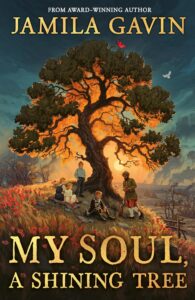
My Soul, a Shining Tree is a short, powerful novel that looks at war through the eyes of different characters. By showing multiple perspectives, it helps readers understand the different ‘sides’ of the conflict and the very real impact on people’s lives. I also really enjoyed how the different perspectives interacted with each other. I found Ernst’s story, in particular, incredibly moving: his experiences really brought the experiences of young people who went into battle to the forefront. Because the book is short, teachers could easily use extracts from the different perspectives as writing prompts or as a stimulus to support lessons about World War I.

The shifting narratives also help children think about how perspective can shape a story, while encouraging discussion about courage, loss, and resilience. I also really liked the inclusion of Khudadad, an Indian gunner, highlighting the important role soldiers from across the Commonwealth played in supporting the war. My Soul, a Shining Tree is perfect for helping young readers connect with history and develop empathy.

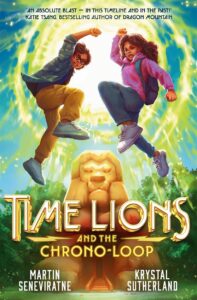
This is an intriguing twist on the time travel genre. The main protagonists are genius twelve-year-old twins – Pearl and Patrick – who are about as far from being ‘normal’ children as possible, although they hide their abilities well from their peers. Pearl is an engineering whizz with a host of mind-blowing inventions to her name, and Patrick has an unsurpassed knowledge of the whole of history. They have engaged in a variety of illegal behaviours using Pearl’s inventions, for example, stealing a diamond from the Crown Jewels in the Tower of London or removing part of a stealth plane from Area 51, and are being watched by MI5!

Then Pearl invents a time machine which relies upon the acquisition of historical items that are originally from the era to which you wish to travel. Despite believing that they have made a successful initial jump back to Ancient Egypt, there is a nasty surprise in store from a secret society which shows just how much damage their little jaunt has done.

There are many interesting themes woven in: the twins’ family has Sri Lankan heritage, which becomes inextricably linked to the storyline further on; Pearl is a fierce advocate for women’s contributions to science to be recognised; and school dynamics where friendship needs to transcend race, culture and ability. Bullying is an issue too and Pearl’s sometimes self-aggrandising motives could provoke interesting discussions.

You can tell that the author has previously written YA books as some of the twins’ achievements may require some explanation to younger readers e.g. breaking into Fort Knox or trying to win the Nobel Prize, and Pearl’s inventions would be ground-breaking sci-fi concepts for this age group. It all makes for an exciting and fast-paced read with likeable characters – I’d love to read more in this series.

A hidden garden. An ancient tale. A missing child. This is an addictive mystery with crossing narratives that’s impossible to put down.

Fran doesn’t want to stay with her aunt and uncle and her annoying cousin, Imogen. Imogen is rude and unfriendly and, it turns out, missing… But her parents don’t seem to know who Fran means – don’t be silly, we don’t have a daughter, you know that. So it’s up to Fran, and Imogen’s best friend, Bex, to find out what’s happened to her.

Except Bex doesn’t know who Imogen is either. All Fran knows is that it’s got something to do with the hidden garden at Stillness Hall and the twelve statues that belong there. Could a mysterious old tale, a story of enchantment and death, hold the answers?
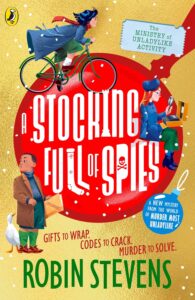
‘It’s hard to know where to start. There’s so much to say – about the murders, and the codes, and the spy, that I’m getting tangled up in the story already…’

It’s December 1941, and almost Christmas, when a bomb falls on Deepdean School for Girls. May and Nuala are whisked away from the chaos and sent to stay with May’s big sister, Hazel Wong, who is working at Bletchley Park.

Within seconds, they’re thrown straight into their most dangerous case yet. A codebreaker has been shot in what appears to be a tragic accident – until a suspicious and top-secret message is discovered in his pocket. Was he a spy, working for the other side? Was the message planted on him? Most importantly – was this murder?

Worst of all, Daisy’s big brother, Bertie Wells, is being blamed. It’s up to May, Nuala and their friend Eric to prove Bertie’s innocence and solve the mystery. But Bletchley is a strange and secretive place, full of Britain’s most ingenious minds. They’ll need to watch, listen, and puzzle out the incredible, unthinkable truth…

The thrilling brand-new mystery from the million-copy-bestselling author of Murder Most Unladylike.

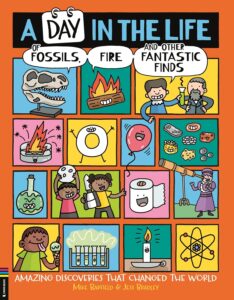
A Day in the Life of Fossils, Fire and Other Fantastic Finds gives a sweeping journey through the history of discovery in comic book form.

The subjects are wildly and wonderfully diverse in scope and scale. As the introduction states, you can jump in anywhere. Each page tells its own story of a discovery. As with the previous titles in the A Day in the Life series (such as A Day in the Life of an Astronaut, Mars and the Distant Stars and A Day in the Life of a Poo, A Gnu and You), this book stretches the brain in many directions. The examples are drawn from across the sciences, geography and history, and the appealing short-form bursts of information are great for opening windows to new potential interests.

The comic strip format blends well with the jokes that break up the facts. It’s fun and informative, and would be great for social reading times.

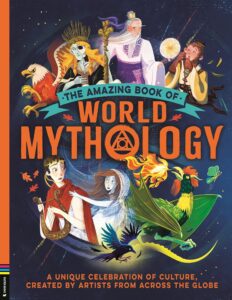
The Amazing Book of World Mythology offers short and accessible retellings of mythical stories from around the world.

It is pleasing to see the stories grouped not by place of origin but by their themes. This emphasises the commonalities of the global tradition of storytelling and the connections between the stories we have all told and been told. Each of the six themed chapters is divided into four or five stories, which can be read in isolation and are well-suited to reading aloud, whether as a short bedtime story or to a whole class. Each chapter finishes with a double-paged spread introducing more stories, objects or characters relating to the theme, further emphasising the similarities in storytelling across the world.

The book is attractively illustrated, and using a different illustrator for each of the myths is particularly effective. The diversity of the artists and their art styles is an essential part of why the book works so well and how it offers such an effective broadening of horizons. In combination, the quality of the storytelling, the illustrations and the breadth of the stories offered mean this is one of those books that every child should have access to. It’s a perfect addition to any collection of mythology books for children.

Recommended Books to Support Science at KS3

If you are looking for recommended books to support secondary Science in Years 7, 8 and 9, this BooksForTopics expertly curated reading list is here to help!

This booklist features a range of themes and formats, including inspiring true-life stories like Women in Science and Reaching for the Moon, and quirkily illustrated non-fiction like The Element in the Room and The Observologist.

There’s also a great choice of chapter books exploring a range of scientific themes, including sci-fi titles like Orion Lost, real-life inspired stories like Lightning Mary, fast-paced adventures like 21% Monster and thought-provoking, topical reads like Pig Heart Boy.

From atomic adventures to real-life experiments, this booklist has something to offer every budding KS3 scientist.

Subscribe to our newsletter

Your Review

Stone Girl Bone Girl

review

Year group(s) the book is most suitable for:

Year group(s) the book is most suitable for:

Does the book contain anything that teachers would wish to know about before recommending in class (strong language, sensitive topics etc.)?

Does the book contain anything that teachers would wish to know about before recommending in class (strong language, sensitive topics etc.)?

Would you recommend the book for use in primary schools?

yes

Curriculum links (if relevant)

Curriculum links (if relevant)

Any other comments

Any other comments